


Keyring Resuscitation Mask
$13.22
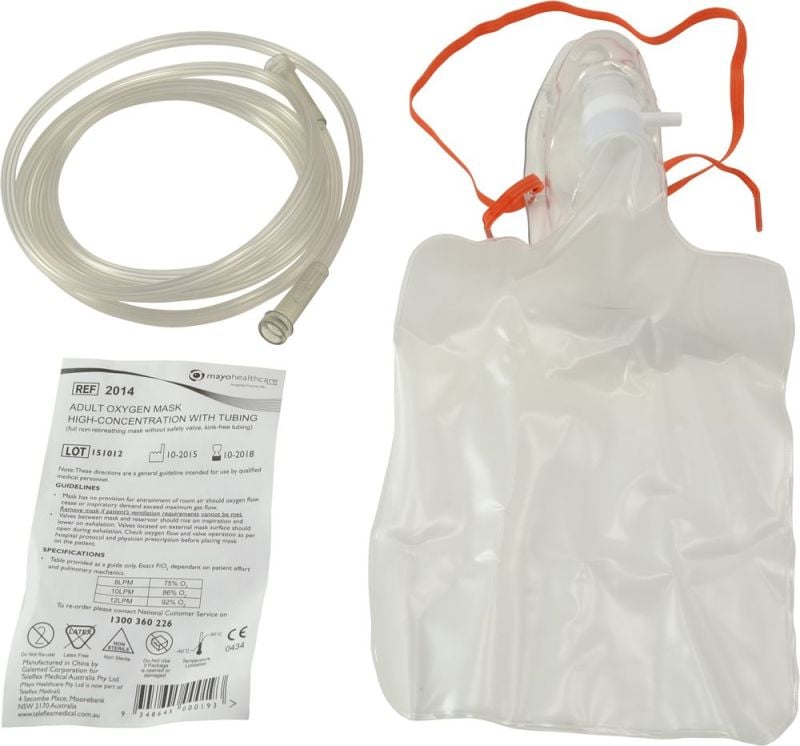
This adult non rebreather mask comes with tubing and a 750ml reservoir bag. It has three low-resistance, latex-free check valves - two of them external - that let exhaled gas escape while preventing rebreathing, and the adaptor swivels so the patient can be repositioned without kinking the line.
The reservoir bag is what makes a non rebreather mask a high-concentration oxygen device. Oxygen fills the bag between breaths, so the patient draws from a reservoir of near-pure oxygen instead of diluting each breath with room air - which is why this mask, not a simple face mask, is the one reached for when a patient is critically hypoxic.
The three check valves are the mechanism behind the name. They allow exhaled gas out and stop it being drawn back in, so carbon dioxide is not rebreathed and the reservoir is not contaminated with exhaled air. Being low-resistance matters because a breathless patient cannot work hard to open a stiff valve, and latex-free removes the allergy risk.
One point of technique decides whether it works: inflate the reservoir bag before applying the mask, and run the flow high enough that the bag never fully collapses on inspiration. A bag that empties means the patient is pulling room air and the concentration has dropped - the commonest reason a non rebreather underdelivers in practice.
| Product | Adult Non Rebreather Mask with Tubing and Reservoir Bag |
| Reservoir | 750ml bag |
| Valves | Three low-resistance check valves (two external) |
| Latex | Latex free |
| Adaptor | Swivels for patient repositioning |
| Supplied with | Tubing |
| Patient | Adult |
| Technique | Inflate the reservoir before applying; keep flow high enough that the bag does not collapse |
Ambulance and first response, workplace and site emergency teams, surf life saving, and clinical rooms holding oxygen therapy equipment. Different masks answer different oxygen requirements, so services carry a range: a nasal cannula for low-flow supplemental oxygen and an oxygen therapy mask for moderate concentrations. Where the patient is not breathing adequately, a bag valve mask resuscitator is required instead. See our oxygen and resuscitation equipment.
Delivering high-concentration oxygen to a spontaneously breathing patient who is significantly hypoxic. The reservoir bag supplies near-pure oxygen so each breath is not diluted with room air, which a simple face mask cannot achieve.
They are one-way valves that let exhaled gas escape and stop it being drawn back in, so carbon dioxide is not rebreathed and the reservoir stays filled with oxygen rather than exhaled air. Two of the three are external.
Because a collapsing bag means the patient is drawing room air and the delivered concentration has fallen. Inflate the bag before applying the mask and set the flow high enough that it never empties on inspiration - this is the most common practical error with these masks.
When the patient is not breathing, or not breathing adequately. A non rebreather mask relies on the patient generating their own breaths - it delivers oxygen but provides no ventilation. An apnoeic or inadequately breathing patient needs a bag valve mask.
Because patients get repositioned - rolled, sat up, moved onto a stretcher - and a fixed adaptor kinks the tubing or drags the mask off the face. A swivel lets the line follow the patient without interrupting delivery.
Oxygen masks and tubing are generally single-patient items. Follow the manufacturer instructions and your infection control policy, and check the mask, valves and reservoir for damage before use - a perished or missing valve defeats the whole design.
For use by appropriately trained personnel administering oxygen within their scope of practice and local clinical guidelines. Oxygen is a drug in most jurisdictions and its administration should follow your protocols. A non rebreather mask requires adequate spontaneous breathing - it does not ventilate the patient. Inflate the reservoir before application and maintain sufficient flow. Oxygen supports combustion: keep away from ignition sources. In an emergency, call 000.