

Reviewed by the Medibc First Aid Team — last updated August 2026. This is general information, not a substitute for advice from your doctor, pharmacist or asthma educator.
A spacer makes reliever and preventer puffers far more effective, but only if the mask actually seals against the face. Spacer masks are not one-size-fits-all — using the wrong size lets medication leak out around the edges instead of reaching the lungs. Here is how to tell whether you need a small or large spacer mask.
Why spacer mask size matters
A spacer is a holding chamber that attaches to a puffer, turning each dose into a slow-moving cloud of medication that is far easier to inhale fully — particularly for young children and anyone who struggles to coordinate a puffer on its own. The mask is the part that seals over the nose and mouth. If it is too big, it will not form a proper seal against a smaller face and much of the dose is lost to the air. If it is too small, it can be uncomfortable and hard to fit properly, which discourages correct technique.
Small vs large: how to choose
As a general guide:
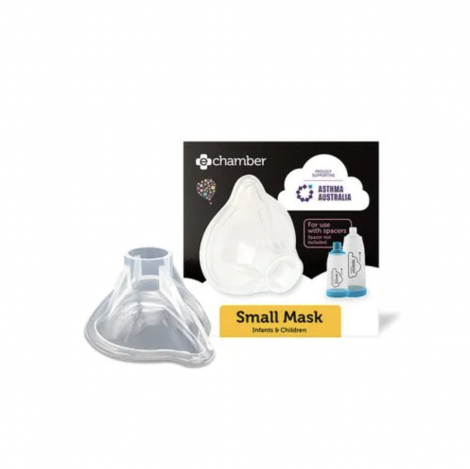
- Small mask — suited to infants and young children, where a compact, close-fitting seal is needed over a smaller face.
- Large mask — suited to older children and adults, covering a larger area for a proper seal over the nose and mouth.
If a child is close to the boundary between sizes, the mask that achieves a full seal without gaps at the cheeks or chin is the right choice — a snug fit matters more than an age cut-off. Many families keep both sizes on hand as a child grows, since a spacer with the wrong mask is only marginally better than no spacer at all.
Using a spacer mask correctly
- Attach the mask firmly to the spacer chamber so there is no gap for air (and medication) to escape.
- Shake the puffer and insert it into the spacer.
- Press the mask gently but firmly over the nose and mouth to form a full seal.
- Give one puff, then allow 4-6 normal breaths in and out through the mask before the next puff.
- Remove and rinse the mask periodically as directed by the manufacturer to keep it clean and free of residue.
Check the fit, not just the age. A mask that leaves gaps around the nose or chin will reduce how much medication actually reaches the lungs, regardless of what age group it is marketed for.
Hygiene and replacement
Spacer masks should be wiped or rinsed regularly and allowed to air dry, and replaced if the seal becomes cracked, discoloured or no longer forms a firm fit. A mask that has lost its seal should be treated the same as using no mask at all.
Spacer Mask FAQs
What size spacer mask does a toddler need?
Most toddlers and young children need a small spacer mask, sized for a smaller face to achieve a full seal. If gaps appear at the cheeks or chin, check whether a different size fits better.
Do adults need a large spacer mask?
Yes — older children and adults generally need a large spacer mask, which covers a wider area for a proper seal over the nose and mouth. Some adults use a mouthpiece instead of a mask once they can coordinate this reliably.
How do I know if my spacer mask fits properly?
A properly fitted mask sits flush against the face with no visible gaps at the cheeks, nose or chin. If medication mist is visibly escaping around the edges, the mask is the wrong size or not sealed correctly.
Can spacer masks be used with any spacer device?
Spacer masks are designed to fit specific spacer chambers. Check that the mask you choose is compatible with your spacer device before relying on it.
Need a replacement spacer mask? Shop our Spacer Masks in Small and Large sizes. For asthma attack steps, see our guide to the 4x4x4 asthma first aid plan, and browse our first aid kits for a fully stocked kit. Fast shipping Australia-wide.
General guidance based on Asthma Australia and National Asthma Council Australia spacer-use information. This is not a substitute for advice from your doctor, pharmacist or asthma educator.