


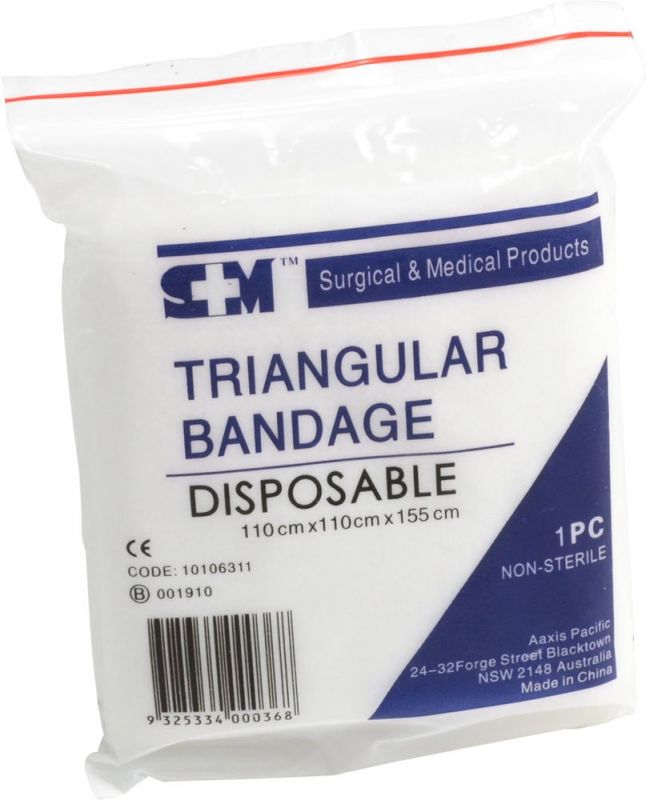

Triangular Bandage Disposable 110 x 110 x 155cm
Bandages | Conforming | Crepe
$2.28
Secure checkout
VISA
Mastercard
Apple Pay
Google Pay
Also accepted
AMEX
Afterpay
Zip
Klarna
PayPal
In stock
Only 998 left
SKU
356
A disposable triangular bandage, 110 x 110 x 155cm. The most versatile single item in a first aid kit: a sling, a broad or narrow bandage, a pad holder, or an improvised pressure dressing, depending on how you fold it.
What a triangular bandage does that nothing else does
Every other bandage has one job. A triangular bandage is defined by how it is folded, which is why kit contents lists specify several. Left open it makes an arm sling or covers a large burn area without adhering. Folded once it becomes a broad-fold bandage for immobilising a limb. Folded twice it becomes a narrow-fold for securing a splint or applying pressure.
That versatility is exactly why it is the item people most often find they have run out of.
The three folds worth knowing
- Open (full triangle) – arm sling, elevation sling, or a large soft covering
- Broad-fold – fold the point to the base, then in half again: for immobilising a limb against the body or a splint
- Narrow-fold – fold the broad-fold in half once more: for securing dressings, splints, or as a figure-of-eight around a joint
Keep several with your other first aid supplies, and see the collar and cuff sling if you need a purpose-made sling rather than an improvised one.
Making an arm sling
Support the injured arm across the chest. Slide the open bandage between the arm and the chest with the point beyond the elbow and one end over the uninjured shoulder. Bring the lower end up over the injured arm and tie at the side of the neck, not on the spine. Tuck or pin the point at the elbow. The hand should sit slightly higher than the elbow.
Check the fingers after tying and keep checking. They should stay warm, pink and with normal sensation. Tie the knot to the side of the neck rather than over the vertebrae, where it will be uncomfortable and can press on the spine. For any suspected fracture, immobilise and get medical assessment.
Why disposable
A triangular bandage that has been used on a wound is contaminated, and laundering one properly is not practical in a workplace or a vehicle. A disposable bandage is used once and replaced, which also means what is in the kit is always clean and its full size, not something previously cut down.
Specifications
| Type | Triangular bandage, disposable |
| Dimensions | 110 x 110 x 155cm |
| Use | Single use |
| Applications | Arm sling, elevation sling, broad-fold, narrow-fold, dressing retention |
| Sterility | Non-sterile |
Triangular bandage FAQs
What is a triangular bandage used for?
Slings, immobilising limbs, holding dressings in place, and as an improvised pad or pressure covering. Its use is determined by how it is folded, which is what makes it the most versatile single item in a kit.
What size is it?
110 x 110 x 155cm, which is the standard size for an adult sling. Anything smaller struggles to make a proper arm sling on a large adult.
How do I make an arm sling with it?
Slide the open bandage between the arm and chest, point beyond the elbow, one end over the uninjured shoulder. Bring the lower end up and tie at the side of the neck. Tuck the point at the elbow. The hand should sit slightly above elbow height.
What is the difference between broad-fold and narrow-fold?
Broad-fold is the point folded to the base then halved, used to immobilise a limb. Narrow-fold is that folded once more, used to secure dressings and splints or as a figure-of-eight. Same bandage, different job.
Is it sterile?
No, it is non-sterile. Use a sterile dressing directly against a wound and the triangular bandage over it to hold it in place or to support the limb.
Can I wash and reuse it?
It is a disposable bandage and should be replaced after use. One that has been in contact with a wound is contaminated, and laundering it to a usable standard is not realistic in a workplace or vehicle.
How many should a kit hold?
Check the contents list that applies to your workplace or kit class, since requirements vary by jurisdiction. As a practical matter, more than one, because a single sling plus any immobilisation already uses two.
A first aid kit supports trained first aid and does not replace it. Seek medical assessment for suspected fractures, dislocations and significant wounds. This information is a general guide and is not medical advice.
Frequently bought together
