

Written by the MediBC medical-supply team · Reviewed against Wounds Australia clinical resources and healthdirect first-aid guidance · Updated June 2026.
Choosing the right wound dressing and gauze swab is the most repeated decision in any first aid kit — every minor injury, every workplace incident, every home accident comes back to "what do I cover this with?" Get the size wrong and you waste stock. Get the type wrong and you tear the wound on every change.
This guide walks you through the sizing matrix for non-adherent dressings and gauze swabs stocked in Australian workplace and home kits, including when to use each size, how to layer them correctly, and how often to change them. It maps to the four standard AEROPAD non-adherent sizes (5 x 5, 7.5 x 10, 10 x 10, 10 x 20cm) and the two standard AEROSWAB gauze sizes (5 x 5 and 7.5 x 7.5cm) every well-stocked Australian kit carries.
Why dressing choice changes wound outcomes
Two wounds of the same size can heal in five days or twelve days depending solely on what was put on them. The mechanism is simple: every time tissue gets ripped off during dressing changes, the wound restarts the inflammatory phase of healing. Pick a dressing that comes off cleanly and the wound progresses; pick one that sticks and you reset the clock with every change.
The wound-contact layer is the critical layer
The wound-contact layer is the surface that touches broken skin or granulation tissue. It must be either non-adherent (coated or perforated so tissue cannot grow into it) or sterile gauze, and it must be at least 1cm larger than the wound on every side so it stays on the wound bed during movement.
The absorbent layer manages exudate
Above the wound-contact layer sits the absorbent layer — usually a thicker pad or several gauze swabs. Its job is to soak up exudate (the clear-to-yellow fluid wounds produce) and keep it away from healthy surrounding skin. Macerated peri-wound skin slows healing and creates secondary breakdown.
The retention layer holds it all in place
A bandage or adhesive tape secures the dressing without compressing it. Too tight = ischaemia and pain; too loose = the dressing migrates and exposes the wound. The finger-slip test applies here too.
Non-adherent dressings explained
Non-adherent dressings are the modern standard for any clean wound — laceration, abrasion, partial-thickness burn, surgical site post-op — where you want the dressing to lift off without disturbing the wound bed. They replaced plain gauze as the primary wound-contact layer in Australian first aid practice over the last 20 years.
What "non-adherent" actually means
A wound-contact layer that is engineered (either by coating or perforation) so blood, exudate and granulation tissue cannot bind into the dressing fabric. When you peel it off at the next change, you peel off only the dressing — not the layer of new tissue under it. The medical literature shows this halves "wound trauma at dressing change" events and accelerates time to complete epithelialisation.
When to choose non-adherent over plain gauze
Anything that needs to stay on for more than a few hours. Anything where you cannot watch the wound continuously. Any wound with active exudate or visible granulation tissue. Burns of any depth. Children's wounds (more painful to redress). And anything someone will want to shower with — non-adherent re-wets and lifts off easily.
When plain sterile gauze is still appropriate
Cleaning wounds (irrigation and skin prep around the wound). Packing deep wound cavities (cavity packing wants the gauze to grip the wound bed for haemostasis and is removed under medical supervision). Absorbing exudate as a secondary layer above a non-adherent. Stopping minor capillary bleeding short-term before a non-adherent goes on.
AEROPAD non-adherent dressing sizing — pick the right size
The four standard AEROPAD sizes cover the wound range a home or workplace kit will realistically face. Sized to the box of 50, they are also the bulk pack standard for workplace WHS-compliant kits.
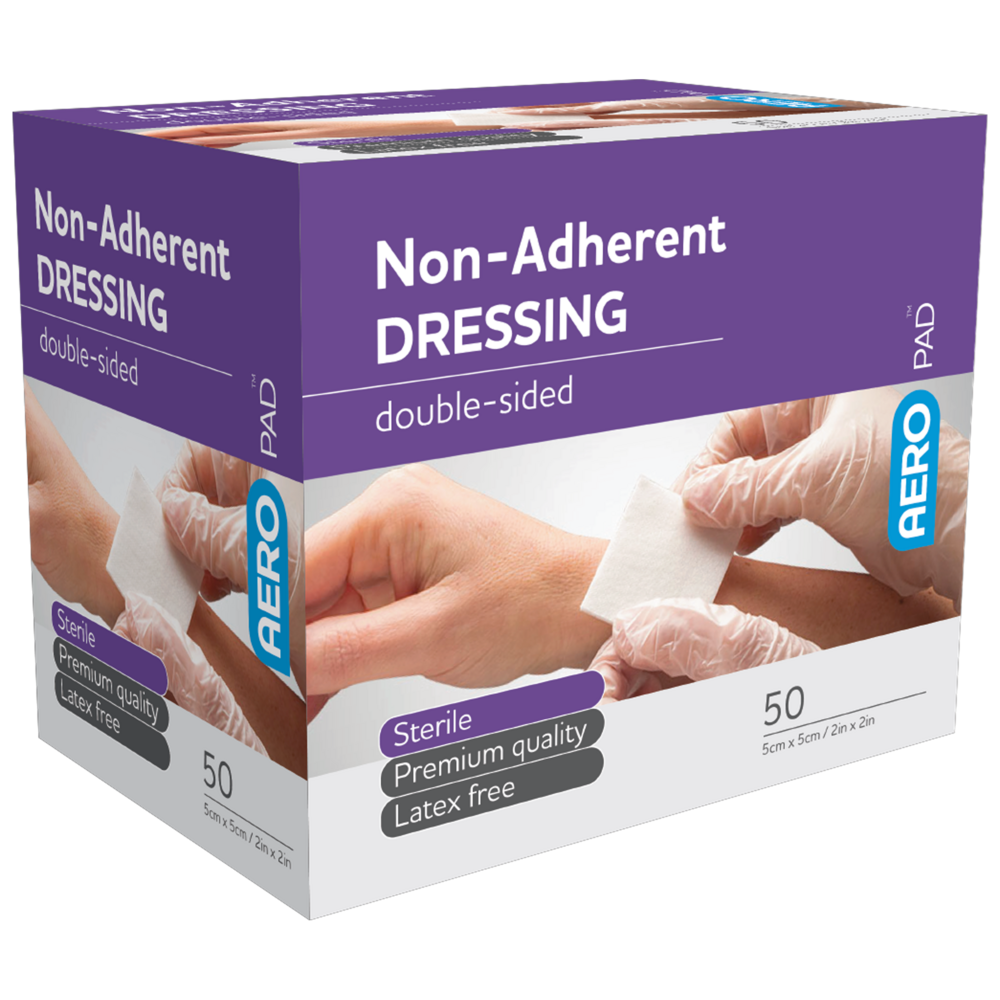
5 x 5cm — the everyday small-wound dressing
The 5 x 5cm non-adherent fits paper cuts, small lacerations (under 3cm), finger injuries with a clean cut, and minor scrapes. It is the box you go through fastest in any office or low-injury workplace. Stock at least one box of 50 in every workstation kit.
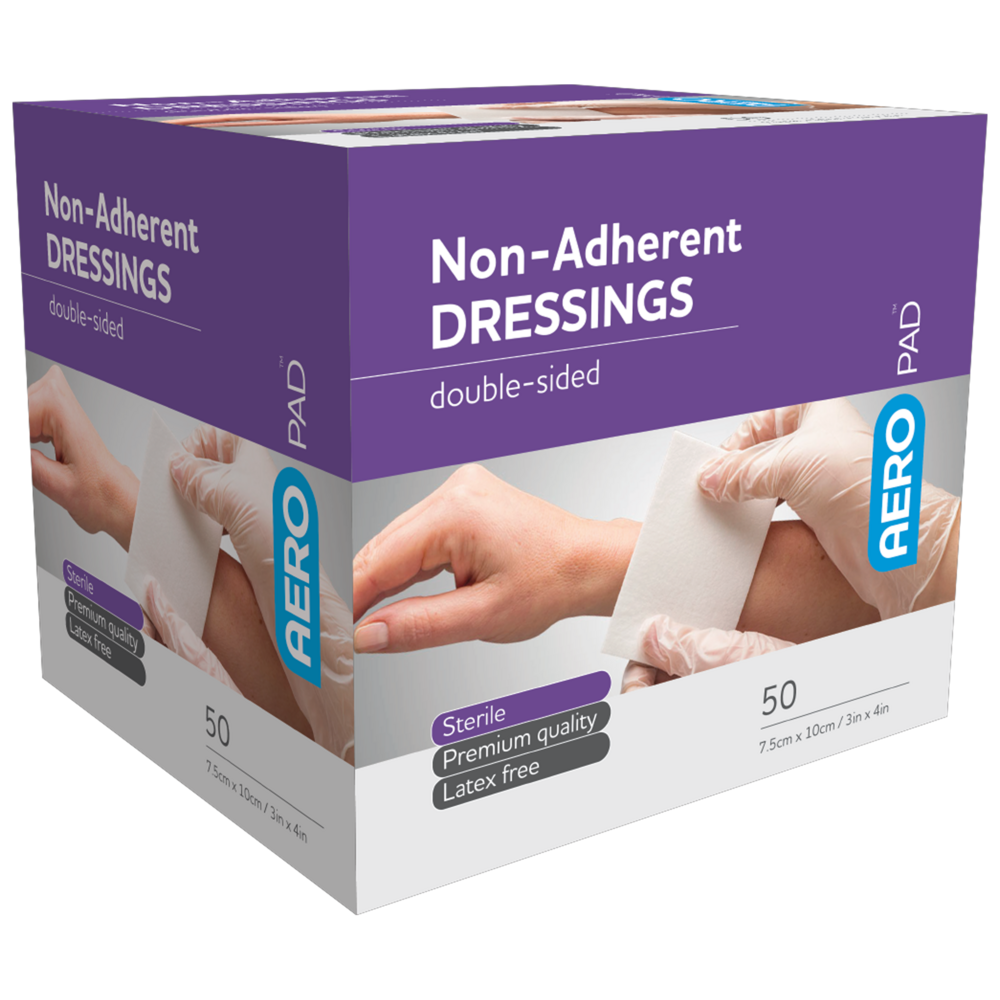
7.5 x 10cm — fingers, knuckles, small palms
The 7.5 x 10cm covers finger-to-knuckle injuries, small palm abrasions, and the typical "kitchen knife" laceration. The longer dimension lets you cover a 5-6cm wound with comfortable margin and the narrower width fits the hand without becoming awkward.
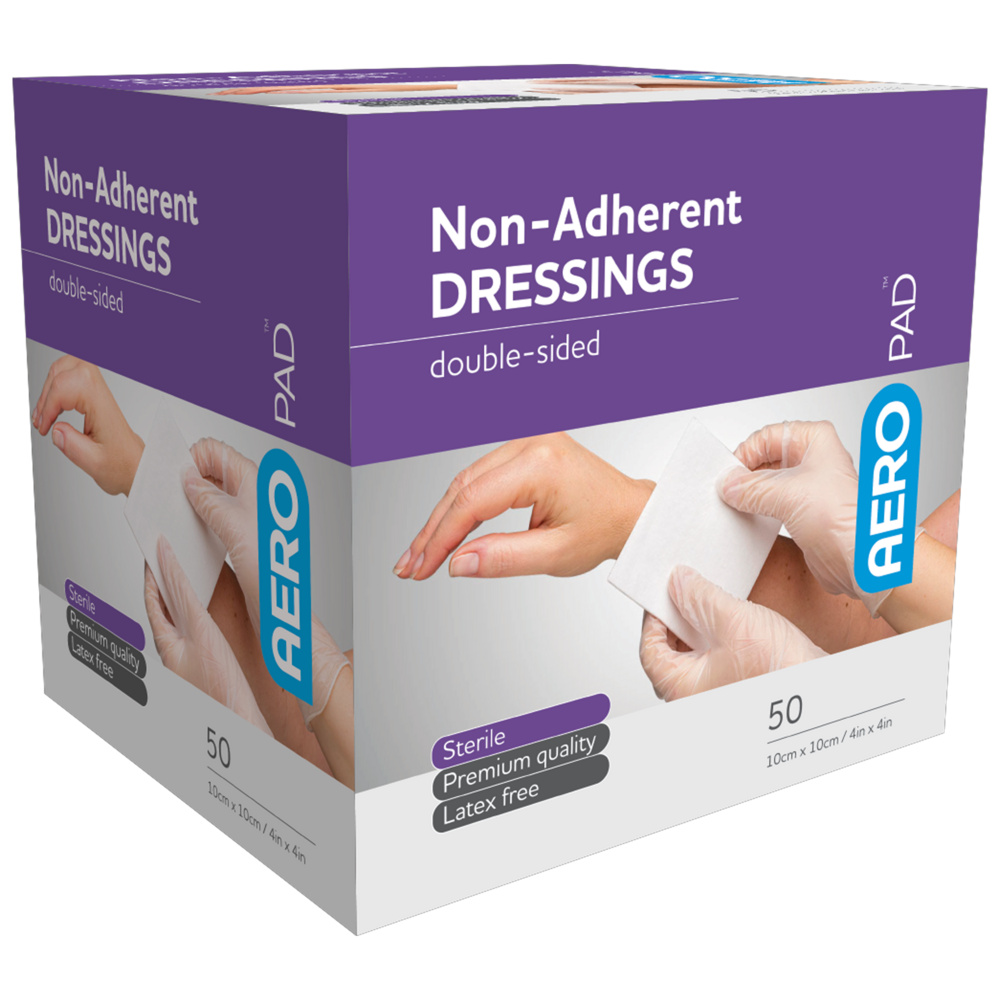
10 x 10cm — the kitchen burn and the workshop abrasion
The 10 x 10cm is the daily workhorse size. It covers most kitchen burns (boiling water splash, oven contact), workshop hand abrasions, knee scrapes on adults, and as the secondary absorbent layer over a smaller non-adherent on a heavily-exudating wound. Stock this size most heavily in any kit.
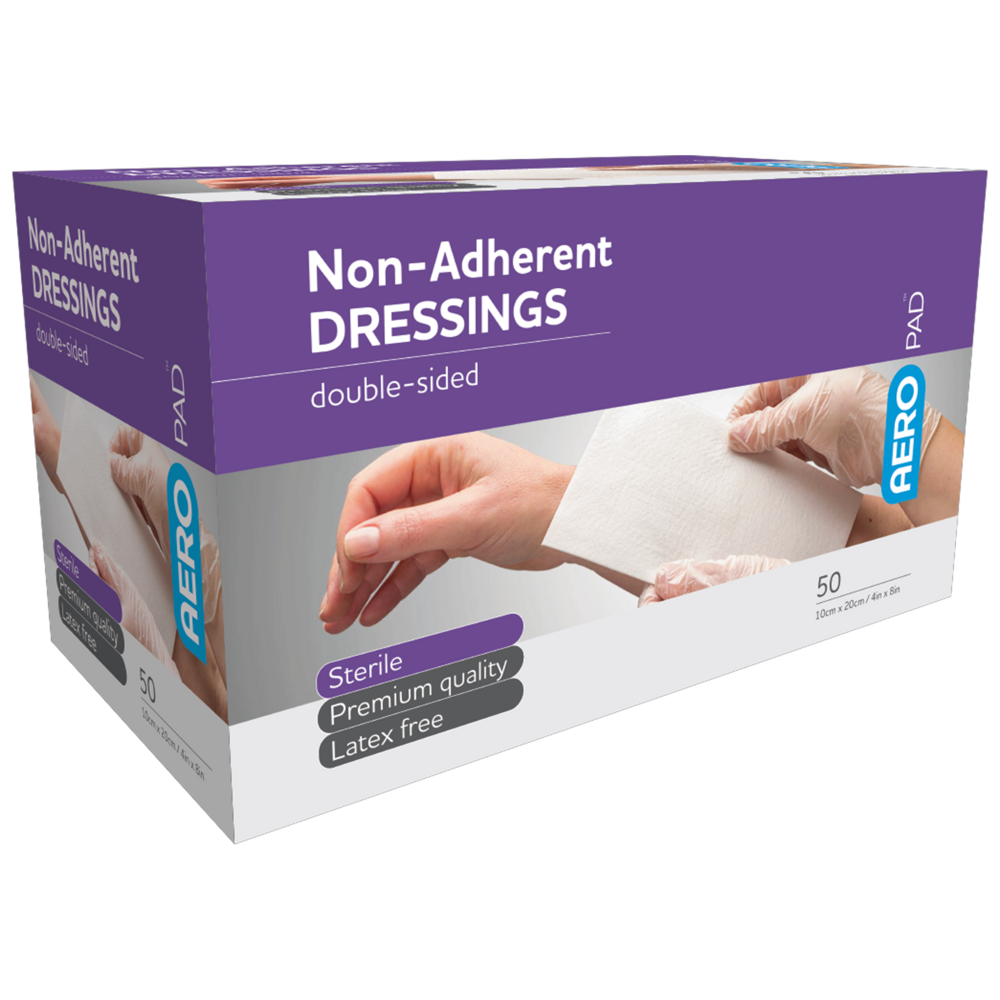
10 x 20cm — forearm, shin, larger burn surface
The 10 x 20cm handles forearm abrasions from falls, shin contact wounds, larger burns and partial-thickness burns up to about 200 square centimetres. It is the largest dressing most workplace first aiders will apply without paramedic backup — anything larger goes to ambulance care.
AEROSWAB gauze sizing — woven cotton for prep and absorption
Gauze swabs are the multi-purpose cotton mesh of every kit. Used for cleaning, packing, absorption and as a backup wound-contact layer when non-adherent is unavailable.
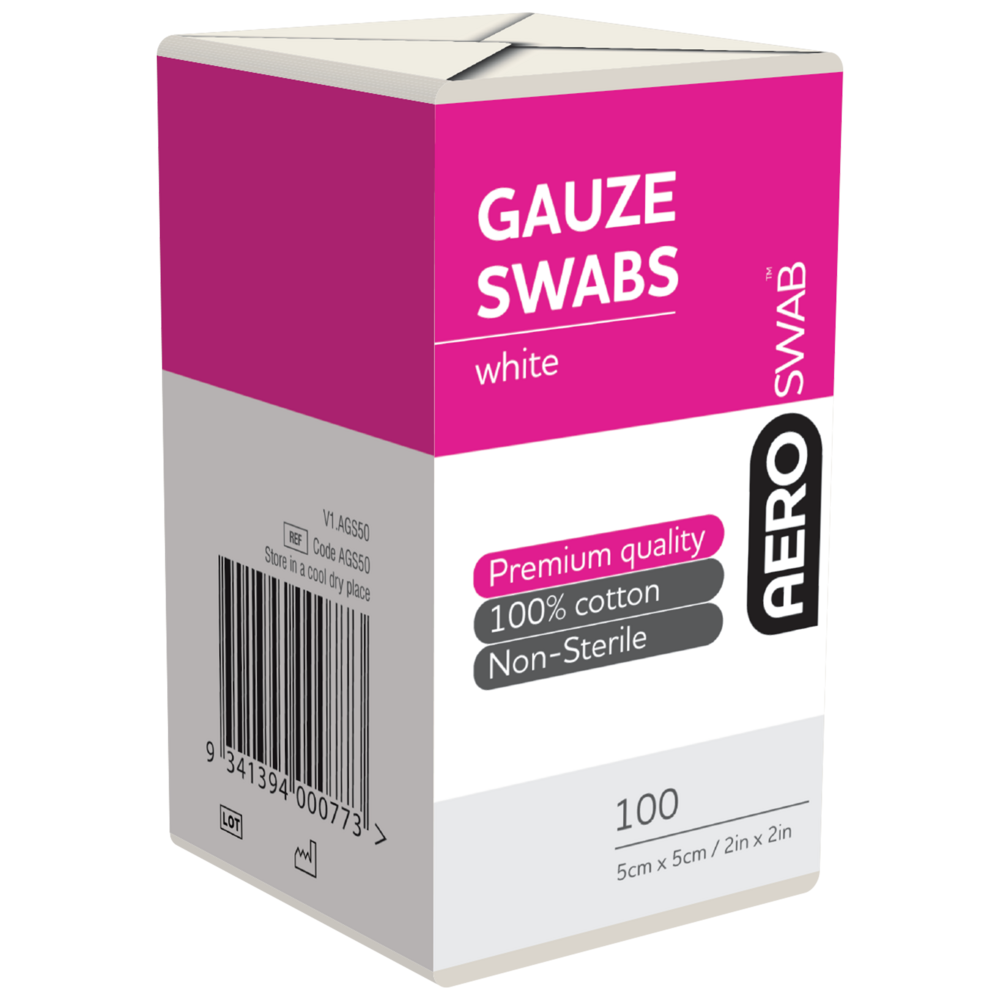
5 x 5cm 8-ply — irrigation, swabbing, eye area
The smaller 5 x 5cm 8-ply swab is the cleaning and irrigation workhorse. Fold it twice into a smaller pad for swabbing wound margins with saline or antiseptic. 8-ply (eight layers of fabric) gives the absorbency without bulk that single-ply muslin lacks.
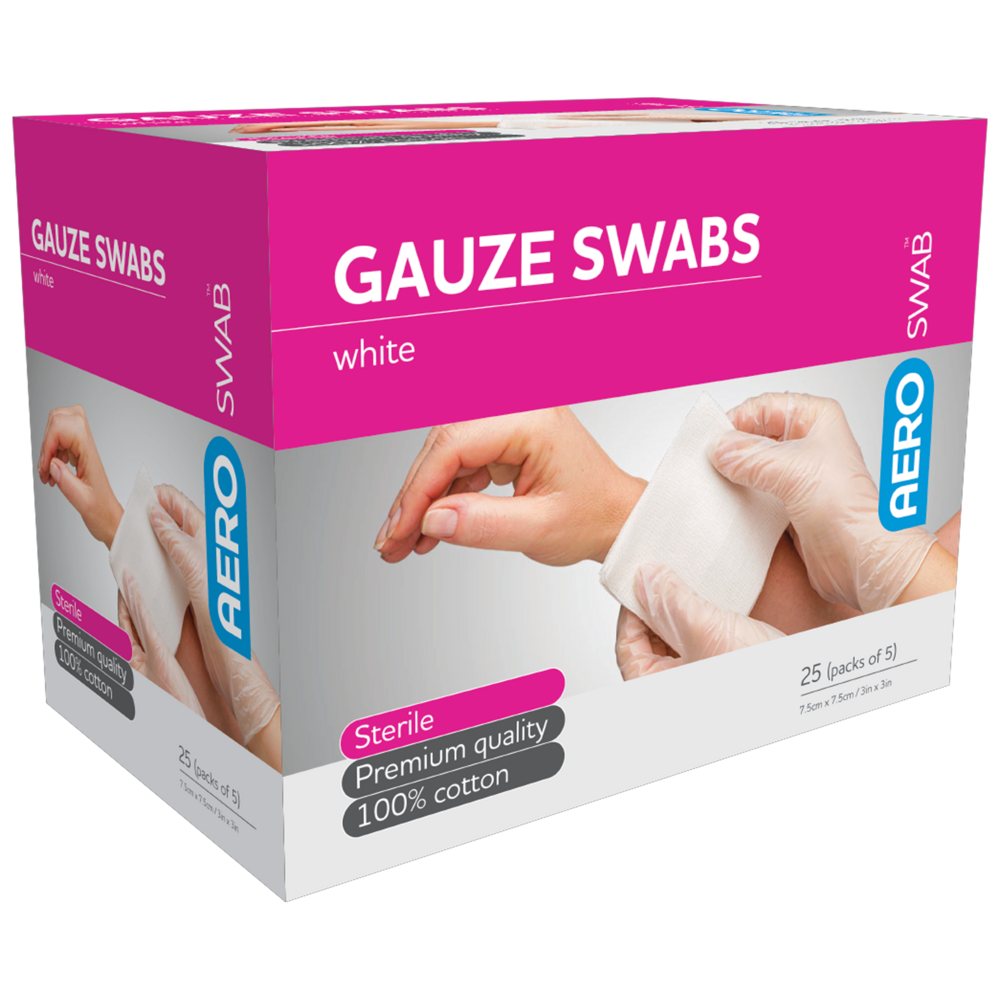
7.5 x 7.5cm 8-ply — absorbent secondary layer, bleeding control
The 7.5 x 7.5cm 8-ply is the absorbent layer that goes on top of a smaller non-adherent. It also doubles as the primary bleeding-control swab — fold it into a tight pad, apply direct pressure, hold for 10 minutes. Eight ply absorbs roughly twice the exudate of single-ply at the same footprint.
Sterile versus non-sterile gauze
Non-sterile gauze (like the AEROSWAB range) is fine for cleaning around wounds, applying topical disinfectant to intact peri-wound skin, and as an absorbent outer/secondary layer. For direct contact against an open wound bed use sterile gauze or a sterile non-adherent. Sterile and non-sterile gauze are physically identical — the difference is whether the pack has been gamma-irradiated.
How to layer dressings on a typical wound
Layered dressings are how nurses do it and how a workplace kit should be assembled. The minimum five-step assembly:
Step 1 — irrigation
Irrigate the wound with normal saline (or running tap water if saline is unavailable) for at least 30 seconds to remove debris. Use a 5 x 5cm gauze swab to wipe loose debris from wound margins outward.
Step 2 — clean peri-wound skin
Wipe the intact skin around the wound (not the wound itself) with antiseptic on a gauze swab. The goal is to reduce bacterial load on the skin that will be under the dressing.
Step 3 — apply the non-adherent
Place a non-adherent dressing sized at least 1cm larger than the wound on every side, with the coated/perforated side against the wound bed. Press lightly to confirm contact across the wound.
Step 4 — add an absorbent secondary layer (optional)
If the wound is exudative, place one or two gauze swabs over the non-adherent. This soaks up drainage without bringing the gauze into direct wound contact.
Step 5 — secure with bandage or tape
A conforming bandage (crepe or cohesive) over the secondary layer, taped at the end. Tape directly to the absorbent layer if no bandage is required and the dressing site is flat (forearm, back of hand). Check distal circulation.
Dressing change intervals — how often is right
Change frequency depends on wound exudate, dressing saturation and infection signs — not the calendar.
Low-exudate wounds (clean lacerations, small burns)
Change every 24 to 48 hours, or when the dressing becomes loose or wet from external sources. Once a stable dry scab has formed, leave it alone — pulling a healing scab is the most common cause of re-bleeding and scarring.
High-exudate wounds (abrasions, larger burns)
Change every 12 to 24 hours during peak drainage (typically days 1-3). Step down to 24-hour and then 48-hour intervals as drainage reduces. The absorbent secondary gauze can be changed independently of the non-adherent if the non-adherent itself is dry — saves dressing stock and reduces wound disturbance.
Always change immediately if
The dressing becomes saturated (fluid visible at the edges). The surrounding skin reddens, swells or becomes warm. The casualty develops fever or feels generally unwell. The dressing has been displaced or soiled with external dirt, food, urine or faeces. Pain at the wound increases rather than decreases over 24 hours.
Recognising wound infection
Workplace first aiders are not expected to diagnose infection — but they must recognise the signs and escalate to GP or hospital.
The five classic signs (calor, rubor, tumor, dolor, function laesa)
Heat (the wound and surrounding skin feel hotter than the opposite limb). Redness (a margin of red extending more than 1cm past the wound edge). Swelling. Pain (increasing rather than decreasing). Loss of function (the limb is harder to use than 24 hours ago).
Spreading cellulitis
If the red margin advances visibly hour-by-hour, or develops streaks tracking up the limb toward the trunk, this is spreading cellulitis and needs medical attention the same day — antibiotics, not just dressing changes.
Tetanus risk
Any wound contaminated with soil, gravel, animal saliva or rusty metal carries tetanus risk if the casualty's vaccination is not up to date (a booster within the last 10 years for clean wounds; 5 years for dirty wounds). Refer to GP for assessment if vaccination status is unknown.
Common dressing mistakes to avoid
Five mistakes show up repeatedly in workplace dressing audits and home first-aid reviews.
1. Plain gauze directly on an open wound
Plain gauze welds itself to the wound bed within hours. Use non-adherent in direct contact; reserve gauze for cleaning and absorption.
2. Dressing too small for the wound
A dressing that does not extend at least 1cm past the wound edges peels off with normal skin movement. Size up rather than down.
3. Adhesive tape directly on broken skin
Tape adheres only to intact skin. Taping over the wound itself causes painful skin tears at the next change. Place tape only on the absorbent layer or surrounding skin.
4. Leaving a saturated dressing on
A saturated dressing is a moisture-saturated bacterial culture surface. Once fluid is visible at the dressing edges, the protective barrier is gone — change immediately, not at the scheduled time.
5. Reusing a dressing
Non-adherent dressings are single-use. Removing and replacing the same dressing contaminates the wound, breaks the wound-contact coating, and offers no infection protection. Always use a fresh dressing.
Stocking dressings + gauze for your workplace kit
Quantity recommendations from the Safe Work Australia model Code of Practice and WHS workplace risk assessments.
Low-risk workplaces (office, retail)
One box each of 5x5 and 10x10 non-adherent. One pack each of 5x5 and 7.5x7.5 gauze. Sufficient for paper cuts, kitchen burns and minor incidents.
Medium-risk workplaces (light industrial, warehouses, schools)
All four AEROPAD sizes (box of 50 each). Both AEROSWAB sizes (pack of 100 each). Plus saline irrigation, antiseptic and tape. Adequate for the realistic range of slips, abrasions and impact injuries.
High-risk workplaces (construction, mining, manufacturing)
Triple-stocked AEROPAD 10x10 and 10x20 (the most commonly used sizes for industrial injuries), double-stocked smaller sizes, both gauze sizes triple-stocked. Add burn-specific dressings, pressure dressings, and a second kit for an additional first aider's load.
Storage, expiry and waste disposal
Dressings have shelf lives. Treat them accordingly.
Storage conditions
Cool, dry, dark. Workplace kits stored above lighting fittings or near boiler rooms see accelerated degradation of dressing adhesives and packaging. Inspect kits in summer for any heat damage.
Expiry dates
Sterile dressings typically carry a 5-year expiry from manufacture. The seal integrity matters more than the printed date — discard any pack with damaged or breached packaging regardless of date. Schedule a six-monthly kit inspection that includes expiry rotation.
Waste disposal
Used dressings contaminated with body fluids go in clinical (yellow-bag) waste in workplaces with a clinical waste contract; in domestic settings, double-bag and place in the general waste. Never compost wound dressings.
Frequently Asked Questions
What is the difference between a non-adherent dressing and a gauze swab?
A non-adherent dressing has a low-adherent coated wound-contact layer designed to lift off without sticking when changed — used as the primary wound contact. A gauze swab is woven cotton mesh used for cleaning, packing wound cavities, or as an absorbent secondary layer. You almost always use both: gauze to clean and absorb, non-adherent against the wound bed.
Why do non-adherent dressings prevent scab pulling on removal?
The wound-contact layer is coated or perforated so granulation tissue and exudate do not bind into the fibres. When you change the dressing the surface lifts off cleanly without tearing the freshly-forming tissue underneath. Plain gauze, by contrast, allows tissue to grow into the weave — pulling it off restarts bleeding and slows healing by 2-3 days.
What size dressing do I need for a paper cut versus a burn?
A paper cut or small laceration (under 3cm) is covered by a 5 x 5cm non-adherent. A 5cm shaving cut or finger laceration fits a 7.5 x 10cm. Hand burns or larger scrapes need a 10 x 10cm. Forearm or shin abrasions and partial-thickness burns over 8cm need the 10 x 20cm. Always leave at least 1.5cm of dressing margin past the wound edge.
How often should I change a non-adherent dressing?
On a clean low-exudate wound — every 24 to 48 hours, or sooner if the dressing becomes saturated or soiled. Cease changes once a stable scab has formed. On a high-exudate wound (large abrasion, partial-thickness burn) change every 12-24 hours initially and step down as drainage reduces. Always change immediately if the wound shows infection signs.
Can I use a non-sterile gauze swab on an open wound?
Use non-sterile gauze for cleaning around the wound (skin preparation) and as an absorbent outer layer when bandaging. The wound-contact layer should be either a sterile non-adherent dressing or sterile gauze. Non-sterile cotton gauze is fine for application/clean-up but should not be the primary surface against open broken skin.
Sources and further reading
- healthdirect — Burns and scalds (dressing guidance)
- healthdirect — Skin infections (wound infection signs)
- healthdirect — Tetanus (contaminated wound risk)
- Wounds Australia — Clinical resources for wound management
- TGA — Medical devices classification (Australian regulatory context)
Related guides on MediBC
- Wound antiseptic cleanser guide for Australia
- Cohesive bandage, sports strapping and crepe sizing guide
- Workplace first aid cabinet guide: WHS compliance for Australian sites
Restock dressings + gauze — workplace bulk packs
The four AEROPAD non-adherent sizes and two AEROSWAB gauze sizes that cover every cut, abrasion and partial-thickness burn a workplace kit will face.
AEROPAD Non-Adherent 5 x 5cm Box/50
Small wound dressing for paper cuts and minor lacerations.
Shop Now
AEROPAD Non-Adherent 7.5 x 10cm Box/50
Finger-to-knuckle coverage and kitchen knife laceration size.
Shop Now
AEROPAD Non-Adherent 10 x 10cm Box/50
Daily workhorse size for kitchen burns and workshop scrapes.
Shop Now