

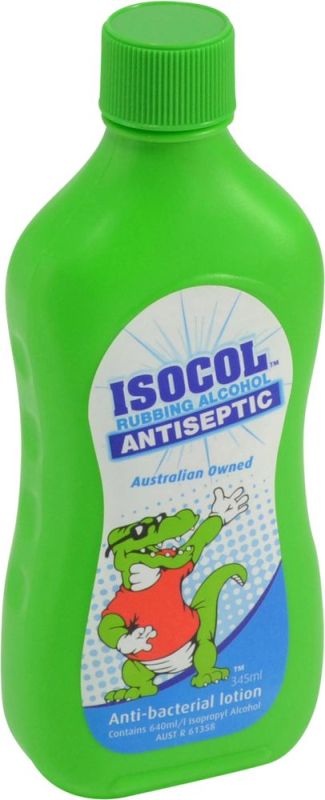
Isocol Rubbing Alcohol 345ml
First Aid Supplies
$27.88
Isocol Rubbing Alcohol 345ml is an Australian household and clinical staple containing 64% isopropyl alcohol. Used for cleaning minor cuts and grazes, disinfecting hard surfaces, sterilising tweezers and small instruments, and skin prep before injections. The fast-evaporating, residue-free formula has been a kitchen-cabinet essential for generations.
Secure checkout
VISA
Mastercard
Apple Pay
Google Pay
Also accepted
AMEX
Afterpay
Zip
Klarna
PayPal
In stock
Only 568 left
SKU
99538
Isocol is the Australian-made rubbing alcohol that has sat in medicine cabinets, garages and clinical bags for generations. It contains 64% isopropyl alcohol with water, and works as both a skin antiseptic and a hard-surface disinfectant - cleaning, drying and evaporating without leaving a residue. This is the 345mL bottle, the size most households buy.
Why Isocol is in so many Australian cabinets
The reason it does so many jobs is that alcohol at this strength both disinfects and evaporates clean. There is no oily residue to wipe off a benchtop, no film left on tweezers, and nothing to rinse away from a phone screen or a pair of glasses. That single property is why one bottle covers first aid, instrument hygiene and general cleaning rather than needing three products.
A point worth being exact about, because it is the most-asked question: Isocol is 64% isopropyl alcohol, not pure isopropanol and not the 70% preparation used in clinical skin-prep swabs. It is the same active, at its own concentration, in a ready-to-use bottle. If a procedure specifies 70% isopropyl, use a product labelled at that strength rather than assuming they are interchangeable.
It is a genuinely broad performer: cleaning minor cuts and grazes before dressing, sterilising tweezers, scissors and small instruments, skin prep before an injection or a blood-glucose test, tick and splinter removal, and lifting sticker residue, marker pen and adhesive from skin. It also handles benchtops, doorknobs, light switches, lenses and screens.
Key features
- 64% isopropyl alcohol with water
- Australian made
- Skin antiseptic and hard-surface disinfectant in one bottle
- Evaporates clean - no residue on skin, tools or screens
- Sterilises tweezers, scissors and small instruments
- Lifts sticker residue, marker pen and adhesive from skin
- 345mL bottle - the standard household size
Specifications
| Product | Isocol Rubbing Alcohol |
| Active | Isopropyl alcohol 64% |
| Remainder | Water |
| Bottle size | 345mL |
| Made in | Australia |
| Skin uses | Cleaning minor cuts and grazes, skin prep before injection or lancet |
| Instrument uses | Tweezers, scissors, small instruments, splinter and tick removal |
| Surface uses | Benchtops, doorknobs, light switches, lenses, screens |
| Not the same as | 70% isopropyl clinical skin-prep alcohol |
| Storage | Flammable - keep away from flame and heat |
Common uses
Households keep it for splinters, tick removal and cleaning a graze before a plaster goes on. Anyone injecting or finger-prick testing uses it for skin prep. Workshops and garages use it for degreasing and lifting adhesive. And it has a long second life as the thing that cleans glasses, camera lenses and phone screens without smearing. If you want measured single-use skin prep rather than a bottle, 70% isopropyl alcohol wipes are the sachet form, and chlorhexidine 0.5% in alcohol 70% is the clinical antiseptic where a residual effect is wanted. Stocked with our first aid supplies.
Isocol FAQs
Is Isocol the same as isopropyl alcohol?
It is isopropyl alcohol, but not at the strength people often assume. Isocol is 64% isopropyl alcohol with water - it is neither pure isopropanol nor the 70% preparation used in clinical skin-prep swabs. Same active, different concentration, ready to use straight from the bottle.
What is Isocol used for?
Cleaning minor cuts and grazes, skin preparation before an injection or blood-glucose test, sterilising tweezers, scissors and small instruments, and disinfecting hard surfaces. It also removes sticker residue and adhesive from skin and cleans lenses and screens.
Can I use it on an open wound?
Only for cleaning around and on minor cuts and grazes as directed. Alcohol stings on broken skin and damages exposed tissue, so it is not the right choice for a large, deep or heavily contaminated wound - use saline or a wound-cleaning antiseptic and have anything significant assessed.
Can I use it to sterilise tweezers before splinter removal?
Yes, that is one of its most common household uses. Wipe or soak the tweezer tips, let the alcohol evaporate, then remove the splinter. The same applies before tick removal, and because it evaporates clean there is nothing left on the tool.
Is it safe on phone screens and glasses?
It is widely used for exactly that and evaporates without smearing. Check your device guidance first - a few coatings and display films do not tolerate repeated alcohol - and apply it to a cloth rather than directly onto the screen.
Is it flammable?
Yes. At 64% alcohol it is flammable, so keep it away from flame, heat and ignition sources, store the cap on, and let treated skin or surfaces dry before going near anything hot.
For external use only. Flammable - keep away from flame, heat and ignition sources, and keep out of reach of children. Avoid contact with eyes and mucous membranes. This information is a general guide and does not replace advice from your doctor or pharmacist - do not use on large, deep or infected wounds, and seek medical advice if a wound is not healing.
| Brand | Isocol |
|---|
Frequently bought together