

Written by the MediBC medical-supply team · Aligned to AS 4775 Emergency Eyewash and Shower Equipment standard and Safe Work Australia first-aid guidance · Updated June 2026.
Eye injuries are the most time-critical workplace first-aid response Australians face. A chemical splash to the eye starts permanent corneal damage within 60 seconds. Foreign-body penetration can scratch the cornea in minutes. And dry-eye irritation from dust or smoke escalates to corneal abrasion if not flushed properly. This guide covers eyewash bottles, saline ampoules, sachets, eye pads and the wall bracket that AS 4775 requires for workplaces with eye-hazard work.
It maps to the six standard eye-care products MediBC stocks for Australian workplaces, plus the AS 4775 compliance framework for chemical-handling workplaces. Every workplace with chemicals, dust, sparks, woodwork, metalwork, food prep, healthcare, laboratories, agriculture, or sun exposure needs at least the basics on this list.
Why eye care is the most time-critical workplace first aid
The cornea is one millimetre thick and has no skin barrier. Anything that touches it can damage it within seconds. Chemical burns to the eye outpace thermal skin burns in damage rate by 5x because no protective barrier slows the chemistry. Foreign bodies — metal slivers, wood splinters, glass dust — embed into the cornea and travel deeper with each blink unless removed within minutes.
The 60-second rule
Begin irrigation within 60 seconds of chemical contact. Don't wait to find saline. Tap water is acceptable if saline isn't immediately at hand. Lost minutes in this window translate directly to lost vision.
The 20-minute rule
Flush continuously for at least 20 minutes once started. For strong alkalis (drain cleaner, oven cleaner, wet cement, mortar, plaster) extend to 30-60 minutes — alkalis penetrate tissue and continue to damage hours after contact. Acid burns coagulate proteins and self-limit; alkali burns saponify and continue.
Why irrigation works
Continuous water flow physically displaces the chemical from the corneal surface, dilutes residual chemical to non-damaging concentration, and washes contaminated tears out of the conjunctival sac. No first-aid intervention substitutes for water volume — antidotes and neutralisers (which don't really exist for most chemicals anyway) cannot replace flushing.
AS 4775 Emergency Eyewash compliance
AS 4775 sets the Australian Standard for emergency eyewash and shower equipment. Compliance is required for workplaces with chemical exposure under WHS regulation.
Accessibility within 10 seconds
Eyewash must be accessible within 10 seconds of the work area without passing through doors, around obstacles, or up/down stairs. For a typical adult walking pace, that's about 15 metres clear path. Workshop layouts often need multiple stations to meet this.
Hands-free flow time
Plumbed eyewash stations must deliver 1.5 litres per minute for at least 15 minutes hands-free (no holding a button). Portable bottle stations need adequate volume — 500ml or larger — to support both eyes for the full irrigation window.
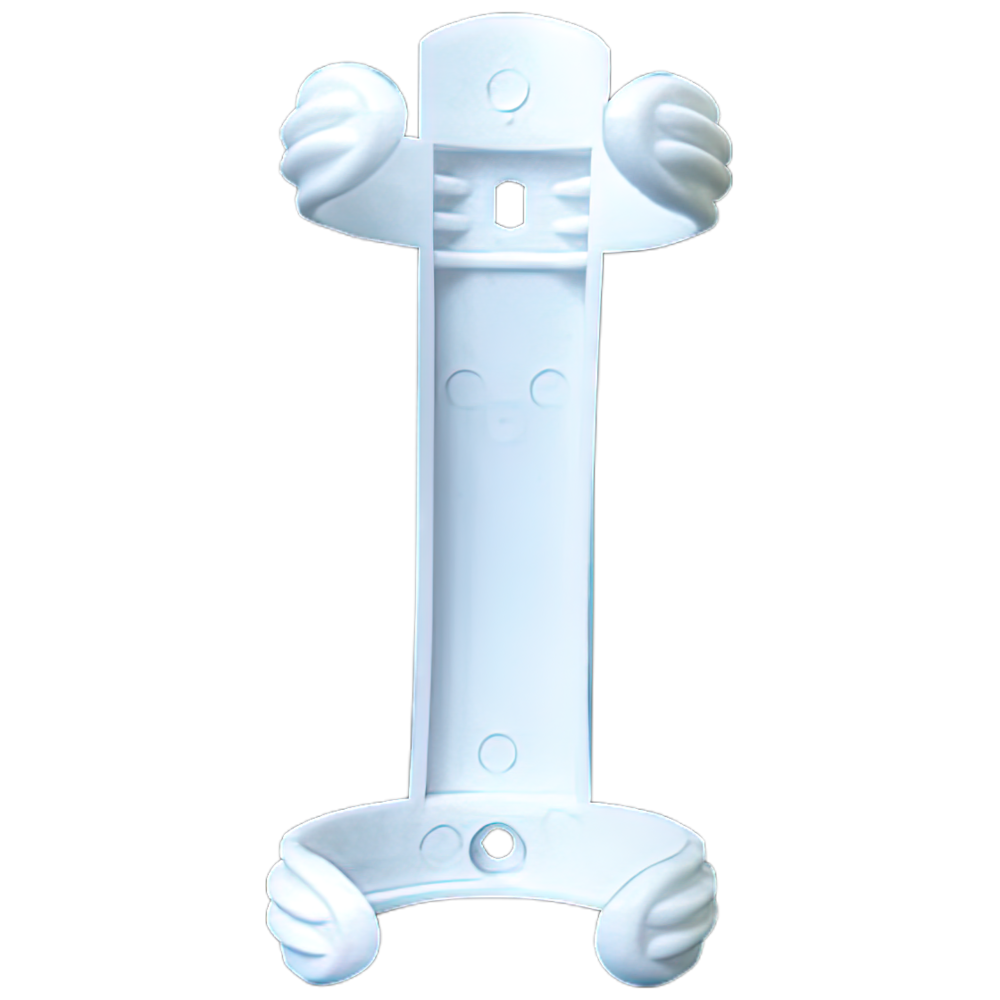
Wall-mount bracket positioning
Bottle stations mount at adult eye-shoulder height, accessible from a comfortable bend-over posture. Too low and the casualty needs to crouch; too high and pouring water into both eyes simultaneously is difficult. Standard installation height is 1.2-1.5 metres centre-of-bottle.
Eyewash bottles — the portable workhorse
Sealed bottles of sterile saline (sodium chloride 0.9%) are the most-used eyewash format. Sterile saline is isotonic — same salt concentration as tears — so it irrigates without further irritation.
100ml drop bottles — single-eye, portable
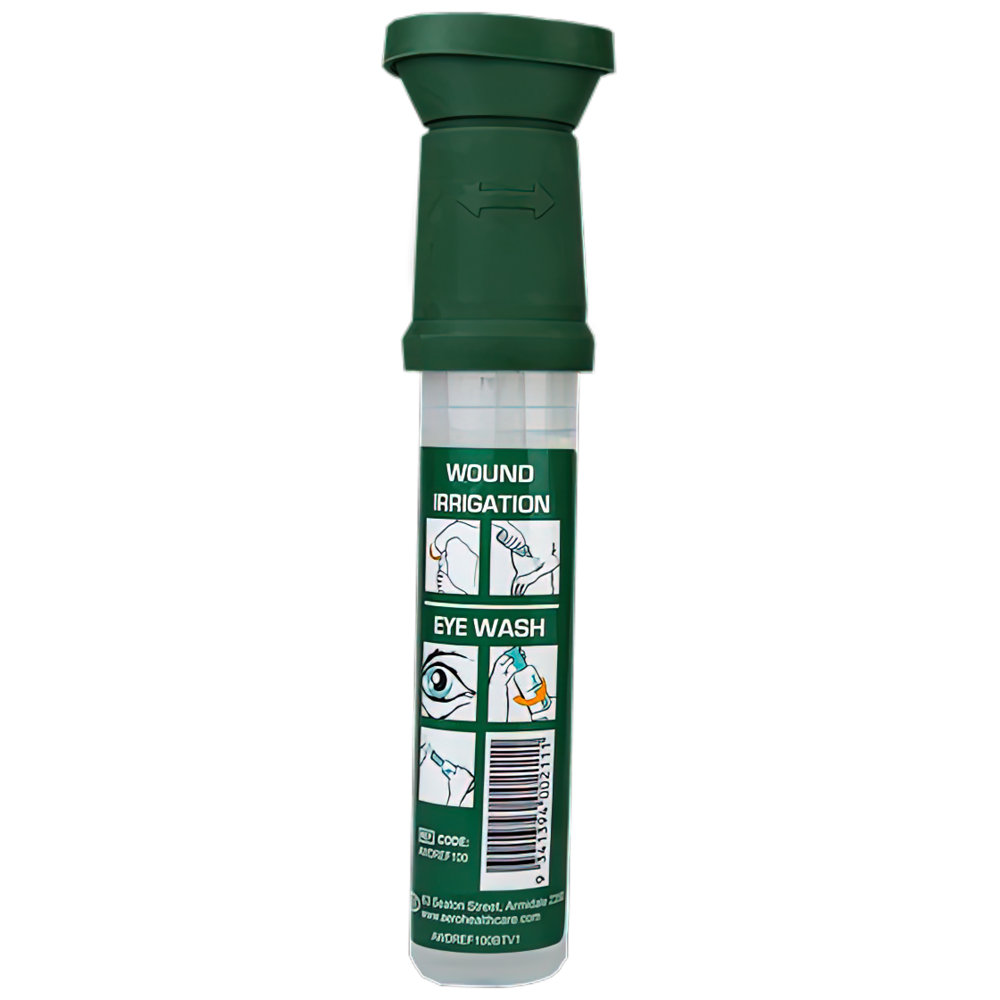
The 100ml AEROWASH bottle is sized for a single-eye flush in a clinical or workshop setting. The flip-top drop dispenser delivers a controlled stream and can be operated one-handed by a first aider. Stock multiple bottles in any kit; one bottle is consumed in 5-10 minutes of irrigation.
500ml refillable bottles — wall-station
The 500ml format goes into the DROP wall-mount bracket for a permanent eyewash station. One bottle covers both eyes for 10-15 minutes — adequate to bridge until paramedics arrive or to complete most workplace flush procedures. Refill or replace the bottle after each use; sterility breaks once the seal opens.
Shelf life and rotation
Sealed sterile saline carries a 3-5 year shelf life from manufacture. Check expiry quarterly and replace expired stock. Sterility is binary — once a bottle's seal is broken (even briefly) it's no longer sterile and goes in the next use or to disposal.
Sodium chloride ampoules — single-use clinical format
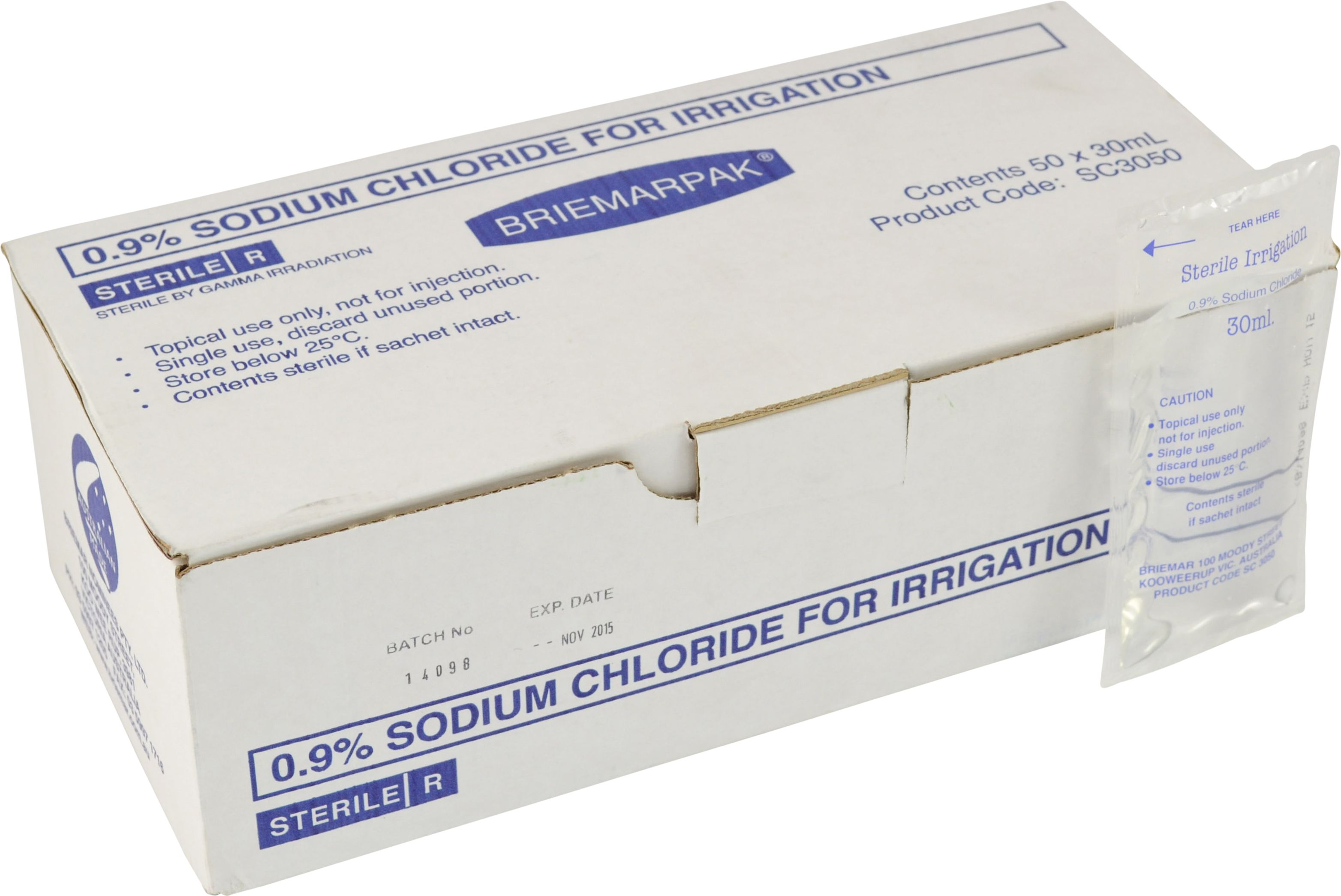
Single-use sealed plastic ampoules of sterile saline. Snap the top, squeeze the saline into the eye. Two formats stocked in Australian workplaces.
15ml ampoules — bulk pack (60 per box)
The 15ml volume is single-use single-eye, delivering 30-45 seconds of controlled flow. Bulk-packed boxes of 60 suit high-traffic workplaces (food prep, light industrial, schools, education) where individual ampoules are the standard issue.
30ml ampoules — workshop format
Larger 30ml ampoules give one minute of irrigation per ampoule, enough to bridge between a casualty starting the flush themselves and the arrival of a first aider with the bottle station. Better suited to workshop and trade environments where each first-aid event is less time-pressured.
Sterile until snap
Sealed ampoules are sterile and have a long shelf life. The snap-off top breaks the seal — from that moment forward the ampoule is in-use. Don't try to reseal or reuse partially-used ampoules.
Saline sachets — vehicle and remote kits
Foil-pouch sachets of sterile saline give the longest shelf life and the lightest weight of any irrigation product.
30ml sachets (75 per pack)
30ml of saline in a heat-sealed foil sachet. Tear the corner, deliver into the eye. Each sachet provides one minute of irrigation. The 75-sachet pack is the standard vehicle/remote-kit issue size.
Why sachets for vehicles
Temperature-resistant (sealed sachets survive vehicle cabin heat), light (no bottle weight), space-efficient. Vehicle first-aid kits should have at minimum 10 sachets — enough for a 30-minute flush on the roadside before ambulance arrival.
Limitations of sachet format
Smaller volumes mean more switching between sachets during an extended flush. For workplace primary stations, bottles or ampoules are better. For remote/portable kits where shelf life and weight dominate, sachets win.
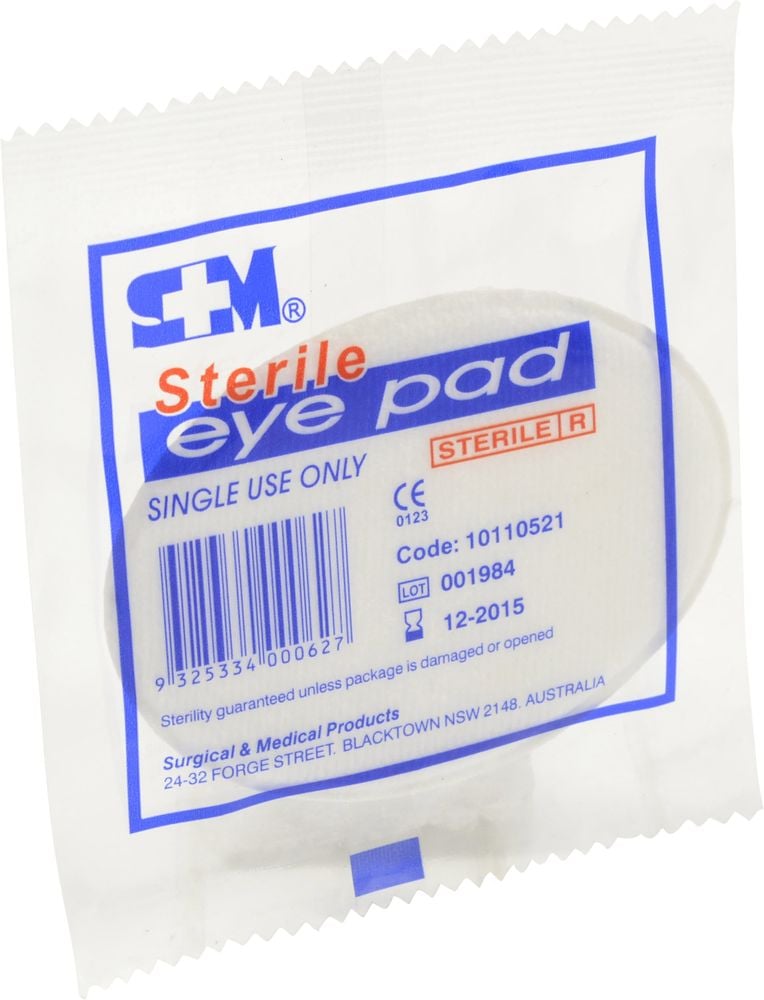
Eye pads — sterile post-flush coverage
After irrigation, the eye usually needs covering to limit further exposure and rest the cornea while the casualty awaits medical assessment.
When to apply an eye pad
After 20-minute chemical irrigation, after foreign-body removal attempts (or even unsuccessful attempts), or after blunt-force injury. Apply with light pressure only — never compress an eye with a possible penetrating object inside.
How to apply
Open the sterile foil pouch. Hold the casualty's eyelid closed gently. Place the pad over the closed eye. Secure with a head wrap or two strips of paper tape across the forehead. The pad doesn't need to be tight — sterility and physical coverage are the goals.
Both eyes if needed
If one eye is injured and patched, the other eye continues to move (the brain doesn't know one eye is closed). This co-movement can aggravate certain injuries. For penetrating-injury cases, cover BOTH eyes; the casualty can't drive or walk independently but it protects the injured eye.
Workplace eye-hazard categories
Knowing your hazard category guides your eyewash inventory.
Chemical workplaces
Cleaning chemical handling, laboratory work, swimming pool maintenance, manufacturing, agriculture chemical application. Need: wall-mount station + portable bottles + sachets + eye pads. Full AS 4775 setup.
Particulate workplaces
Workshops with metal grinding, woodworking with sawdust, construction with concrete dust, agricultural dust. Need: portable bottles + sachets + eye pads. Foreign-body irrigation is the primary scenario.
Heat/radiation workplaces
Welding (arc flash burns retina even with cooler exposure), foundry work, glass blowing. Need: bottles for thermal/UV irritation flush + eye pads. Heat injuries less responsive to flushing than chemical, but irrigation soothes.
General office/retail
Lower probability of eye injury but not zero (paper cuts, kitchen splash, cleaning chemical incidents). Need: 1-2 portable bottles in the main first-aid kit. AS 4775 doesn't apply but basic provision matters.
Foreign-body eye injuries — when to flush, when to refer
Foreign bodies in the eye are common workplace injuries. The decision to flush versus refer depends on the type.
Loose dust, eyelash, small grit — flush
Hold the eye open. Direct a gentle stream of saline across the eye from inner corner to outer corner. Have the casualty look in different directions to bring all conjunctival surfaces into the stream. Two to three minutes of flushing usually clears non-embedded particles.
Embedded particle (metal, glass, splinter) — DO NOT flush
If you see a particle embedded in the cornea or conjunctiva, do NOT try to flush or wipe. Cover the eye with a sterile pad (DO NOT press) and transport to ED. Removal requires slit-lamp examination and specialist tools.
Chemical exposure — always flush
Regardless of visible particle, flush for 20+ minutes. Chemical exposure is the irrigation-mandatory scenario regardless of foreign body.
Welding flash and UV eye injuries
"Arc eye" or photokeratitis affects welders, foundry workers, even office workers exposed to germicidal UV lights. The cornea sunburns from UV exposure. Symptoms peak 6-12 hours after exposure.
Symptoms
Gritty foreign-body sensation in both eyes, severe pain, light sensitivity, watering, redness. Usually presents the morning after a welding job. Welders who skip eye protection "just for a quick weld" learn the lesson once.
First aid
Cool compresses, dim light, oral pain relief. Avoid rubbing. The condition self-resolves in 24-48 hours but is extremely uncomfortable. Eye pads + ibuprofen + dark room are the practical management. GP visit for severe cases.
Prevention
Welding helmets, side-shielded UV protective glasses, UV-rated polycarbonate safety glasses. There is no first-aid substitute for proper eye protection.
Chemical eye burn — the full protocol
Most time-critical workplace first-aid scenario.
Step 1 — start irrigation within 60 seconds
Don't run for the perfect equipment. Use the closest water source — tap, drinking fountain, eyewash bottle, saline sachet. The 60-second window matters more than the irrigation medium.
Step 2 — flush from inner corner outward
Direct the water stream from the inner corner of the eye to the outer corner so contaminated water flows AWAY from the unaffected eye. Hold the eyelids open with two fingers — the casualty will instinctively close them, but the irrigation works only on exposed surfaces.
Step 3 — both eyes if both exposed
Splashes commonly hit both eyes. Irrigate both. Use bottles, ampoules, or a continuous source so neither eye stops getting flushed.
Step 4 — continue at least 20 minutes
Set a timer. Continue until medical help arrives. Document start time + duration on the casualty's hand or a tag for hospital handover.
Step 5 — pad and transport
After irrigation, cover with sterile eye pad(s). Transport to ED. Provide Safety Data Sheet or product label for the chemical involved.
Stocking your eye-care kit
Recommended supplies by workplace risk class.
Low-risk (office, retail)
One 100ml eyewash bottle + 2 sachets + 2 eye pads in the main first-aid kit. Total cost under $20.
Medium-risk (food service, schools, healthcare)
Add: box of 15ml ampoules + box of sachets + extra eye pads. Two 100ml bottles in different areas. Total around $80.
High-risk (chemical handling, workshops, construction)
Full setup: wall-mounted 500ml bottle station with bracket + portable bottles in each work area + ampoules and sachets in supplementary kits + eye pads + signage. AS 4775-compliant emergency shower if any chemical handling is significant volume.
Inspection and maintenance
Monthly check
Bottles intact, seals unbroken, expiry dates valid, wall-station accessible (not blocked by furniture or supplies). Photograph the station setup for WHS records.
Replace after use
Any opened bottle, ampoule, or sachet gets disposed of after use even if material remains — sterility broken. Restock immediately.
Re-fill the wall station promptly
A wall-mounted bottle that ran out is a workplace safety failure if another incident happens during the gap. Inspect twice weekly in high-risk environments.
Common eye-care mistakes
1. Trying to remove embedded objects
Hospital territory. Field removal of embedded objects causes additional damage. Cover and transport.
2. Under-flushing chemical burns
20 minutes is the minimum. Set a timer. Don't stop at the casualty's request — pain reduces but damage continues.
3. Pressing on the eye with bandages
Any pressure on a possible penetrating-injury eye worsens it. Cover lightly only.
4. Using expired saline
Expired saline can develop bacterial growth and adds infection to the original injury. Rotate stock religiously.
5. Not double-covering for transport
For penetrating injuries, both eyes need cover — even the uninjured one. Single-eye cover lets eye co-movement aggravate the injured eye.
Frequently Asked Questions
How long should I flush an eye after a chemical splash?
At least 20-30 minutes of continuous irrigation, longer for strong alkalis like drain cleaner or wet cement (these may need 60 minutes). The flush time exceeds thermal-burn cooling because chemistry continues to damage corneal tissue until completely removed. Keep flushing until paramedics or hospital takes over.
Saline ampoule vs eyewash bottle vs sachet — which is best?
Bottles for prolonged ongoing flushing (10-100ml continuous stream). Ampoules for single-use single-eye flushing in clinical-style workplaces. Sachets for vehicle kits and remote work because they have 3-5 year shelf life and weigh nothing. Most workplaces stock all three formats — different scenarios call for different containers.
Does my workplace need an eyewash station?
AS 4775 (Emergency Eyewash and Shower Equipment) and Safe Work Australia first-aid Code require eyewash provision wherever workers risk chemical eye exposure. The minimum is portable eyewash bottles in a hand-accessible position; the recommended setup for chemical-handling sites is a wall-mounted gravity-fed bottle station with bracket, accessible within 10 seconds of the work area.
Can I use tap water if I don't have saline available?
Yes — clean running tap water is better than no irrigation. The Australian Resuscitation Council allows tap water for eye chemical-burn flushing when sterile saline is not immediately available. Start with whatever water is closest; switch to saline once it becomes available. Don't waste 60 seconds finding saline when tap water is at hand.
Do eye pads need to be sterile?
Yes — the eye pad is applied directly to a vulnerable cornea/conjunctiva and must be sterile to avoid introducing infection. Use the single-foil-sterile-pack pads, not gauze swabs. Apply lightly with a head-band or crepe; do not put pressure on the eye if there's any chance of a penetrating object in it.
Sources and further reading
- healthdirect — Eye Injuries (Australian government health portal)
- Australian Resuscitation Council — Guidelines (including eye-injury first aid)
- Safe Work Australia — First Aid in the Workplace Code of Practice
- Standards Australia (AS 4775 Emergency Eyewash and Shower Equipment)
- TGA — Medical Devices (regulatory context)
Related guides on MediBC
- Workplace eyewash station guide: AS 4775 compliance
- AEROBURN burn first aid guide
- Workplace first aid cabinet guide
Stock your eye-care kit — eyewash, saline, eye pads
Bottles, ampoules, sachets, eye pads and the wall-bracket — the complete AS 4775-aligned eye-care lineup for Australian workplaces.
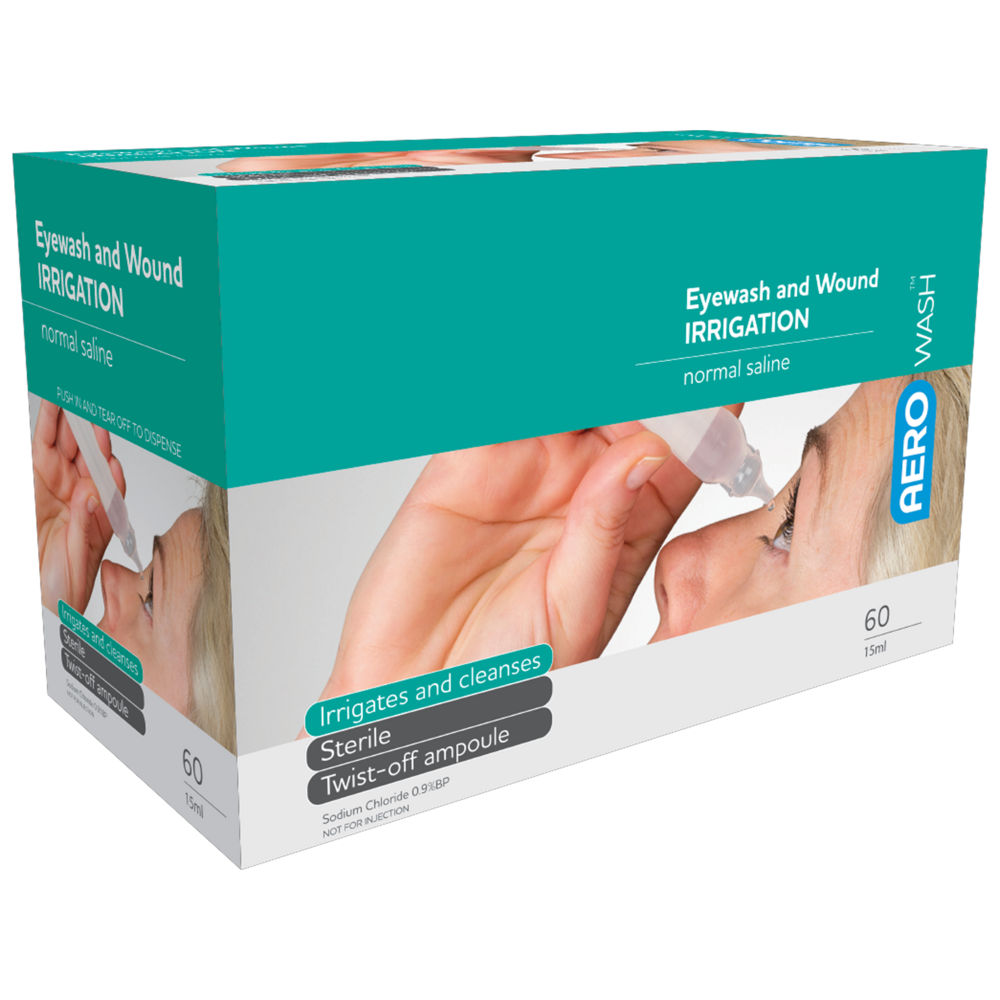
AEROWASH 15ml Eyewash Ampoules Box/60
Single-use 15ml ampoules — bulk-pack for high-traffic workplaces.
Shop Now
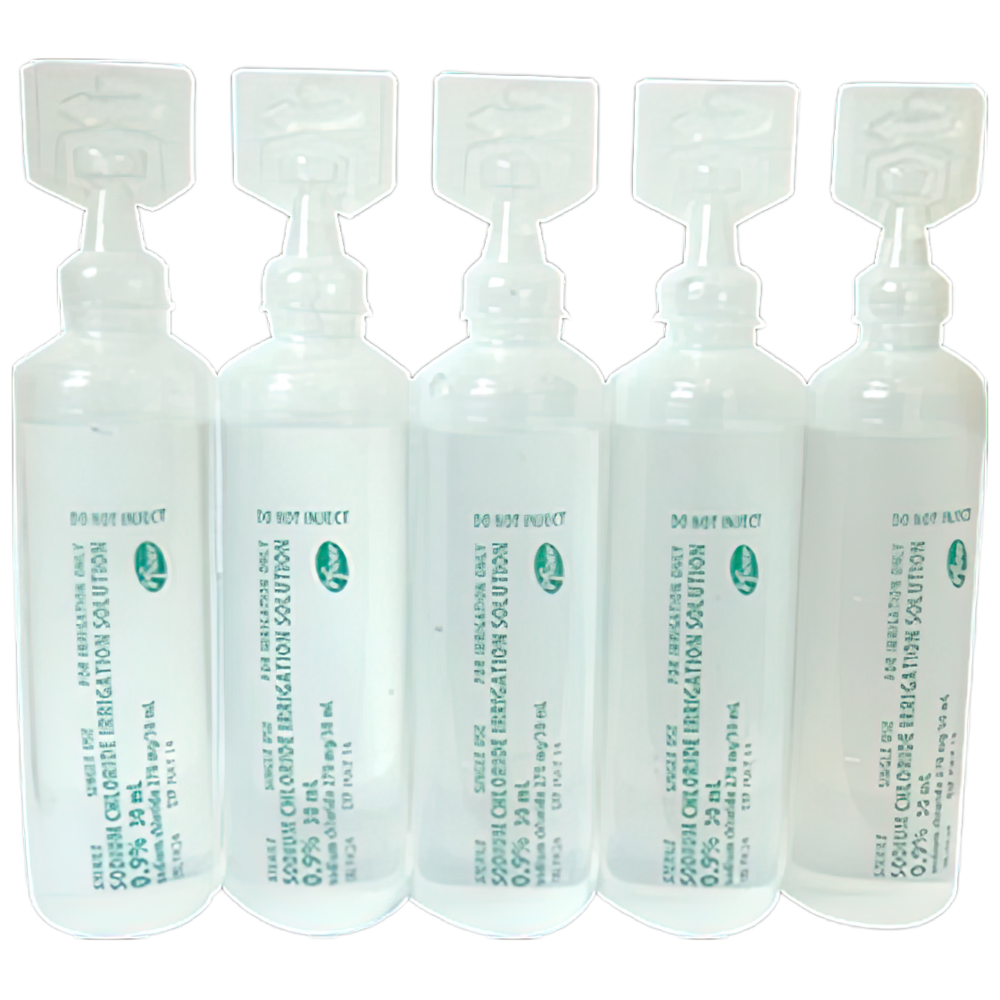
Sodium Chloride 30ml Eyewash Ampoules Box/30
Larger 30ml single-use ampoules — workshop-friendly volume per flush.
Shop Now