


Reviewed by the Medibc First Aid Team — last updated May 2026.
An unprotected eye exposed to a corrosive chemical can suffer permanent damage in under 60 seconds. That's why healthdirect.gov.au and the Australian and New Zealand Committee on Resuscitation both list immediate, copious eye irrigation as the single most important first aid intervention for any chemical splash. Australian Standard AS 4775-2007 (Emergency eyewash and shower equipment) sets out exactly what equipment your workplace must have, where it goes, and how often it must be tested.
This guide breaks down which eyewash units suit which workplaces, the AS 4775 placement and maintenance rules, and the step-by-step first aid response when a chemical reaches someone's eye.
Why workplace eyewash matters
The 60-second rule
Strong alkalis (drain cleaner, ammonia, lime, cement, sodium hydroxide) continue penetrating the eye long after splash — corneal damage and blindness can occur within 60-90 seconds. Strong acids (battery acid, sulfuric, hydrochloric) cause immediate but more contained burns. Either way, the time between exposure and first flush is the single biggest predictor of vision outcome. Anything beyond 10 seconds delay measurably increases scarring.
Legal duty under WHS
The Safe Work Australia Code of Practice requires employers to identify chemical eye hazards in the WHS risk assessment and provide eyewash equipment within 10 seconds walking time of any hazard zone. Failure to provide compliant eyewash equipment after a chemical incident is treated as a Category 1 or 2 WHS offence, with penalties up to $3 million for body corporates.
Common workplace eye hazards
Eyewash isn't just for laboratories. Required in: vehicle workshops (battery acid, brake fluid, degreasers), hairdressing salons (peroxide, ammonia), commercial kitchens (oven cleaner, sanitiser), construction (cement, lime, paint thinner), agriculture (pesticides, herbicides, fertiliser), photographic processing, pool chemical stores, art studios, manufacturing (cutting fluids, solvents), and any laboratory using corrosives.
AS 4775 in plain English
The headline requirements
AS 4775-2007 specifies:
- Flow rate — eyewash 1.5 L/min minimum; combination shower 75 L/min
- Duration — 15 minutes continuous, hands-free flushing
- Water temperature — tepid 16-38°C (cold causes hypothermia, hot worsens chemical burns)
- Activation — single hand or foot motion, no more than 1-second to activate
- Stream pattern — aerated, irritant-free, covers both eyes simultaneously
- Location — within 10 seconds walking time (or ~17 metres) of any hazard area
- Lighting — clear visibility 24/7, emergency lighting if required
- Path — unobstructed, no doors, no stairs, no locked rooms
What counts as compliant equipment
Any unit certified to AS 4775, AS/NZS 4775, ANSI Z358.1, or EN 15154 meets Australian compliance. Most quality manufacturers print certification on the unit body and accompanying paperwork. Improvised eye wash (a tap, a hose, a bottle of water) does NOT meet AS 4775 and does not satisfy the employer's WHS duty.
What AS 4775 does NOT replace
An eyewash station does not replace personal protective equipment (chemical goggles, face shields), workplace ventilation, hazard substitution, or first aid training. It is the LAST line of defence after primary controls fail.
Types of workplace eyewash stations
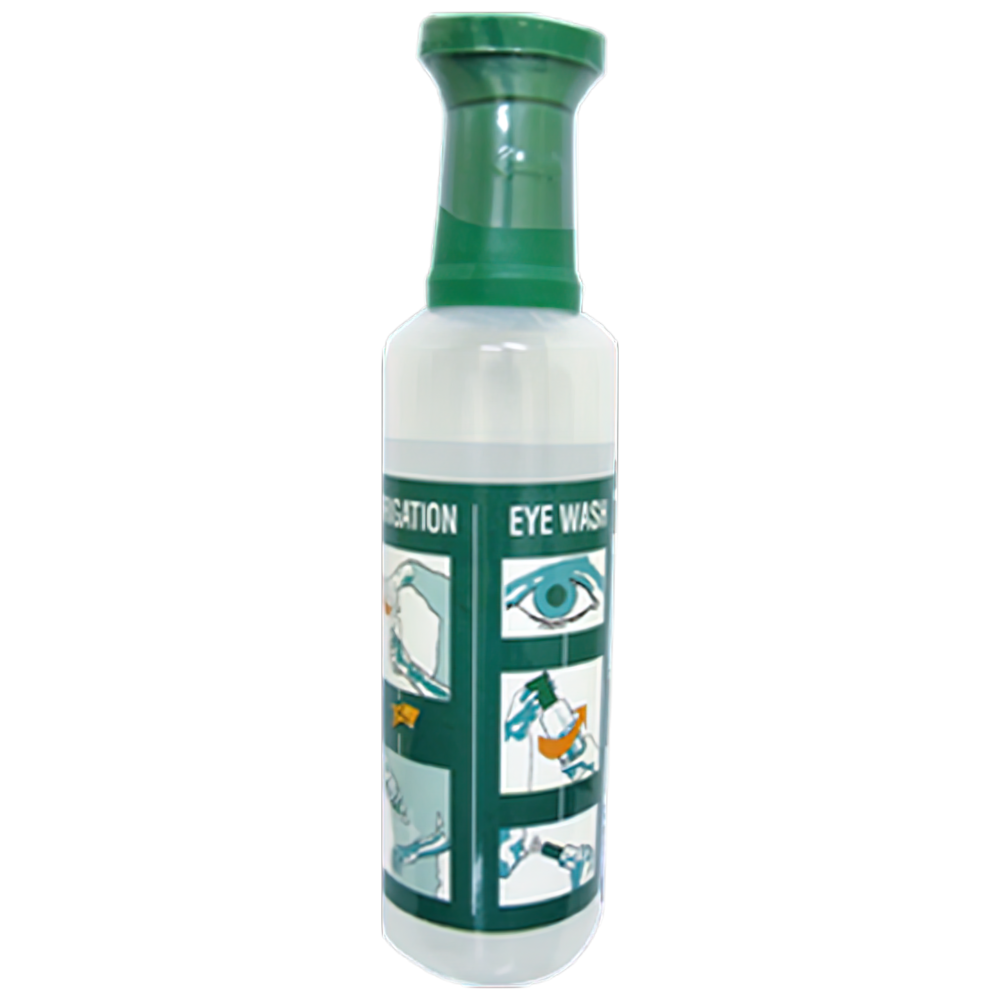
Drop bottles (single-use sterile saline)
Sealed bottles of sterile saline solution — the simplest, lowest-cost first response option. Suitable for: low-risk areas with occasional dust or particulate exposure, mobile workers, vehicles, first aid kits. Limitations: limited volume (250-500 mL doesn't reach 15-minute flushing requirement on its own), bottles must be in-date (2-3 year shelf life), single-use only. Best deployed as the FIRST response while moving the casualty to a higher-capacity unit.
Drop bottle stations (wall-mount, dual bottle)
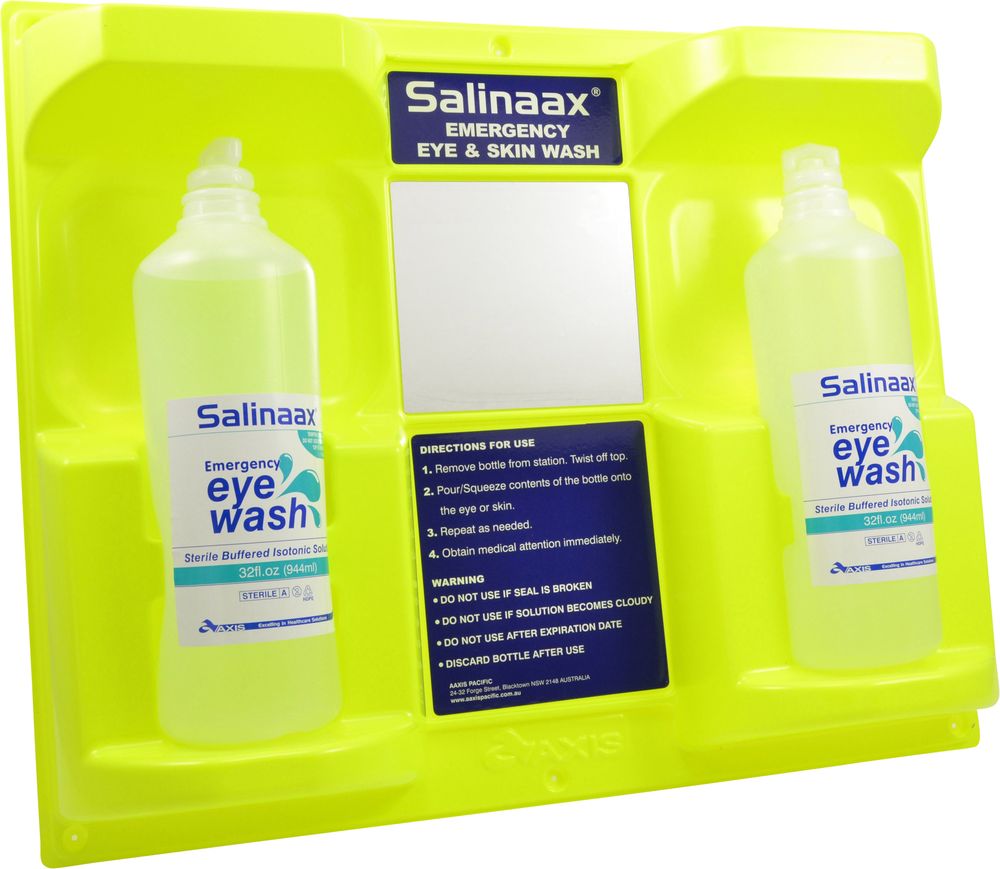
Wall-mounted holder with two 500 mL sterile saline bottles — provides enough volume for the initial 5-10 minutes of flushing. Good for medium-risk workplaces where plumbing is impractical. Bottles replace as a set. Signage and clear access path are still required by AS 4775.
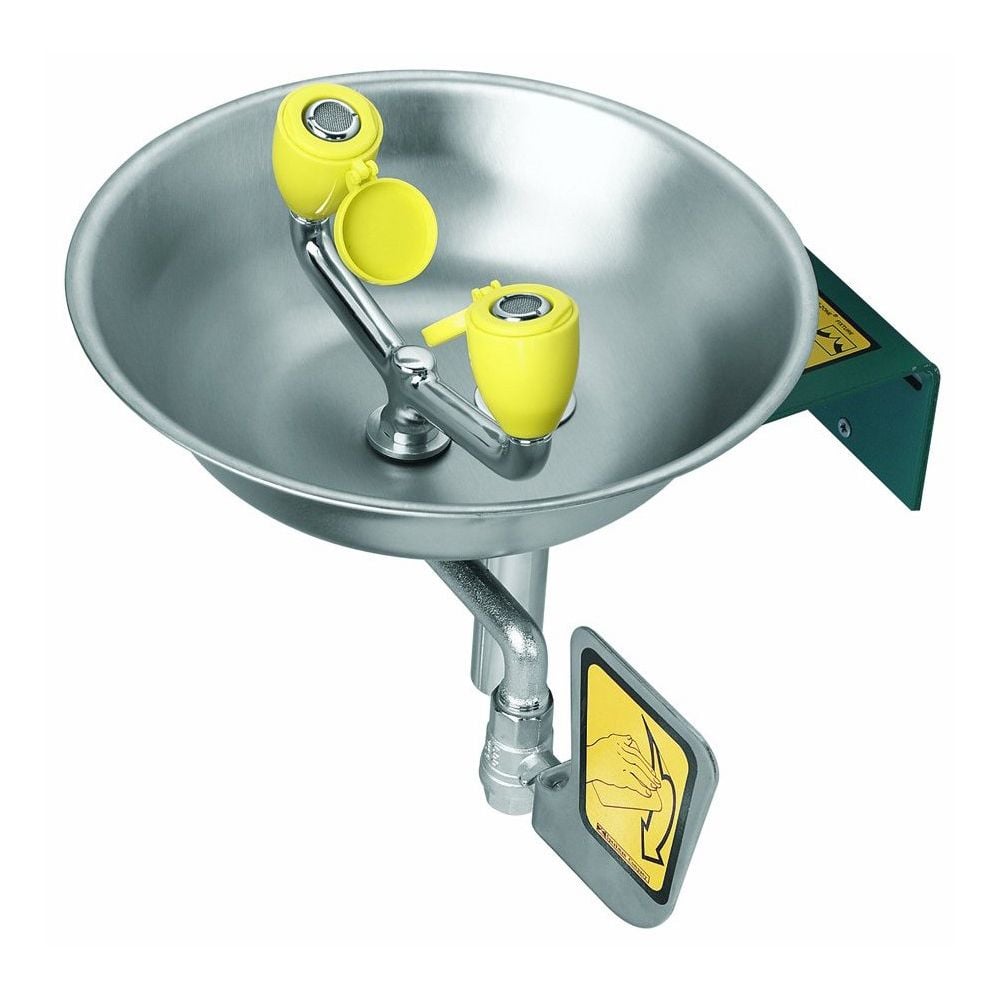
Wall-mount plumbed eyewash
Connected to building water supply via dedicated plumbing — provides unlimited flushing time and meets the 15-minute requirement in full. Hand-push flag or paddle activates the bowl-style eyewash. Bowl drains to floor or sink. Requires weekly activation and annual professional inspection.
Combination shower and eyewash (free-standing)
The full-body decontamination station — a vertical drench shower above an integrated eyewash, both activated by overhead pull rod (shower) or hand/foot pedal (eyewash). Required for: laboratories handling corrosives, chemical manufacturing, pool chemical stores, paint manufacturing. Floor drainage and dedicated water supply are needed. Annual flow-rate certification required.
Pressurised portable units
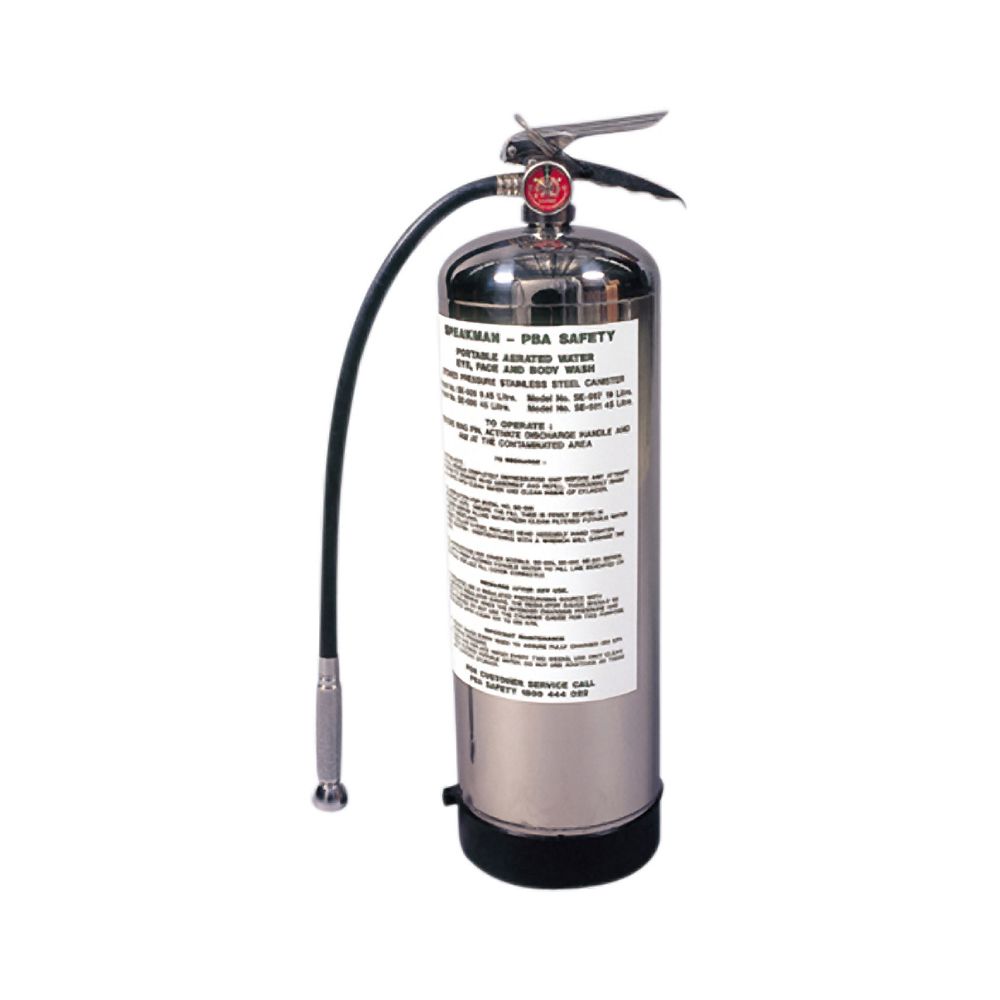
Self-contained 9-litre or 15-litre tanks pressurised by pump, providing portable AS 4775-equivalent flow for 15+ minutes. Suitable for: agricultural worksites, remote construction, marine operations, vehicles. Tank water must be replaced every 4-6 months (or per manufacturer) due to bacterial growth risk. Pre-flushed bacteriostatic preservative options extend service life.
Self-contained sealed cartridge units
Hybrid wall-mount stations with single-use sterile saline cartridges — combine the convenience of plumbed activation with the sterility of bottled saline. Cartridge swaps out after each use. Best for: clinical environments, medical clinics, dental practices where contamination control is paramount.
How to choose the right station for your workplace
Step 1: Map your eye hazards
Walk each work area with your WHS officer and list every: chemical used (consult SDS sheets), particulate source (welding, grinding, sanding), biological hazard, hot work zone, and any task with eye-impact potential. Mark each location on a site plan. Each marked area needs eyewash within 10 seconds walking time.
Step 2: Match station type to risk level
- Low risk (occasional dust, minor splash) — drop bottle station, wall-mounted near hazard
- Medium risk (regular chemical use) — plumbed wall-mount eyewash
- High risk (corrosives, full-body splash possible) — combination shower + eyewash
- Remote or vehicle-based — pressurised portable + drop bottle backup
Step 3: Plumbing and drainage check
Plumbed units need: cold water connection capable of 1.5 L/min flow (eyewash) or 75 L/min (shower), mixing valve if hot/cold supply available (target 16-38°C), floor drainage or sump drain (showers especially), backflow prevention valve to protect potable water supply, and isolation valves for maintenance.
Step 4: Signage and access
Every eyewash station needs an AS 1319 green-and-white eyewash sign mounted directly above or beside the unit, visible from 7+ metres in normal lighting. The path from any work area to the unit must be clear of obstructions, well-lit, no stairs, no doors that lock. Tape arrows on the floor in high-risk areas if path-finding could be confused.
Eye injury first aid — AS-compliant response
Step 1: Move to eyewash immediately
Don't waste time looking for the casualty's contact lens, washing your own hands, or finding a phone — get them under flowing water FIRST. Every second delay increases corneal scarring.
Step 2: Position correctly
Tilt the casualty's head over the eyewash so the affected eye is UPPERMOST. This prevents contaminated runoff washing into the unaffected eye. Hold their eyelids open with your fingers if they cannot keep them open themselves (the natural reflex is to clamp shut against the pain).
Step 3: Flush for 15-20 minutes minimum
Time the flush by the clock — not by feel. For alkali splashes (drain cleaner, lime, ammonia, cement), flush for 60 minutes if eyewash supply allows. The water should run through to the inner corner of the eye, then out the outer corner. Direct the stream INWARD (don't flush from outer to inner — this can wash debris across the eye).
Step 4: Remove contact lenses
If the casualty wears contacts and they have not already dislodged, gently slide the lens out AFTER several minutes of flushing. Continue flushing for the full 15-20 minutes after lens removal — chemicals trapped under the lens need additional decontamination.
Step 5: Call 000
For any chemical eye injury, call 000 and request paramedic transport to a hospital with an ophthalmology service. Tell the operator: which chemical, when exposed, duration of flushing so far, casualty's age, contact lens status. Continue flushing until paramedics arrive.
What NOT to do
- Do NOT use tap water with high pressure — can damage the cornea further
- Do NOT use eye drops, milk, vinegar, or 'antidote' substances — sterile saline or clean tepid water only
- Do NOT rub the eye, even if it feels gritty
- Do NOT patch or bandage the eye until paramedics assess
- Do NOT let the casualty drive themselves to hospital
Maintenance and audit schedule
Weekly activation testing
Every Monday morning, a designated worker activates each eyewash unit for 60 seconds. This: clears stagnant water from the supply lines, prevents bacterial buildup (Pseudomonas, Acanthamoeba), confirms the activation mechanism still works, and refreshes the bowl water. Record each test in the eye wash register with date, tester name, observations.
Monthly visual inspection
Check: signage is visible and clean, path is unobstructed, water clarity is good (no rust, no debris), spray pattern is even and covers both eyes, dust cover is in place when not in use, mixing valve temperature reading is within 16-38°C, and floor drainage is unblocked.
Annual professional inspection
Once per year, a competent person (plumber or WHS auditor) performs: flow rate measurement (calibrated meter), water temperature certification across full 15-minute flush, valve operation test, backflow prevention test, drain pipe inspection, and certification documentation for WHS audit file. Replace any worn components.
Portable unit refill schedule
Pressurised portable tanks need water replacement every 4-6 months. Drop bottles expire 2-3 years after manufacturing date. Stock spare bottles or cartridges to cover unexpected use. After ANY use, fully refill or replace consumables before the unit goes back into service.
Industry-specific eyewash recommendations
Laboratories and research
Combination shower-eyewash within 10 seconds of every fume hood, chemical storage cabinet, and benchtop work station. Drop bottle station as secondary. All units AS 4775 + ANSI Z358.1 dual-certified. Annual ophthalmologist audit recommended for high-risk labs.
Workshops and automotive
Plumbed wall-mount eyewash near battery storage, brake fluid bench, and degreaser station. Pressurised portable for mobile mechanics in vehicles or remote sites. Replace single-use bottles annually due to dust contamination in workshop environment.
Construction and demolition
Pressurised portable units at site sheds and at each work face. Drop bottle backup in every personal first aid kit. Eyewash signage in multiple languages if multilingual workforce.
Agriculture and rural
Pressurised portable units (15+ L) in shearing sheds, dairy parlours, pesticide stores, and chemical-mixing areas. Vehicle-mounted units for tractor and ATV operators. Annual replacement of saline due to temperature extremes.
Healthcare and clinical
Sealed cartridge wall units with single-use sterile cartridges — prevents cross-contamination between patient incidents. Located in: triage room, dressings room, sterile preparation, and morgue. Combination shower in chemical storage room.
Documentation for WHS audits
The eye wash register
A bound log book (or digital equivalent) kept at each station containing: weekly activation test results, monthly visual inspection records, annual certification documents, after-use refill log, any incidents and outcomes, and contractor inspection certificates. Auditors review this register first.
Risk assessment integration
Your WHS risk assessment must list every eye hazard, the eyewash unit covering that hazard, the distance and time from hazard to unit, and the residual risk after the eyewash is provided. Update annually or whenever new chemicals or processes are introduced.
Training records
All workers in eyewash-equipped areas must be trained on: identifying eye hazards, location of nearest eyewash, how to activate the unit, 15-20 minute flush rule, and emergency response. Training records (signed attendance, date, trainer) are required for WHS audits.
Frequently asked questions
Which Australian Standard covers workplace eyewash stations?
AS 4775-2007 'Emergency eyewash and shower equipment' is the Australian Standard. It specifies: minimum flow rate (1.5 L/min for eyewash, 75 L/min for combination shower), 15-minute continuous flushing capacity, water temperature 16-38°C, eyewash within 10 seconds (or 17 metres) of any chemical hazard, weekly activation testing, and annual inspection by a competent person. The standard aligns with US ANSI Z358.1 and ISO 16927 - most Australian eyewash units are dual-compliant.
Where must I install eyewash stations in my workplace?
AS 4775 requires eyewash within 10 seconds walking distance (or ~17 metres) from any area where chemical, biological, or particulate eye hazards exist. Common required locations: chemistry labs, photographic darkrooms, battery rooms, vehicle workshops, paint spray booths, hairdressing salons, swimming pool chemical stores, agricultural pesticide stores, food production cleaning areas, and any laboratory using corrosive substances. The path must be unobstructed, lit, and well-signed. Eyewash should NEVER be behind a locked door.
How long do you flush an eye after chemical exposure?
ANZCOR recommends 15-20 minutes minimum continuous flushing for any chemical splash to the eye, regardless of how 'mild' the chemical seems. For strong alkalis (drain cleaner, ammonia, lime, cement) or strong acids (battery acid, sulfuric, hydrochloric), flush for 60 minutes if available - alkalis penetrate the eye continuously and need extended decontamination. Always remove contact lenses BEFORE flushing if possible. Get the casualty to keep their eyes open under the stream. Call 000 for any chemical eye injury - permanent vision loss can occur.
What is the difference between a plumbed and portable eyewash station?
Plumbed stations connect to building water supply - they provide unlimited flushing time and are required for workplaces with frequent or high-volume chemical exposure (labs, manufacturing). Portable stations (sealed bottles, pressurised tanks) hold 15 minutes of flushing volume in single-use sterile saline, suitable for: mobile worksites, remote locations, vehicles, agriculture, areas where plumbing is impractical. AS 4775 permits BOTH if they meet flow and duration specs. Best practice for medium-risk sites: combine plumbed primary + portable secondary.
How often do you maintain an eyewash station?
AS 4775 requires WEEKLY activation testing - flush the unit for 60 seconds to clear stagnant water and prevent bacterial buildup. Log each activation in the eye wash register. ANNUAL inspection: full pressure test, replace mineral cartridges if fitted, check signage visibility, verify clearance around unit. Portable saline bottles have a 2-3 year shelf life - replace before expiry. Single-use sterile cartridge stations replace cartridges after EACH use. Always document maintenance for WHS audits.
Workplace Eyewash Stations
AS 4775-compliant eyewash units — drop bottles, wall-mount, free-standing combination showers and pressurised portable tanks for every workplace risk profile.
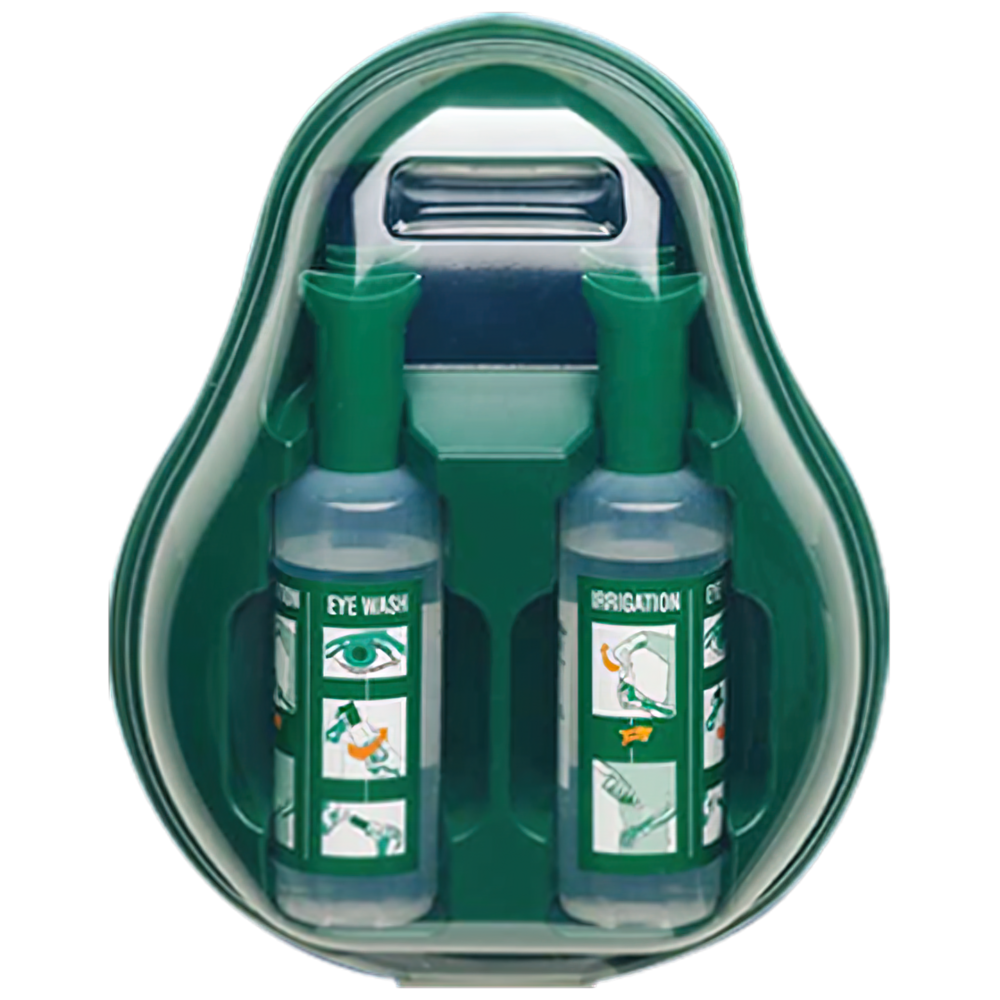
AEROWASH Drop Eyewash Station (2 x 500mL)
Twin 500mL bottle wall-mount station for medium-risk areas.
Shop Now
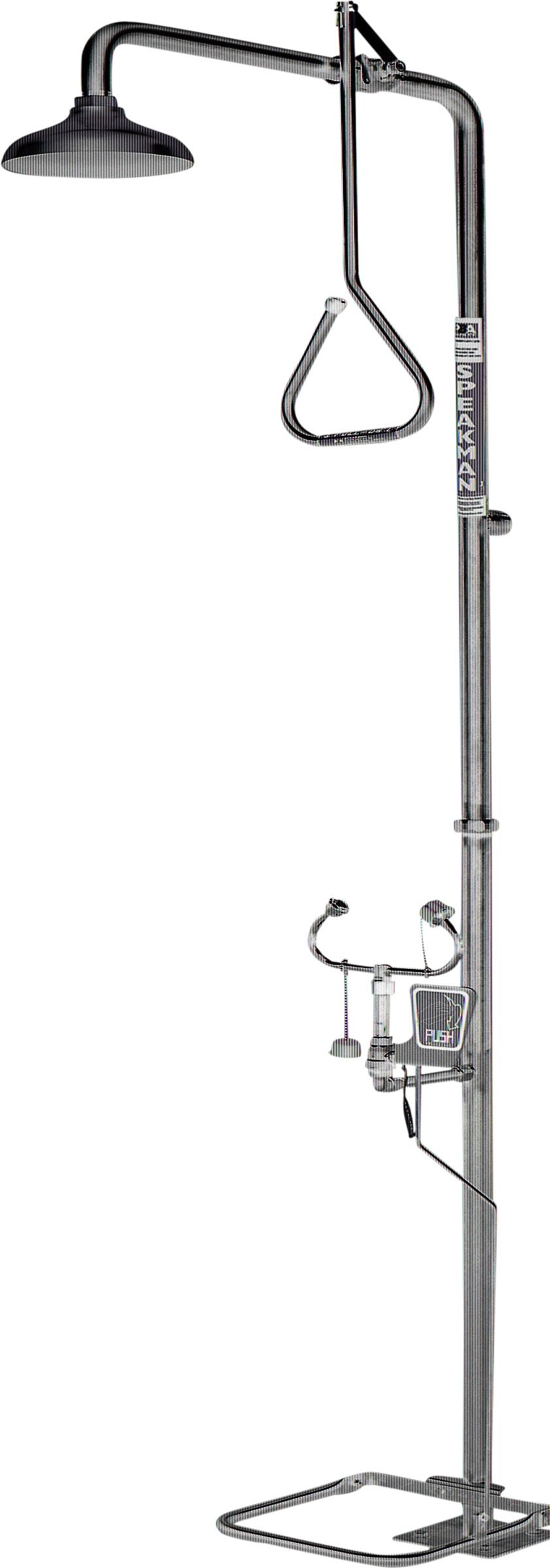
Combination Shower & Eye Wash (Free-Standing)
Plumbed shower + eyewash combo with hand and foot activation.
Shop Now
Sources: Safe Work Australia — First aid in the workplace, healthdirect.gov.au — Objects or chemicals in the eye, Australian and New Zealand Committee on Resuscitation (ANZCOR), Australian Red Cross.