


Quick answer
Triage is the process of sorting patients by how urgently they need care, so the most seriously ill or injured are treated first. Hospitals in Australia use the Australasian Triage Scale (categories 1–5); at mass casualty incidents, responders use colour-coded triage tags.
General information only. This page explains what triage is and how triage tags work. Formal triage is performed by trained emergency and healthcare personnel — it is not something bystanders are expected to do. In an emergency, call 000.
What does triage mean?
Triage means sorting patients by how urgently they need treatment. The word comes from the French trier, meaning to sort. When needs outstrip resources — a busy emergency department or a mass casualty incident — triage decides who is assessed and treated first.
You meet triage in two very different settings. In a hospital emergency department, the triage nurse who greets you assesses your condition and assigns an urgency category before you see a doctor. In the field — a multi-vehicle crash, a building collapse, a bushfire evacuation — paramedics and first responders triage many casualties at once, and they record each decision on a physical triage tag attached to the casualty. Both settings apply the same principle: clinical urgency, not order of arrival, decides who is seen first.
What are the triage categories and colours?
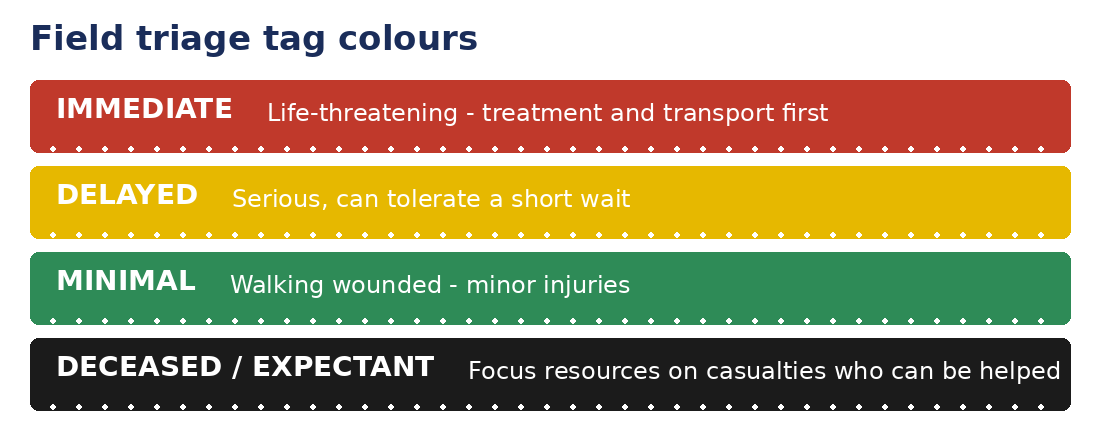
Most field triage systems use four colour-coded categories: red (immediate), yellow (delayed), green (minor or walking wounded) and black (deceased or expectant). Australian hospital emergency departments use a different scale, the Australasian Triage Scale, with five numbered categories.
| Category | Colour | Meaning | Typical example |
|---|---|---|---|
| Immediate | Red | Life-threatening injuries; needs treatment and transport first | Severe bleeding, obstructed airway, major chest injury |
| Delayed | Yellow | Serious injuries that can tolerate a short wait | Limb fractures, deep wounds with bleeding controlled |
| Minimal | Green | Walking wounded; minor injuries | Small cuts, sprains, minor burns |
| Deceased / expectant | Black | Not breathing after the airway is opened, or injuries incompatible with survival given available resources | Recorded so responders can focus on casualties who can be helped |
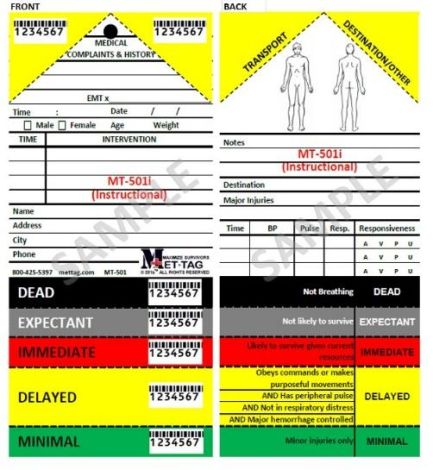
Some newer systems separate the black category into two. The SALT system uses five categories — dead, immediate, expectant, delayed and minimal — so an expectant casualty (unlikely to survive given the resources available) is distinguished from a deceased one. The METTAG MT-501 tag carries five colour tear-offs for exactly this reason.
What is the difference between hospital triage (ATS) and field triage?
Hospital triage in Australia uses the Australasian Triage Scale (ATS): a triage nurse assigns a category from 1 to 5 that sets the maximum time a patient should wait. Field triage at mass casualty incidents uses colour-coded systems such as START and SALT, recorded on physical triage tags.
The ATS, set out in Australasian College for Emergency Medicine (ACEM) policy and used across Australian and New Zealand emergency departments, has five categories with maximum waiting times: category 1 is seen immediately, category 2 within 10 minutes, category 3 within 30 minutes, category 4 within 60 minutes and category 5 within 120 minutes. It assumes a functioning hospital — one patient at a time, full records, monitored queues.
A mass casualty incident (MCI) is the opposite situation: many casualties, few responders, and no time for detailed assessment. Field systems like START (Simple Triage And Rapid Treatment) and SALT (Sort, Assess, Life-saving interventions, Treatment/Transport — the official expansion of the acronym) let a first responder categorise each casualty in seconds and move on. The triage tag is the paper trail: it travels with the casualty from the scene, through ambulance transport, to the receiving hospital — where ATS triage takes over.
| START | SALT | ATS | |
|---|---|---|---|
| Where it is used | Mass casualty incidents in the field | Mass casualty incidents in the field | Australian and New Zealand hospital emergency departments |
| Categories | Four colours: red, yellow, green, black | Five: dead, immediate, expectant, delayed, minimal | Five numbered categories (1–5) with maximum waiting times from immediate to 120 minutes |
| Who performs it | Paramedics and trained first responders | Paramedics and trained first responders (NHTSA-suggested guidelines, US) | Triage nurses and emergency department clinicians |
| Origin | Newport Beach Fire and Marine Department, 1983 | Developed under US national guidance with Gold Cross Ambulance | ACEM policy, national standard for EDs |
| Physical tag | Yes — e.g. METTAG MT-480 | Yes — e.g. METTAG MT-501 | No tag — recorded in hospital systems |
Shop METTAG triage tags What is DRSABCD?
What are triage tags?
A triage tag is a durable card attached to each casualty at a mass casualty incident. Tear-off colour strips record the person’s triage category, and sequential barcodes or serial numbers track casualties and their belongings from the scene through transport to hospital.
The tag exists because an MCI breaks the systems hospitals rely on. There is no admission desk in a paddock beside a highway. Radios drop out, phones are overloaded, and casualties are moved by different crews to different hospitals. A physical tag on an elastic band keeps the triage decision, the casualty number and any status changes with the person, readable at a glance by every crew that handles them — in rain, smoke or darkness. That is why emergency management plans for ambulance services, fire brigades, event medical teams, mines and industrial sites all specify triage tags in their MCI kits.
How METTAG triage tags work
METTAG is one of the longest-established triage tag systems in the world. It was developed in 1975 by Robert F. Blodgett, a TACDA official and Civil Defense Director of Jacksonville, Florida, and gifted to TACDA (The American Civil Defense Association) in 1976. TACDA remains the official manufacturer and copyright holder, describes METTAG as the standard since 1976, and reports millions of tags distributed worldwide to fire departments, EMS, the military and emergency operations centres.
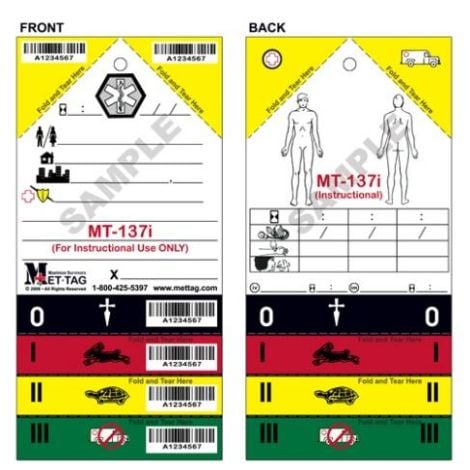
The original MT-137 global tag shows how the system works:
- Four-colour tear-off strips. The responder tears the tag down to the casualty’s category, leaving the colour visible at the bottom edge. If the casualty’s condition changes, the tag is torn again or replaced — the record moves with the person.
- Universal graphic symbols. Category symbols are pictorial, so the tag works across language barriers with minimal training.
- Sequential barcodes. Each tag carries unique barcodes for the casualty and their belongings, supporting casualty tracking and reconciliation after the incident.
- Damage-resistant construction. High-density synthetic material with thermal printing — waterproof, fire resistant, chemical resistant, tear-proof, and UV and heat resistant, per TACDA’s specifications.
- 30-inch elastic band to attach the tag to the casualty, and a US National Stock Number (NSN 8465013376792). Made in the USA.
The range then specialises by triage system and use:
- MT-501 (SALT): follows the SALT algorithm under NHTSA-suggested guidelines, developed with Gold Cross Ambulance, with five colour tear-offs — dead, immediate, expectant, delayed and minimal.
- MT-480 (START): follows START, developed by the Newport Beach Fire and Marine Department in 1983, with four-colour tear-offs on water and chemical-resistant stock. The line MediBC stocks is supplied without barcodes.
- CB-100 (chemical/biological): built for HAZMAT and CBRN incidents, with sequential barcodes and a triage status log that records category changes during an MCI. It works with START or the A–E triage system, and is supplied in packs of 25.
- MT-137i and MT-501i training tags: printed on recyclable card stock with non-functioning barcodes, at a lower cost than field tags — for CERT-style and in-house training exercises only, so teams can drill without consuming field stock.
Where can you buy triage tags in Australia?
MediBC is an authorised reseller of METTAG triage tags in Australia. The range covers the original disaster triage tag, MT-501 SALT and MT-480 START field tags, the CB-100 chemical and biological tag, and MT-137i and MT-501i training tags — in packs of 50 (25 for the CB-100).
Field tags suit ambulance and event medical services, fire and rescue, mines, ports and industrial emergency response teams; training tags suit anyone who runs MCI exercises and does not want to consume field stock. Prices and pack details are on each product page.


Triage tags are one part of an MCI and emergency preparedness kit — alongside a stocked first aid response and, for sudden cardiac arrest, an accessible defibrillator. See our defibrillator range and the AED cabinet and public access defibrillator guide.
Frequently asked questions
Why is triage called triage?
Triage comes from the French verb trier, meaning to sort. It entered medical use through battlefield medicine, where wounded soldiers were sorted by urgency, and now describes any system that prioritises patients by clinical need rather than order of arrival.
What is a METTAG?
METTAG is a triage tag system manufactured by TACDA (The American Civil Defense Association) since 1976. Each tag uses colour tear-off strips to record a casualty's triage category, plus graphic symbols and sequential barcodes for casualty tracking at mass casualty incidents.
What does a black triage tag mean?
Black is the deceased or expectant category. It records that a casualty is not breathing after the airway has been opened, or has injuries they are unlikely to survive given the resources available, so responders can direct care to casualties who can be helped.
What is the difference between START and SALT triage?
START (Simple Triage And Rapid Treatment, from 1983) uses four categories: red, yellow, green and black. SALT is a newer approach under US national guidelines that adds a fifth, expectant, category and includes a brief round of rapid interventions during sorting.
What are training triage tags?
Training tags such as the METTAG MT-137i and MT-501i are printed on recyclable card stock with non-functioning barcodes. They cost less than field tags and are for CERT-style and in-house mass casualty exercises only, so teams can train without consuming field stock.
Related emergency preparedness guides
See also what is DRSABCD — the first aid action plan, the chain of survival in sudden cardiac arrest, and the AED cabinet and public access defibrillator buying guide. Browse defibrillators for your site’s emergency response plan.
Sources
- Australian Government Department of Health — Emergency Triage Education Kit, Triage Quick Reference Guide: ATS Categories (Australasian Triage Scale categories 1–5 and maximum waiting times). https://www1.health.gov.au/internet/publications/publishing.nsf/Content/triageqrg~triageqrg-ATS
- Australasian College for Emergency Medicine (ACEM) — Policy on the Australasian Triage Scale (P06).
- TACDA (The American Civil Defense Association) — METTAG triage tags: history, tag specifications and range. https://tacda.org/mettag-triage-tags/
This guide is general information about triage systems and equipment, not medical advice. Formal triage is performed by trained emergency and healthcare personnel. In an emergency call 000.
