

Dextrose (Glucose) 5% Iv 1 Litre
Miscellaneous
€5.44
Secure checkout
VISA
Mastercard
Apple Pay
Google Pay
Also accepted
AMEX
Afterpay
Zip
Klarna
PayPal
In stock
Only 999 left
SKU
99511
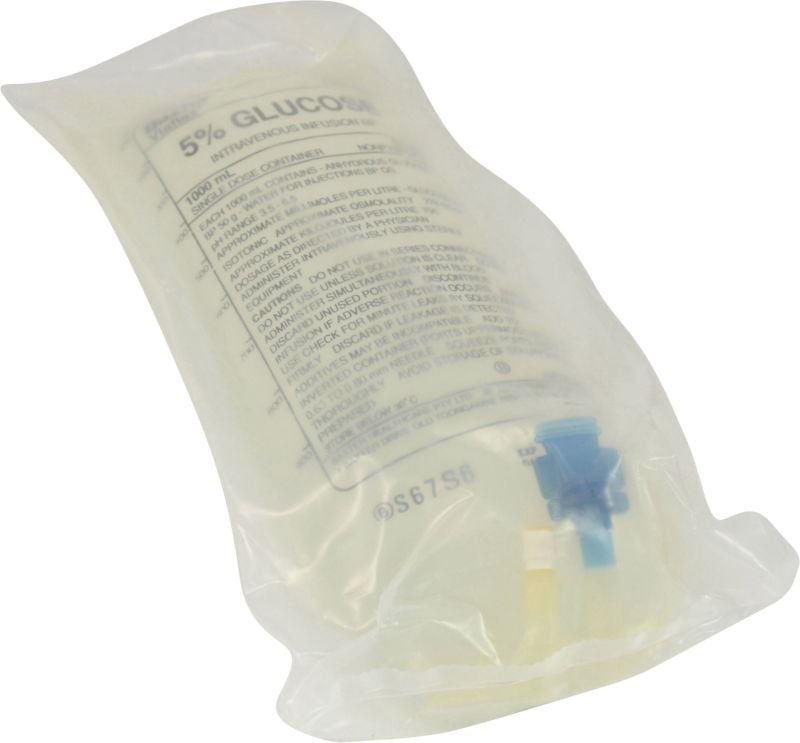
Dextrose 5% intravenous infusion in a 1 litre bag - 50 grams of glucose per litre in water for injection. It is a clinical supply item for use by trained healthcare professionals under prescription, stocked by clinics, day procedure units, aged care facilities and ambulance services. It is not a consumer product.
Why Dextrose 5% behaves differently to saline
The behaviour that matters clinically is what happens after it goes in. Dextrose 5% is approximately isotonic in the bag, so it does not haemolyse red cells on infusion - but the glucose is metabolised quickly, and what remains distributed through the body is effectively free water. That is why it is chosen when free water is the requirement, and why it behaves quite differently from sodium chloride 0.9%, which stays in the extracellular compartment.
It supplies a modest amount of energy alongside the fluid - 50g of glucose per litre - which is meaningful for a patient who is not eating but is nowhere near nutritional support. It is also widely used as a vehicle for compatible intravenous medicines, where the fluid is the delivery mechanism rather than the therapy.
Selection between dextrose and saline is a clinical decision, not a stock decision. Free-water replacement, sodium status, glucose tolerance and the compatibility of any drug being added all bear on it, and getting it wrong matters. Follow your local protocols and the product information rather than substituting one clear bag for another.
Key features
- Dextrose (glucose) 5% w/v intravenous infusion
- 50 grams of glucose per litre
- 1 litre bag
- Approximately isotonic in the bag
- Provides free water once the glucose is metabolised
- Commonly used as a vehicle for compatible IV medicines
- For administration by trained healthcare professionals
Specifications
| Product | Dextrose (glucose) 5% intravenous infusion |
| Volume | 1 litre |
| Glucose | 50g per litre (5% w/v) |
| Tonicity | Approximately isotonic in the bag |
| In the body | Effectively free water once glucose is metabolised |
| Route | Intravenous infusion only |
| Common uses | Fluid replacement, free water, vehicle for compatible IV medicines |
| Administration | By trained healthcare professionals, under prescription |
| Not for | Consumer or home use |
Common uses
This is clinical stock rather than a retail item. Clinics and day procedure units hold it for perioperative and procedural fluids; aged care and subacute facilities for maintenance fluids and free-water replacement; ambulance and retrieval services as part of a standard fluid load. It is also stocked simply as a diluent where compatible medicines are given by infusion. Order it alongside a standard IV giving set and Surflo IV cannulae, and see sodium chloride for irrigation for non-infusion saline. Part of our wider medical supplies range.
Dextrose 5% FAQs
What is Dextrose 5% used for clinically?
Fluid replacement and maintenance where free water is required, provision of a small amount of glucose as energy, and as a vehicle for compatible intravenous medicines. The specific indication in any patient is a clinical decision made against local protocols.
How is it different from normal saline?
Sodium chloride 0.9% stays largely in the extracellular compartment because of its sodium content. Dextrose 5% is roughly isotonic in the bag, but once the glucose is metabolised what remains distributes as free water throughout total body water. They are not interchangeable, and the choice depends on what the patient actually needs.
How much glucose does a litre contain?
Fifty grams, which is what 5% w/v means. That provides a small amount of energy - useful in a patient who is not eating, but nowhere near nutritional support, which requires dedicated parenteral nutrition.
Can it be used at home?
No. This is a prescription clinical product for intravenous administration by trained healthcare professionals. Intravenous fluids carry real risks - fluid overload, electrolyte disturbance, infection and air embolism among them - and are not suitable for self-administration.
Can medicines be added to the bag?
It is commonly used as a vehicle for compatible intravenous medicines, but compatibility must be checked for each drug before adding anything. Some medicines are incompatible with glucose solutions specifically. Consult the product information and your pharmacy department.
How should it be stored?
Follow the storage conditions on the product labelling. Inspect every bag before use - check the expiry date, confirm the solution is clear and free of particles, and check the bag and ports are intact. Discard any bag that fails inspection rather than using it.
For administration by trained healthcare professionals only, under prescription and in accordance with local clinical protocols. Not for consumer or home use. Always read the full product information, check compatibility before adding any medicine, and inspect each bag for clarity, particles, expiry and integrity before use. This information is a general guide and does not constitute clinical advice.
Frequently bought together