

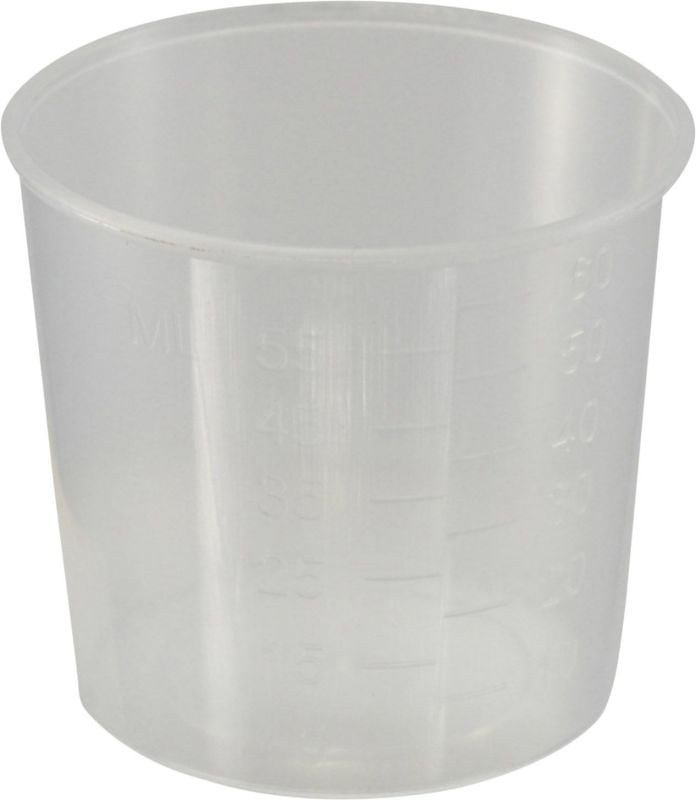
Medicine Measure Cup 5 - 60ml Disposable
Miscellaneous
€0.33
Secure checkout
VISA
Mastercard
Apple Pay
Google Pay
Also accepted
AMEX
Afterpay
Zip
Klarna
PayPal
In stock
Only 1000 left
SKU
9958
Disposable medicine cups graduated from 5mL to 60mL, for measuring and administering liquid medicines accurately. They are the standard measure in clinics, aged care and workplace first aid rooms, and they solve a problem most households do not realise they have.
Why medicine cups beat a kitchen spoon
A kitchen teaspoon is not a measure. Household spoons vary widely in capacity - a "teaspoon" from the drawer can hold anywhere from roughly 2.5mL to 7mL - so a dose measured that way can be half or nearly double what was intended. For a paracetamol syrup given to a child four times a day, that error compounds. Graduated medicine cups remove the guesswork entirely.
Being single use matters wherever more than one person is being dosed. A cup that is reused between residents, patients or family members carries whatever was in it last, both medicine residue and organisms. Disposables cost little and remove the question, which is why clinical settings use them as a matter of course rather than washing and reusing.
The 5 to 60mL graduation range covers essentially everything given by mouth as a liquid, from a 5mL paediatric dose to a 30mL antacid or a 15mL gargle. Clear moulded markings stay legible when the cup is full, and the wide base means it will sit on a bench without tipping.
Key features
- Graduated from 5mL to 60mL
- Clear, moulded graduations that stay readable when full
- Single use - no cross-contamination between people
- Suits paediatric doses through to antacids and gargles
- Stable wide base - sits on a bench without tipping
- Standard measure for clinics, aged care and first aid rooms
- Inexpensive enough to use once and discard
Specifications
| Product | Disposable medicine measure cup |
| Graduations | 5mL to 60mL |
| Material | Clear moulded plastic |
| Use | Single use, disposable |
| Typical doses | Paediatric syrups, antacids, mixtures, gargles |
| Settings | Clinics, aged care, workplace first aid, home |
| Related | Graduated 30mL pill cups for solid dose forms |
Common uses
Medicine cups earn their place anywhere liquid medicine is given to someone other than yourself. Aged care and nursing rounds, where several residents are dosed in sequence and reusing a cup is not an option. Workplace first aid rooms. Childcare and schools administering prescribed medicine. And at home, for any family giving syrups to children - which is the setting where kitchen spoons still do the most damage. For tablets and capsules rather than liquids, graduated 30mL pill cups are the companion item. Both sit with our everyday pharmacy and medical supplies in the wider medical supplies range.
medicine cups FAQs
Why not just use a kitchen teaspoon?
Because household spoons are not calibrated. Capacity varies from roughly 2.5mL to 7mL depending on the spoon, so a dose measured that way can be well under or well over what was intended. With a child's syrup given several times a day, that error repeats every dose.
What sizes can they measure?
They are graduated from 5mL to 60mL, which covers the great majority of oral liquid doses - a 5mL paediatric syrup at the low end, a 30mL antacid or 15mL gargle in the middle, and larger volumes up to 60mL.
Can they be washed and reused?
They are designed for single use. In any setting where more than one person is being dosed, reusing a cup risks carrying medicine residue and organisms from one person to the next, which is why clinical settings discard them. At home the calculation is more relaxed, but they are cheap enough that reuse is a false economy.
Are they suitable for measuring a child's medicine?
Yes for volumes of 5mL and above. For doses below 5mL, or for an infant, an oral syringe is more accurate and easier to administer - ask your pharmacist, who will usually supply one with the medicine.
Will the markings stay readable?
The graduations are moulded into the clear plastic rather than printed on, so they do not rub off and remain visible when the cup is full. Read the level at eye height on a flat surface rather than holding the cup up, which is where most measuring errors come from.
How many should I keep?
For a home medicine cabinet, a small quantity is plenty. For aged care, a clinic or a workplace first aid room, buy in bulk - the whole point is having enough that nobody is tempted to reuse one, and they take up very little space.
Always measure medicines exactly as directed on the label or by your pharmacist. This information is a general guide and does not replace advice from your doctor or pharmacist. For doses under 5mL, or for infants, an oral syringe is more accurate than a measuring cup.
Frequently bought together