


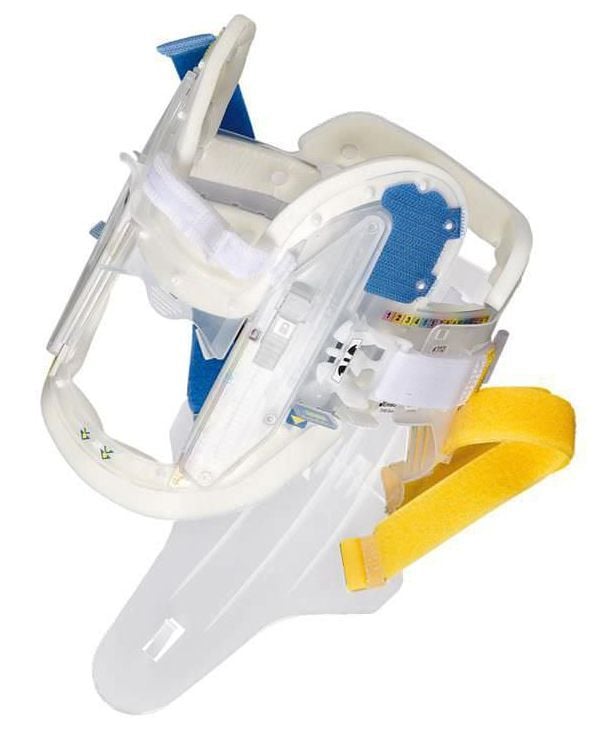
X Collar Cervical Splint
Other First Aid Supplies
€45.35
Secure checkout
VISA
Mastercard
Apple Pay
Google Pay
Also accepted
AMEX
Afterpay
Zip
Klarna
PayPal
Out of stock
SKU
400244
The X-Collar is a rigid cervical collar used to immobilise the cervical spine in emergency and trauma situations. By limiting neck movement it helps reduce the risk of secondary spinal-cord injury during extrication, transport and assessment of a trauma patient. It is designed to give strong stabilisation with straightforward field application.
Why choose a rigid cervical collar
The purpose of a cervical collar is narrow and specific: after a suspected spinal or head and neck injury, uncontrolled neck movement can convert an unstable fracture into a cord injury. The collar restricts that movement through the phases where it is most likely to happen - freeing a patient from a vehicle, moving them onto a stretcher, and the handling that assessment involves.
It is not used alone, and that is the most common misunderstanding. A collar restricts flexion and extension but does very little to stop rotation, so it is applied as part of cervical spinal immobilisation together with head blocks and straps - the combination often called triple immobilisation. The collar is one component of a system, not the system.
Field application is the design priority. A rigid collar that is slow or fiddly to fit gets applied badly, and a badly sized collar can hyperextend the neck or leave it unsupported - either of which defeats the purpose. This one is built for strong stabilisation with straightforward application in the conditions first responders actually work in.
Key features
- Rigid cervical collar for spinal immobilisation
- Restricts neck movement during extrication and transport
- Helps reduce the risk of secondary spinal-cord injury
- Designed for straightforward application in the field
- Used with head blocks and straps for full immobilisation
- For first responders, paramedics and rescue teams
Specifications
| Product | X-Collar Cervical Splint |
| Type | Rigid cervical (neck) collar |
| Purpose | Immobilise the cervical spine in trauma and emergency care |
| Used during | Extrication, transport and patient assessment |
| Use with | Head blocks and straps - "triple immobilisation" |
| Users | First responders, paramedics and ambulance services, workplace and event emergency teams, rescue and extrication teams |
| Application | By trained personnel, per local clinical protocol |
Common uses
Ambulance and first response, workplace and event medical teams, rescue and extrication units, and mine or remote-site emergency response. It is bought as part of an immobilisation set rather than on its own: an AERORESCUE spine board stretcher with straps and T-strap head restraint supply the rest of the system. Where an adjustable multi-size collar suits better, the Laerdal Adjustable Stifneck Collar is the alternative we stock. See our softpack, backpack and trauma kits.
cervical collar FAQs
What is a cervical collar used for?
To immobilise the neck and cervical spine after a suspected spinal or head and neck injury, reducing movement that could worsen the injury. It is used through extrication, transport and assessment - the phases where a patient is most likely to be moved.
Is a collar enough on its own?
No. A rigid collar limits flexion and extension but does relatively little to prevent rotation. It is applied with head blocks and straps as part of full cervical spinal immobilisation, and the patient is kept still throughout.
When should a cervical collar be applied?
When there is a mechanism of injury and clinical findings suggesting possible cervical spine injury, according to your service's protocol. Practice varies between services - some now use graded spinal motion restriction rather than routine collar application - so follow your own clinical guidelines rather than a general rule.
Does sizing matter?
Considerably. A collar that is too tall hyperextends the neck; too short and it provides no support. Both are worse than a well-applied manual hold. Size it as the manufacturer directs and maintain manual in-line stabilisation while it is being fitted.
Who should apply it?
Personnel trained in cervical spinal immobilisation, working within their scope of practice. Application involves maintaining in-line stabilisation, correct sizing and secure fastening - it is a trained skill, not an intuitive one.
Can it be reused?
Follow the manufacturer's instructions on reuse, cleaning and disinfection, and your facility's infection control policy. Inspect any collar before use and discard it if the shell, padding or fastenings are damaged or contaminated.
For use by appropriately trained personnel working within their scope of practice and local clinical guidelines. A cervical collar is one component of cervical spinal immobilisation and does not by itself prevent neck movement - use it with head blocks, straps and appropriate patient handling. Follow the manufacturer's sizing and application instructions. This information is a general guide and does not replace training, clinical judgement or your service's protocols. In an emergency, call 000.