


Resusci Anne Airways (24)
$299.47
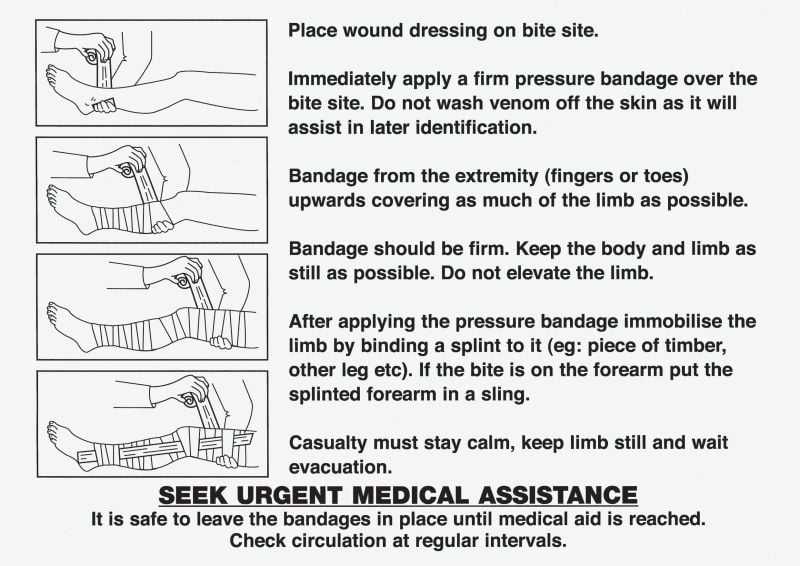
A printed Snake Bite First Aid Instructions card, 15 x 21cm, to keep with the bandage. The reason a card matters is simple: the person applying a pressure immobilisation bandage is frightened, possibly alone, and almost certainly has not practised recently. A card in the kit is the difference between remembering the sequence and improvising it.
Written Snake Bite First Aid Instructions stay in the kit and stay legible when a phone is flat, out of range or being used to talk to 000. In remote and bushland settings that is not a hypothetical — those are exactly the places snake bite happens and reception does not exist.
The card supports current guidance; it does not replace it. Where the card and the 000 call-taker differ, follow the call-taker. Current Australian Resuscitation Council guidance governs the technique itself.
Store it with the bandage rather than loose in the kit, so whoever grabs one gets both. Pair it with an AEROFORM snake bite bandage and read how to treat snake bites before you need either.
| Size | 15 x 21cm |
| Format | Printed instruction card |
| Role | Supports current ARC guidance, does not replace it |
| Keep with | The snake bite bandage |
| Pricing unit | Card |
| SKU | SBIC-1521 |
Remote-area, farm, bushwalking, mining and outdoor workplace first aid kits. Store with an AEROFORM snake bite bandage or a SURVIVAL SMART pressure immobilisation bandage. Read how to treat snake bites.
Call Triple Zero (000) immediately — a suspected Australian snake bite is a medical emergency. Keep the person still, calm and lying down where practical, because movement increases lymphatic flow. Do not wait for symptoms and do not delay the call to find a bandage or identify the snake. Follow the instructions the 000 call-taker gives you; they take priority over anything on this page.
PIT is a first aid technique that retards the flow of lymph, which is a route by which some venoms reach the circulation. It does not stop, neutralise or remove venom. It is used in accordance with current Australian Resuscitation Council guidance for suspected Australian snake bites including sea snakes, funnel-web spider bites, blue-ringed octopus bites and cone shell stings.
Do not apply a tourniquet. Do not wash, scrub or wipe the bite site — residual venom can help medical staff identify what caused it. Do not cut, incise, burn or suck the site. Do not use ice, heat or electric shock. Do not try to catch or kill the animal. Do not let the person walk around. And once a PIT bandage is applied, do not remove it unless emergency services or a clinician tell you to.
No, and this matters. PIT is not the routine first aid response for redback spider bites, bee, wasp or ant stings, tick bites or most jellyfish stings — those have different pathways. For other bites and stings follow current ARC guidance and seek medical advice.
Correct application takes practice, and a tension indicator is a visual aid rather than a guarantee. Getting bandage tension right is genuinely the hardest part. Learn the technique before you need it, keep a snake bite instruction card with the bandage, and in the moment follow the 000 call-taker. Read our guide on how to treat snake bites.
You must not rely on the information on this site as an alternative to medical advice from your medical physician or other qualified healthcare provider. Consult your healthcare provider immediately if you think that you may have a medical emergency or for the diagnosis and treatment of injuries. Always seek the advice of your physician or other qualified healthcare provider before starting any new treatment or with any questions that you may have regarding a medical condition or injury.
| Brand | Alpha First Aid |
|---|