

Nasopharyngeal Airway Single
Oxygen & Resuscitation Equipment
£17.85
Secure checkout
VISA
Mastercard
Apple Pay
Google Pay
Also accepted
AMEX
Afterpay
Zip
Klarna
PayPal
In stock
Only 999 left
SKU
WEB-NA
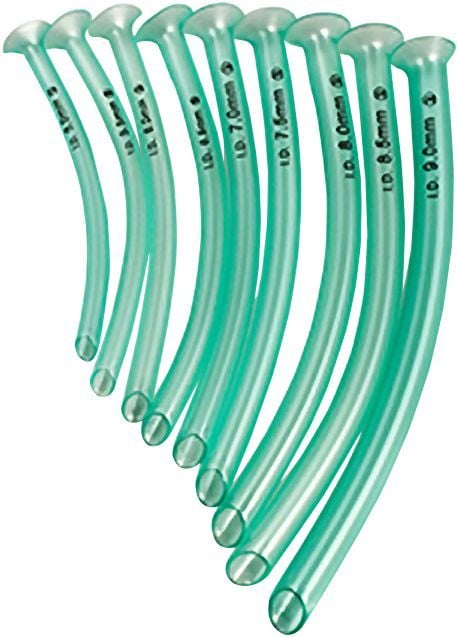
A nasopharyngeal airway is a flexible airway adjunct inserted through the nostril to help maintain an open upper airway. It is frequently better tolerated than an oropharyngeal airway in a semi-conscious patient, because it does not press on the back of the tongue in the same way. Sold as a single unit, available across a full size range from 14fg to 36fg.
Why choose a nasopharyngeal airway
The clinical case for a nasopharyngeal airway is the patient in between - not deeply unconscious, not fully alert. An oropharyngeal airway in someone with an intact gag reflex provokes gagging, retching and often vomiting, which is exactly what you do not want near an unprotected airway. A soft nasal tube is usually accepted where a Guedel is not, which is why both belong in a well-stocked airway roll.
Sizing is done by measurement, not by guessing from age. Measure from the tip of the nose to the tragus of the ear to get the length, then choose a diameter that passes gently through the nostril without force. Too short and it will not sit past the tongue base; too long and it can stimulate the larynx. The French gauge refers to external diameter - 14fg is 3mm and 36fg is 9mm, with the sizes between at half-millimetre steps.
It should be lubricated and inserted along the floor of the nasal cavity, directed straight back perpendicular to the face rather than angled upward. It is an airway adjunct: it helps keep the upper airway patent, but it does not protect against aspiration and it does not replace correct head positioning, jaw thrust, suction or ventilation.
Key features
- Flexible design - inserted via the nostril
- Often better tolerated than an oropharyngeal airway in semi-conscious patients
- Full size range from 14fg (3mm) to 36fg (9mm)
- Sold as a single airway
- Sized by measurement from nose tip to ear tragus
- For use by trained personnel
Specifications
| Product | Nasopharyngeal Airway (NPA), single |
| 14fg | 3mm |
| 18fg | 4mm |
| 24fg | 6mm |
| 26fg | 6.5mm |
| 28fg | 7mm |
| 30fg | 7.5mm |
| 32fg | 8mm |
| 34fg | 8.5mm |
| 36fg | 9mm |
| Insertion | Via nostril, lubricated, along the floor of the nasal cavity |
Common uses
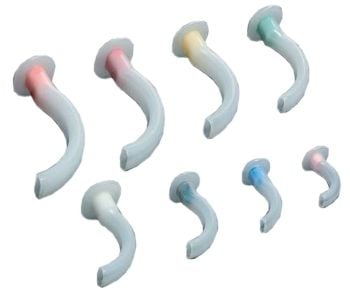
It is carried by ambulance and retrieval services, emergency departments, theatre and recovery, industrial and remote-site medics, and anyone maintaining an airway roll to a defined standard. Most kits carry both types, because the choice depends on the patient in front of you: the Guedel airway is the oropharyngeal alternative for the patient without a gag reflex. Where ventilation is also needed, a bag valve mask resuscitator is the companion item. See the full range of oxygen and resuscitation equipment.
nasopharyngeal airway FAQs
What is a nasopharyngeal airway used for?
Helping maintain an open upper airway. It is a soft tube passed through a nostril to sit behind the tongue, holding the airway patent in a patient whose own tone is not doing it. It is an adjunct used alongside positioning, suction and ventilation, not instead of them.
How do you size a nasopharyngeal airway?
Measure from the tip of the nose to the tragus of the ear and pick the closest length. Choose the diameter by the size of the nostril and by clinical assessment - a tube that passes gently without force - rather than by the patient's age alone.
What do the fg sizes mean?
French gauge describes the external diameter. In this range 14fg is 3mm, 18fg 4mm, 24fg 6mm, 26fg 6.5mm, 28fg 7mm, 30fg 7.5mm, 32fg 8mm, 34fg 8.5mm and 36fg 9mm - so the sizes step in half-millimetres through the adult range.
Why choose it over an oropharyngeal airway?
Because it is usually better tolerated by a semi-conscious patient who still has a gag reflex. An oropharyngeal airway in that patient tends to cause gagging and vomiting. Most services carry both and select based on the patient's conscious level.
How is it inserted?
Lubricate it, then insert it along the floor of the nasal cavity - directed straight back, perpendicular to the face, not angled upward towards the bridge of the nose. It should pass without force. If resistance is met, do not push; try the other nostril or a smaller size.
When should an NPA be avoided?
Care is needed where there is suspected base-of-skull fracture or significant mid-face trauma, and where there is a bleeding disorder or heavy anticoagulation, given the risk of nasal bleeding. This is equipment for trained personnel working to their scope of practice and local clinical guidelines.
For use by appropriately trained personnel working within their scope of practice and local clinical guidelines. An NPA is an airway adjunct - it does not protect against aspiration and does not replace airway positioning, suction, ventilation or definitive airway management. Do not force insertion, and exercise caution where base-of-skull fracture, mid-face trauma or a bleeding tendency is suspected. In an emergency, call 000 (or your local emergency number).
Frequently bought together