

Air Splint - Half Arm
$40.30
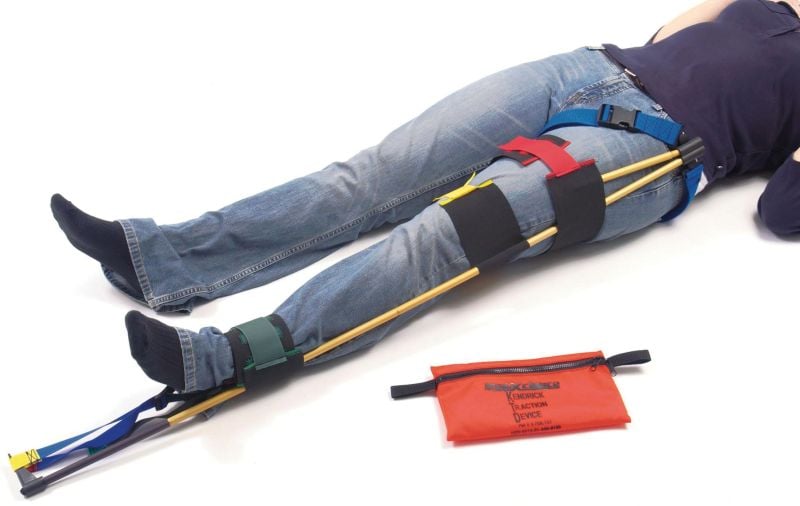
The Kendrick Traction Device (KTD) is a compact, lightweight traction splint for the mid-shaft femur, well suited to remote area operations and outdoor activities. The traction pole adjusts quickly for adult or paediatric application, application does not require rolling the patient or unnecessary leg raising, and there is no ischial bar - which removes a common source of pressure problems. Supplied in a compact pouch with instructions.
Weight and bulk are what usually keep a traction splint out of a pack, and this is where the KTD earns its place: 567g, stored at 24cm long by 9cm wide. A traditional traction splint is a long rigid frame that realistically stays on the truck. This one goes in a rescue pack, which means it is present at the remote job, the trail, the mine site and the surf club - the settings where a femur fracture is furthest from definitive care and traction matters most.
The application method suits difficult patients. Because it needs no patient roll-over and no unnecessary leg raising, it can be applied where movement is limited or where spinal precautions are in place, and with less of the pain that repositioning a fractured femur causes. Fewer movements also means a faster application by a smaller team.
Removing the ischial bar addresses a genuine problem. On splints that use one, the bar concentrates load in the groin, and on a long extrication or transport that is where pressure injuries and nerve compression develop. The KTD applies traction without it, which matters most on exactly the long remote transports this device is designed for.
| Product | Kendrick Traction Device (KTD) |
| Type | Traction splint, mid-shaft femur |
| Sizing | Adjustable traction pole - adult or paediatric |
| Stored dimensions | 24cm long x 9cm wide |
| Weight | 567g |
| Ischial bar | None |
| Supplied in | Compact storage pouch with instructions |
| Use by | Trained personnel, within scope of practice |
Ambulance and retrieval services, mine site and remote-area medics, ski patrol, surf life saving, expedition and outdoor education teams, and rescue units that carry rather than drive their equipment. It sits alongside the rest of an immobilisation load-out: full leg air splints for lower-limb injuries where traction is not indicated, and an AERORESCUE spine board stretcher with straps for extrication. See our farming, mining and remote area first aid kits for the wider remote-response range.
It applies steady longitudinal pull to a fractured mid-shaft femur. That realigns the limb, reduces the powerful thigh muscle spasm that shortens and overrides the fracture, and in doing so reduces pain and further bleeding into the thigh - a femur fracture can lose a significant volume of blood.
Yes. The traction pole length adjusts quickly for adult or paediatric application, so one device covers both rather than requiring a separate paediatric splint - a real advantage when pack space is limited.
An ischial bar concentrates pressure in the groin. Over a long extrication or transport that can cause pressure injury and nerve compression. The KTD applies traction without one, which is most valuable on exactly the extended remote transports it is designed for.
567g, and 24cm long by 9cm wide in its pouch. That is small enough to carry in a rescue pack rather than leave in a vehicle, which is the practical difference between having a traction splint at the patient and having one back at the road.
Traction splinting is for isolated mid-shaft femur fractures. It is generally not used where there is a suspected pelvic fracture, hip dislocation, knee injury, fracture of the lower leg or ankle, or a partial amputation of the limb. Follow your service's clinical guidelines.
Personnel trained in its use, working within their scope of practice. Instructions are supplied with the device, but a femur fracture in the field is not the moment to read them for the first time - practise application as part of regular skills maintenance.
For use by appropriately trained personnel working within their scope of practice and local clinical guidelines. Traction splinting is indicated for isolated mid-shaft femur fracture and is not appropriate for all lower limb injuries - assess for pelvic, hip, knee, lower leg and ankle injury before application. This information is a general guide only and does not replace training, clinical judgement or your service's protocols. In an emergency, call 000.
| Brand | Kendrick |
|---|