


Reviewed by the Medibc First Aid Team — last updated May 2026.
Every Australian workplace, from a 5-person accounting office to a 500-worker construction site, is legally required to provide first aid — and the workplace first aid cabinet is the centrepiece. The Safe Work Australia Model Code of Practice sets out exactly what employers must provide, but the right cabinet for YOUR workplace depends on workforce size, hazard rating, and physical layout.
This guide walks through the legal requirements, how to size and locate cabinets, what to stock, what signage you need, and the maintenance routine that keeps your workplace WHS-compliant year-round.
Why workplace first aid cabinets matter
Legal duty under Australian WHS
Under each state's Work Health and Safety Act, employers must provide first aid equipment that is "adequate, accessible, and ready to use for the size and nature of the workplace". The Safe Work Australia model Code of Practice "First Aid in the Workplace" is the national reference document used by every state regulator. Failure to comply is a Category 2 offence with fines up to $300,000 for businesses and $60,000 for individuals.
The case for cabinets over loose kits
While portable kits suit small teams and mobile workers, fixed workplaces benefit from cabinets because they: stay in a known accessible location, can be supplemented with eye wash and burns kits in adjacent compartments, lock against tampering and theft, scale up as the business grows, and visibly demonstrate workplace safety commitment to staff and clients.
What a cabinet contains
A workplace first aid cabinet is more than a box of bandages. Beyond consumables, it typically includes: triangular bandages, eye wash, instant cold packs, scissors, tweezers, gloves and aprons, CPR face shields, blanket, sharps disposal container, and laminated quick-reference action posters. Browse our full first aid supplies range for cabinet stocking.
Sizing your cabinet by workforce
Low-risk workplaces (offices, retail, hospitality)
Up to 25 workers in a single location: one small cabinet (around 25 x 31 x 12 cm) is sufficient. Stock with workplace-grade bandages, plasters, eye wash sachets, gloves, and one A3 emergency poster. Locate at the reception or staff kitchen.
Medium workplaces (25-100 workers)
A medium cabinet (32 x 50 x 16 cm) accommodates a fuller restock and burns/eye injury supplies. Office workplaces of this size also benefit from a portable kit at each floor or zone so first aiders can carry supplies to the casualty rather than bring the casualty to the cabinet.
High-risk workplaces (manufacturing, construction, remote)
Construction sites, factories, agriculture, mining, marine, and remote workplaces need a large cabinet (41 x 61 x 18 cm) plus dedicated portable trauma kits at each major work area. Workplaces over 100 workers usually have a designated first aid room with at least one cabinet, a clinical waste bin, an emergency phone, an examination couch, and a wash basin.
Multi-site campuses
Each accessible zone (building, floor, separate worksite) needs its own cabinet — you cannot rely on a single central cabinet if it takes more than 5 minutes to reach. Site plans should mark every cabinet with a green-and-white first aid symbol.
Cabinet types — metal vs plastic, locked vs open
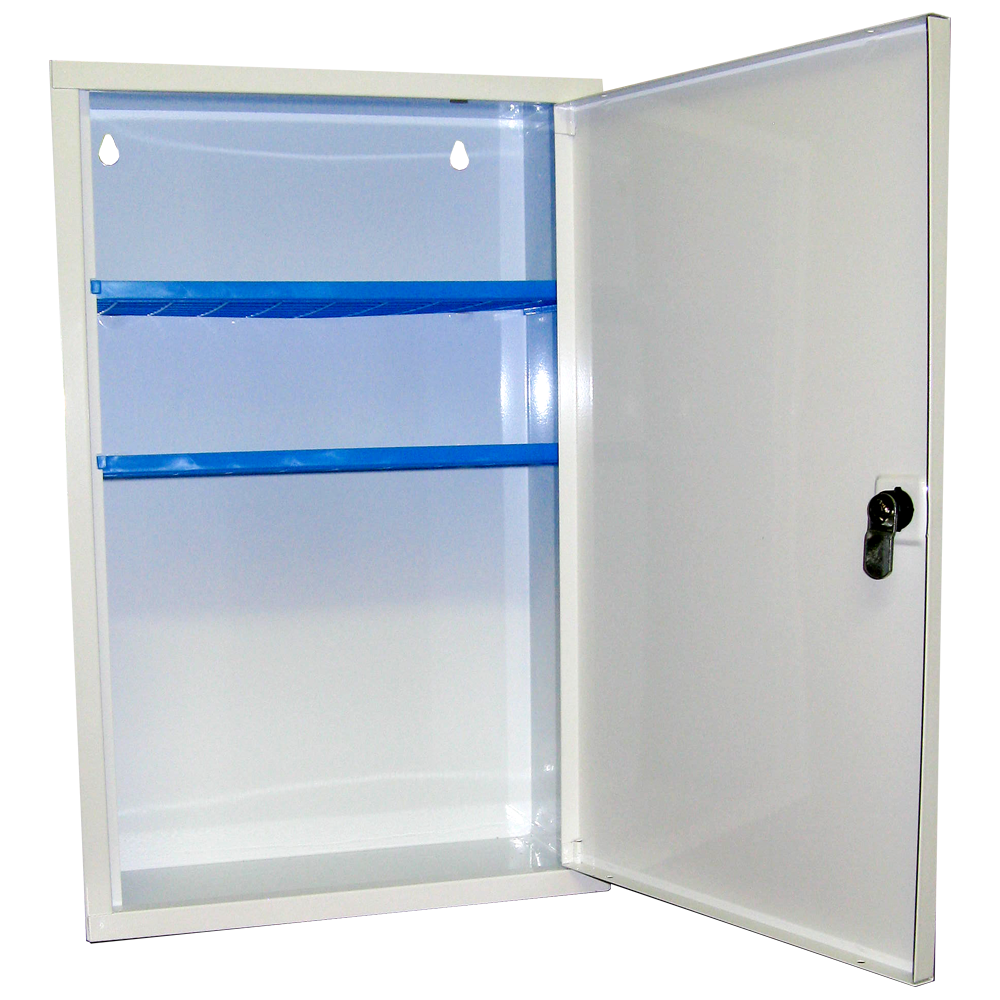
Metal cabinets
Steel powder-coated cabinets like the AEROCASE range are the most robust option, suited to: workshops, factories, warehouses, construction sites, schools, and outdoor work areas. They survive impact, dust, and heavy daily use, and are typically wall-mounted via the rear-panel screws. Allow 1-2 cm clearance behind for cable routing.
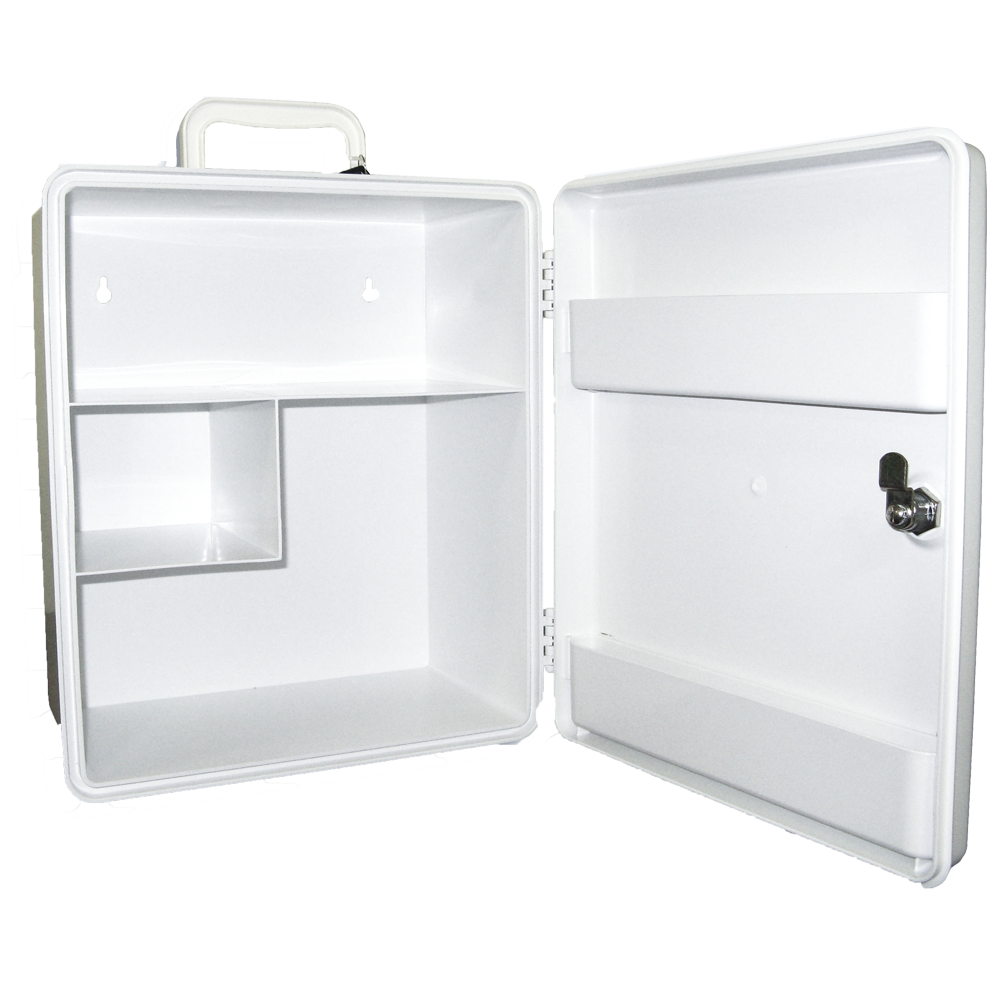
Plastic cabinets with key latch
White ABS or polypropylene plastic cabinets suit clinical environments: GP clinics, dental surgeries, kitchens, food-handling areas, and aged care. They wipe down easily, do not corrode in humid environments, and the lockable variant prevents tampering with Schedule 2 medications. The key is kept by the first aid officer or duty manager.
Lockable vs open-access
The trade-off is access vs accountability. Lockable cabinets prevent theft of paracetamol, ibuprofen, glucose gel, and bandages, but require a key-holder to be available. Open-access cabinets allow any worker to grab supplies in seconds, but rely on a sign-out sheet for accountability. Most workplaces use a HYBRID approach: keep the cabinet open during shifts, locked overnight.
Wall-mount vs benchtop
Wall-mount is the workplace standard — it keeps the cabinet at consistent eye level, frees bench space, and prevents the cabinet being moved. Drill into a structural wall stud or use heavy-duty wall anchors (never plasterboard alone). Benchtop cabinets suit GP clinics, mobile clinics, and rooms where the cabinet may need to relocate.
Where to install — placement rules
Accessibility
The Safe Work model Code requires cabinets to be reachable within 1-2 minutes from any work area. For most office workplaces this means one cabinet per floor, near the lift lobby or reception. For factories and warehouses, install one cabinet per work zone.
Visible signage
Mount the cabinet at adult shoulder height (1.4-1.6 metres to the cabinet centre) so it is visible. Place a green-and-white AS 1319-compliant first aid sign directly above or to the side — visible from at least 7 metres in normal lighting. The sign must NOT be obscured by furniture, posters, or plants.
Lighting and access path
The cabinet area needs adequate lighting (minimum 200 lux) for treating injuries on the spot. The path from any work area to the cabinet should be clear of trip hazards, locked doors, or steep stairs. Lifts must not be the only access route — emergency stairs must work too.
Stocking your workplace cabinet
The model Code of Practice provides a guideline list. Adjust based on your WHS risk assessment.
Essential consumables (every cabinet)
- Adhesive plasters — assorted sizes, 100 minimum
- Conforming bandages — 5cm, 7.5cm, 10cm widths
- Triangular bandages — for slings and splint securing
- Non-adherent dressings — 10 x 10 cm, 10 x 20 cm
- Combine dressings — for major wounds
- Saline eye wash sachets — 15 mL ampoules, 10 minimum
- Instant ice packs — single-use cold compresses
- Gauze swabs — sterile, individually wrapped
- Latex-free nitrile gloves — multiple sizes
- CPR face shield with one-way valve
- Stainless steel scissors and splinter forceps
- Adhesive tape — 25 mm and 50 mm rolls
Hazard-specific additions
If your WHS risk assessment identifies specific hazards, add:
- Workshops with hot work — burns gel sachets, burns dressings, hydrogel cooling pads
- Chemical or food handling — 500 mL eye wash bottle plus wall bracket
- Construction / sharp tools — trauma dressing, haemostatic gauze, tourniquet
- Outdoor / remote work — snake bite pressure bandages, splints, emergency blanket, sunscreen
- Food service kitchens — blue detectable plasters, burns kit
Documentation in the cabinet
Inside the cabinet door, attach: a contents checklist with quarterly tick-box audit columns, the contact card for the workplace first aid officer, an injury register or notebook with pen, an A4 incident report template, and a laminated "How to use this cabinet" instruction sheet.
Signage and posters — what AS 1319 requires
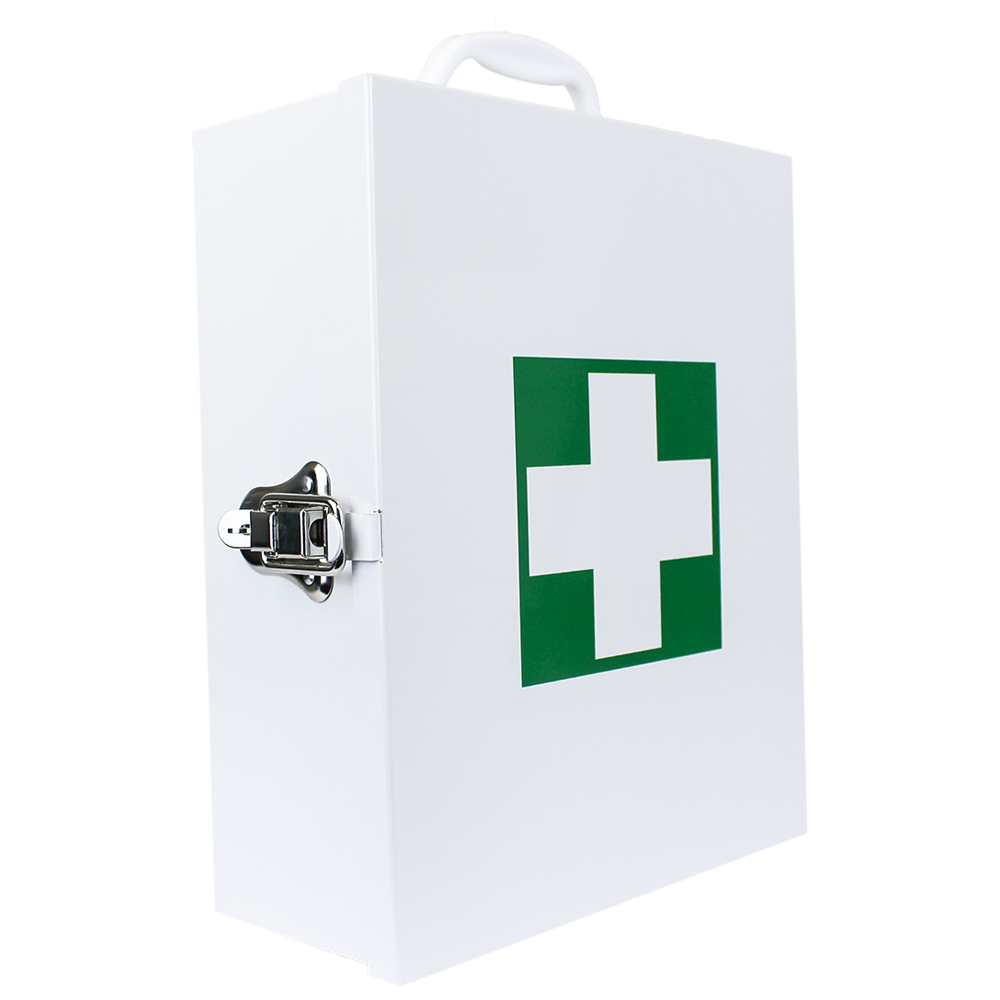
The green-and-white first aid sign
Mandatory at every cabinet location. White cross on green background. Minimum dimensions: 200 x 200 mm for indoor walls, 300 x 300 mm for warehouses and large workplaces. Letters under the cross spelling "FIRST AID" should be at least 25 mm high.
Emergency response posters
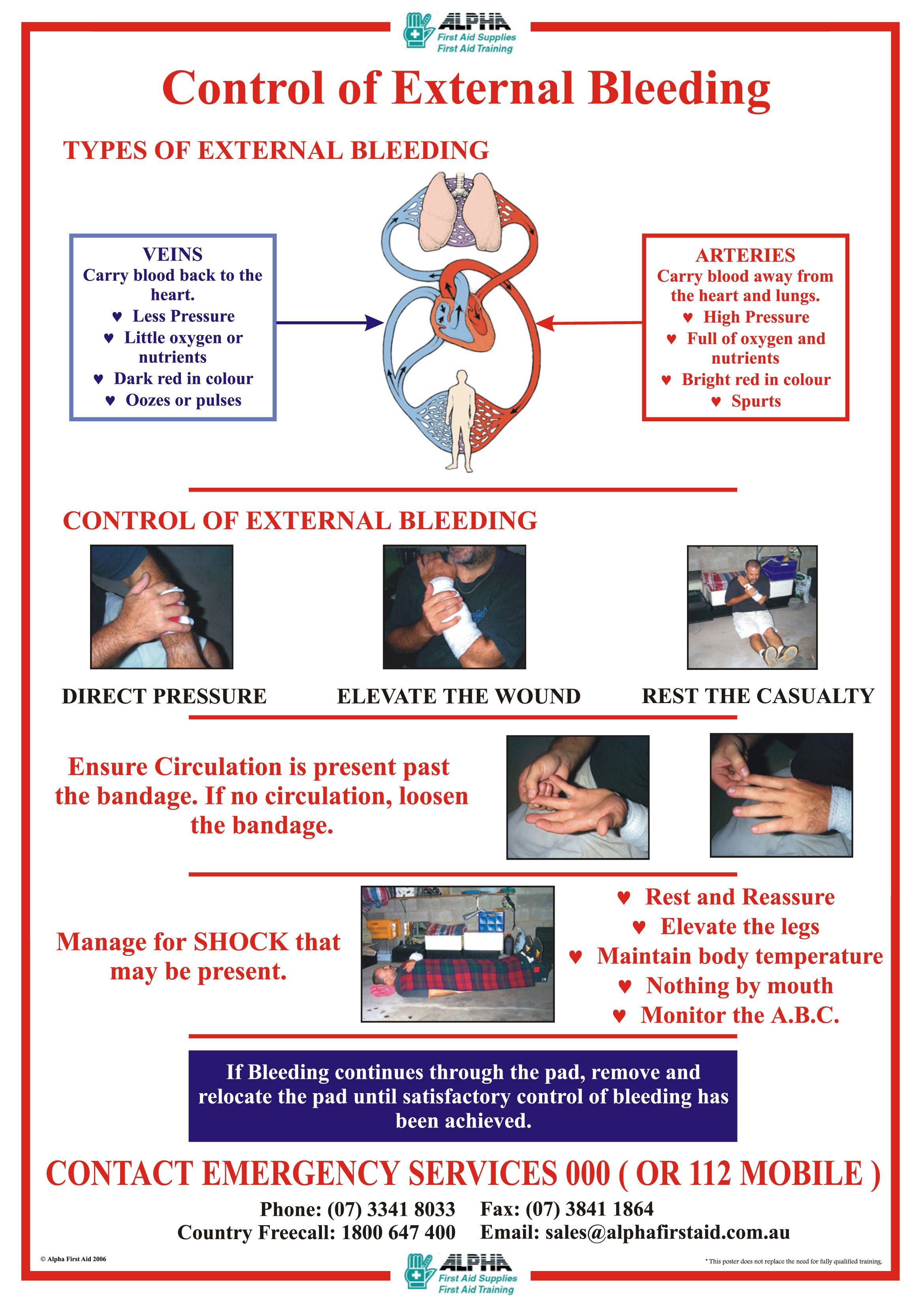
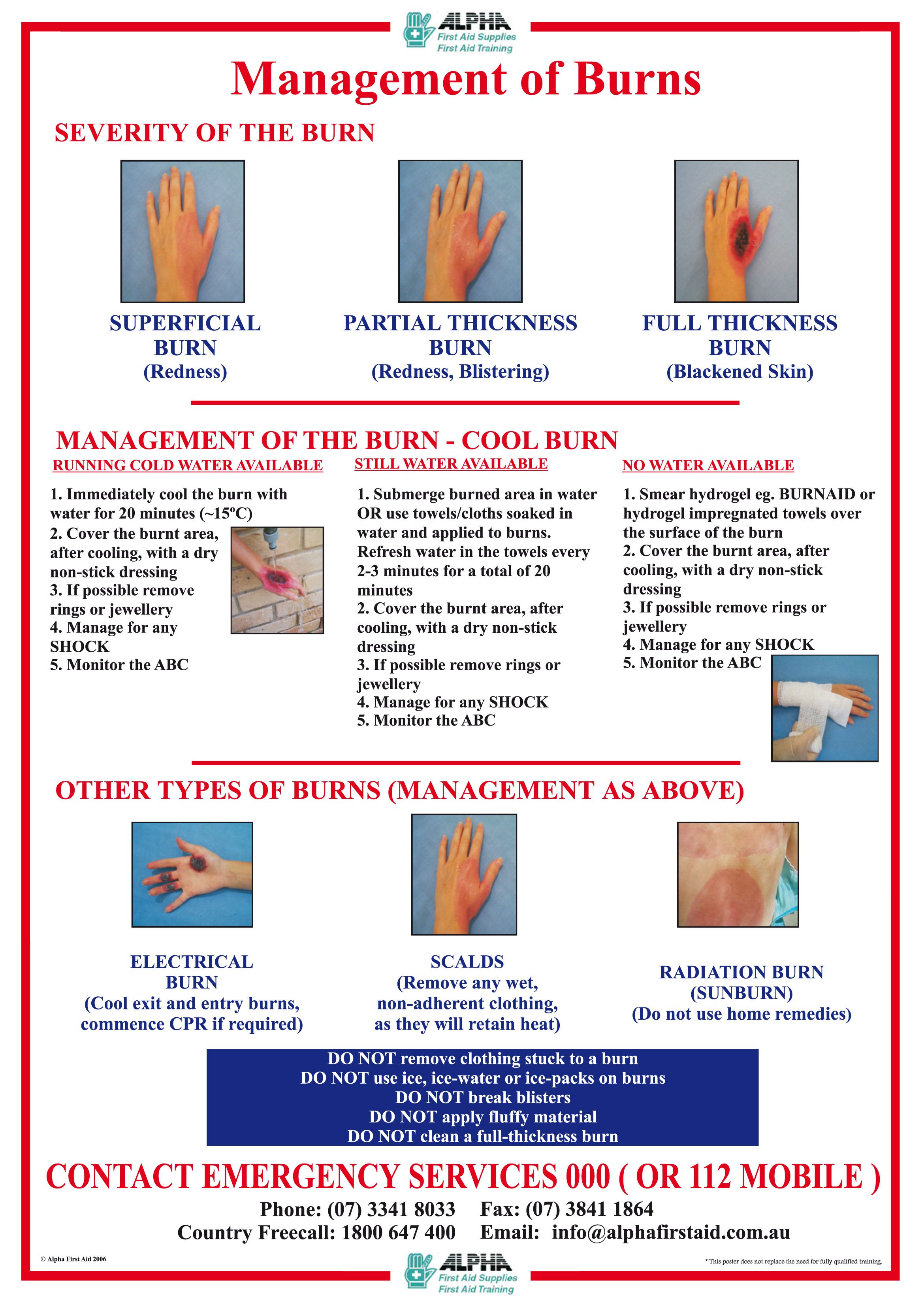
Laminated A3 posters mounted near the cabinet help any worker (not just trained first aiders) respond. Standard set includes: CPR / DRSABCD action sequence, bleeding control, burns first aid, choking response, snake/spider bites, and stroke recognition (FAST). View our laminated bleeding poster and burns poster for workplace walls.
First aid officer contact card
Display the name, photo, and contact details of every trained workplace first aider at the cabinet. Include their qualification (HLTAID011 standard first aid, HLTAID014 advanced first aid, or HLTAID009 CPR-only) and expiry date. Workers should know who to call before they need to.
Maintenance, restocking and audits
Quarterly audit checklist
Every 3 months, the first aid officer should: check every item against the cabinet contents list, replace any used items immediately, check expiry dates on EVERY consumable (not just opened ones), test the seal on sterile dressings (broken seal = discard), wipe the cabinet interior with disinfectant, refresh the laminated posters if faded, and log the audit in the workplace first aid register.
Post-incident restock
After any cabinet use — even minor — the first aider should restock within 48 hours. Major incidents (cardiac arrest, severe bleeding, chemical exposure) require an immediate full inventory audit before the end of the shift, with bulk replenishment ordered the same day. Browse our workplace first aid kit refills for fast restock packs.
Annual safety audit
Once per year, a WHS-trained officer should formally review: the entire cabinet contents against the current WHS risk assessment, signage compliance, accessibility of the cabinet from all work areas, training currency of all first aiders, and the workplace injury register for patterns suggesting cabinet upgrades.
Special-case workplaces
Construction sites
Site offices need a large metal cabinet, plus weatherproof portable kits at each work face. Daily site meeting should include first aid kit location reminder. New subcontractors get a first aid orientation as part of site induction.
Schools and childcare
Schools need cabinets at the office, sports oval, science lab, and any kitchen. Child-specific items: paediatric thermometer, smaller bandages, asthma reliever spare puffer (per state policy). Lockable cabinets prevent student access. Excursion leaders carry portable kits.
Mobile and home-based workers
Tradies, couriers, real-estate agents, and field service technicians cannot rely on a fixed cabinet. Each worker needs a personal portable kit in their vehicle, with the employer providing scheduled restock supplies and quarterly inspection.
Aged care and disability services
In addition to the standard cabinet, these workplaces need: incontinence pads, increased PPE (gowns, masks), suction equipment, oxygen, and resident-specific medications (per individual care plan). The cabinet must be lockable due to medication storage.
How many first aiders does your workplace need?
The Safe Work formula
The model Code recommends: low-risk workplace — 1 first aider per 50 workers (minimum 1 per workplace). High-risk workplace — 1 first aider per 25 workers, plus an advanced first aider (HLTAID014) for remote sites. All first aiders must hold current HLTAID011 certification (3-year expiry) with annual CPR refresh (HLTAID009).
Coverage hours
A trained first aider must be reasonably accessible during all working hours, including overtime and night shifts. For 24/7 operations like hospitals, manufacturing, and security, every shift needs at least one first aider. Use shift rotation to ensure CPR-trained coverage at all times.
Frequently asked questions
How big should a workplace first aid cabinet be in Australia?
Safe Work Australia's model Code of Practice 'First Aid in the Workplace' recommends sizing by workforce + hazard rating. Low-risk office workplaces (under 25 workers): small wall-mount cabinet (around 25 x 31cm). Medium offices (25-100 workers): medium cabinet (32 x 50cm). High-risk worksites (factories, construction, remote work): large cabinet (41 x 61cm) plus portable kits at each work area. Multi-site or campus workplaces need one cabinet per accessible zone, not per building.
Do workplace first aid cabinets need to be locked?
Cabinets must be accessible to all workers but reasonably secured against vandalism or theft of medications. The standard approach: keep the cabinet UNLOCKED during work hours, with a tamper-evident seal or sign-out sheet. After hours, a key-latch cabinet (kept with the night supervisor or duty manager) prevents misuse. Schedule 2/3 medications (paracetamol, ibuprofen) require lockable storage. Wall-mount cabinets must be drilled into a structural wall, not plasterboard.
What signs do I need on or near a workplace first aid cabinet?
Australian Standard AS 1319 requires a green-and-white 'first aid' sign (white cross on green background) above or next to every workplace first aid cabinet. The sign must be visible from at least 7 metres in normal lighting. Additionally, post: the name and contact of the workplace first aid officer, location of the nearest defibrillator (AED), and emergency contact 000. Most workplaces also display laminated A3 posters covering CPR, choking, bleeding, and burns response.
How often do you need to restock a workplace first aid cabinet?
Safe Work Australia recommends quarterly cabinet audits at minimum. Most consumables (bandages, dressings, gloves, eye wash) have 3-5 year shelf lives. Restock immediately after any use. Replace expired items (check ALL items quarterly - not just used ones). Schedule 2 medications expire faster (12-24 months) and need monthly checks. After major incidents, audit the cabinet before the end of the shift and order replacements within 48 hours.
Can I use a portable first aid kit instead of a cabinet?
Yes - if the workplace is small (under 5 workers), low-risk, and the kit is accessible to all. Portable kits ARE preferred for: construction sites, mobile teams (electricians, plumbers, couriers), school excursions, and pop-up events. However, fixed workplaces with 10+ workers should have a wall-mounted cabinet as the primary first aid station, supplemented by portable kits for first aiders to take to the casualty's location. Both approaches need to be documented in your WHS first aid risk assessment.
Workplace First Aid Cabinet Range
AEROCASE metal & plastic wall-mount cabinets sized for every workplace, plus laminated A3 emergency response posters.
AEROCASE Small Metal Cabinet (25 x 31cm)
Compact metal first aid cabinet for small low-risk offices.
Shop Now
AEROCASE Medium Metal Cabinet (32 x 50cm)
Standard medium-office cabinet, 25-100 worker workplaces.
Shop Now

AEROCASE Large Metal Cabinet (41 x 61cm)
Large workplace cabinet for factories & construction sites.
Shop Now
AEROCASE Plastic Cabinet with Key Latch
Lockable plastic cabinet for kitchens, food service & clinics.
Shop Now
Sources: Safe Work Australia — First aid in the workplace, healthdirect.gov.au — First aid, Australian and New Zealand Committee on Resuscitation (ANZCOR), Australian Red Cross.