


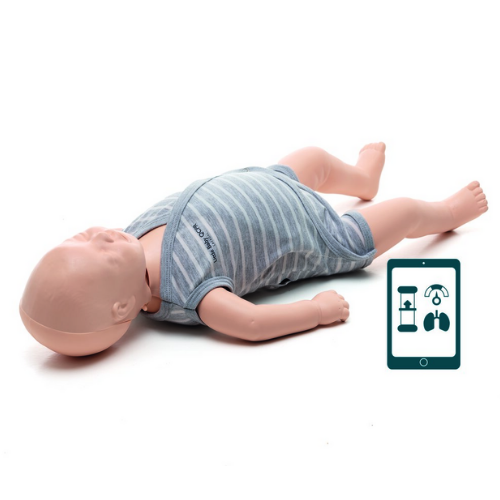
LAERDAL QCPR Manikin Baby Anne
€451.81
LAERDAL QCPR Manikin Baby Anne
Secure checkout
VISA
Mastercard
Apple Pay
Google Pay
Also accepted
AMEX
Afterpay
Zip
Klarna
PayPal
In stock
SKU
LMQ-B
A QCPR infant manikin from Laerdal for paediatric BLS, giving objective feedback through the QCPR app rather than an instructor's impression. Gamified scoring lifts learner engagement, a one-click connection sets up a class, and the app onboarding walks the instructor through the classroom setup.
Why choose the QCPR infant manikin?
For years, instructors of infant CPR could not be certain what a participant had actually learned. A QCPR infant manikin answers that with measurement: the app reports whether compressions and ventilations met standard, so the record reflects performance rather than attendance.
The gamified layer is not decoration. Scored, immediately visible results produce more attempts per session, and repetition is what builds a motor skill that has to survive real stress. Engagement and retention are the same problem.
Set-up time is the other practical gain: a one-click connection per manikin means classroom setup does not eat teaching time. Compare the Brayden Baby, which teaches the same skill through lights rather than app data.
Key features
- Objective, measured feedback on infant CPR performance
- Gamified learning through the QCPR app raises engagement
- One-click connection to set up a class quickly
- App onboarding guides the instructor through classroom setup
- Realistic and affordable paediatric BLS manikin
Specifications
| Size | Infant |
| Feedback | Objective, via QCPR app |
| Setup | One-click class connection |
| Courses | Paediatric BLS |
| Pricing unit | Unit |
| SKU | LMQ-B |
Common uses
Hospitals, RTOs and childcare training. Compare the Brayden Baby infant manikin. Hygiene: manikin wipes and manikin face shields. Theory: the DRSABCD action plan.
QCPR infant manikin FAQs
How is a training manikin cleaned between students?
Face shields or manikin wipes between users, with face skins and airway parts replaced periodically. Treat it as a standing consumable cost, not a one-off — it is the line most often left out of a purchase comparison and the one that decides whether a manikin is still usable in year three.
Is infant CPR different from adult CPR?
Substantially. Compression technique, depth and hand position all differ — two fingers or two encircling thumbs rather than two hands. Practising infant technique on adult anatomy trains the wrong motor pattern, which is why a dedicated infant manikin exists at all.
What consumables will I need on an ongoing basis?
Face and body skins, airway parts or valves, and hygiene items between students. Check the consumable list for your specific model rather than assuming parts are shared across brands — they usually are not.
How many students can one manikin support?
It depends on your instructor-to-student ratio far more than on the manikin. The practical constraint is hands-on repetitions per learner: two manikins for eight students gives each person a fraction of the practice that six manikins would.
Does it suit accredited Australian courses?
These are standard teaching manikins used across workplace, community and clinical training. Whether a specific model satisfies a particular accredited unit of competency is a question for your training package — confirm rather than assume.
You must not rely on the information on this site as an alternative to medical advice from your medical physician or other qualified healthcare provider. Consult your healthcare provider immediately if you think that you may have a medical emergency or for the diagnosis and treatment of injuries. Always seek the advice of your physician or other qualified healthcare provider before starting any new treatment or with any questions that you may have regarding a medical condition or injury.
| Manufacturer_ms | Germany |
|---|---|
| Model Number_ms | K61SD521 |
| Ecolabel_ms | yes |
| Brand | Laerdal |