


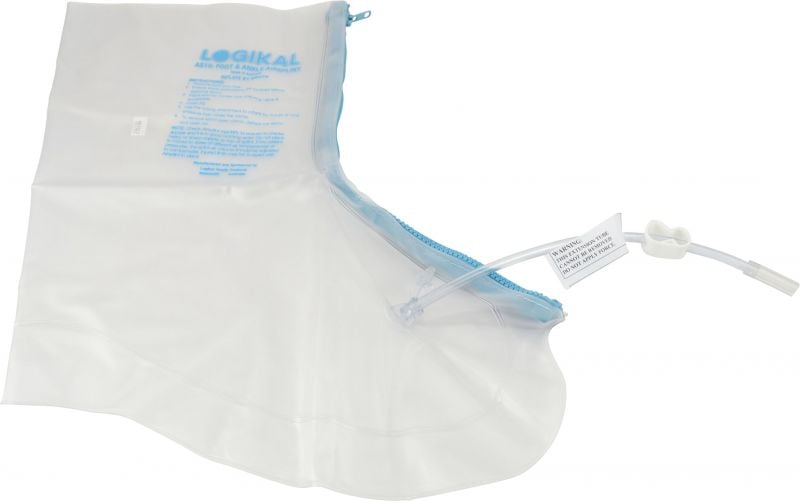
Air Splint - Foot & Ankle
Other First Aid Supplies
£33.57
Secure checkout
VISA
Mastercard
Apple Pay
Google Pay
Also accepted
AMEX
Afterpay
Zip
Klarna
PayPal
In stock
Only 1000 left
SKU
455
This foot and ankle air splint is an inflatable splint measuring 430mm long by 237mm wide at the top, sized to support and immobilise a suspected foot or ankle injury. It is the smallest of the three air splint sizes and the one that suits the most common lower-limb presentation in sport and at work.
Why choose a foot and ankle air splint
An air splint immobilises by enveloping the limb in even, low pressure rather than strapping it to something rigid. On a foot and ankle that is a real advantage - the joint is awkwardly shaped, swelling is rapid, and a rigid board has to be padded into place while the patient is in pain. A foot and ankle air splint conforms to the shape it finds.
It should be inflated by mouth, not with a pump. This is the single most important point of technique: a pump can raise the pressure far beyond what is needed and compress the circulation, whereas lung pressure is self-limiting. Inflate until the splint is firm enough to support the limb and no further.
Circulation has to be checked and rechecked. Look at colour, warmth, sensation and distal pulses after applying and at intervals afterwards, because swelling continues after injury and a splint that was correct on application can become too tight. Note also that air volume changes with temperature and altitude - relevant on any aeromedical transfer.
Key features
- 430mm long x 237mm wide at the top
- Sized for foot and ankle injuries
- Inflatable splint - immobilises a suspected limb injury
- Inflate by mouth to avoid over-inflation
- Allows the limb to be supported without rigid padding
- Reusable
- For use by trained personnel
Specifications
| Product | Air Splint - Foot and Ankle |
| Length | 430mm |
| Width at top | 237mm |
| Type | Inflatable limb splint |
| Region | Foot and ankle |
| Inflation | By mouth - do not use a pump |
| Monitoring | Check colour, warmth, sensation and distal pulses regularly |
| Use by | Trained personnel, within scope of practice |
Common uses
Sporting clubs, workplaces, first aid rooms, surf life saving and remote-area response - ankle injuries being one of the most common things a first aid team actually treats. Most services hold the full range rather than one size: the full leg air splint covers lower limb injuries above the ankle and the full arm air splint covers the upper limb. The complete air splint set with bag supplies all sizes together. See our sports and club first aid range.
foot and ankle air splint FAQs
How is an air splint inflated?
By mouth. Do not use a pump - lung pressure is self-limiting, whereas a pump can easily over-inflate the splint and compress the circulation in the injured limb. Inflate only until it is firm enough to support the limb.
What size limb does this fit?
430mm long by 237mm wide at the top, which is sized for the foot and ankle. For an injury higher up the leg, use the full leg splint - a splint that is too short will not immobilise the joint above the injury.
How do I check the splint is not too tight?
Check the colour, warmth and sensation of the toes and the distal pulses immediately after applying, then at regular intervals. Swelling continues after an injury, so a correctly applied splint can become too tight - deflate slightly if circulation is compromised.
Does altitude or temperature matter?
Yes. The air inside expands and contracts with temperature and with altitude, so a splint applied on the ground can tighten in an aircraft. Anyone doing aeromedical transfer needs to monitor and adjust it during the flight.
Can it be reused?
Yes, air splints are reusable. Inspect it before every use for punctures, perishing and valve function, clean it according to the manufacturer instructions and your infection control policy, and test that it holds pressure before it goes back in the kit.
When is an air splint not appropriate?
It supports and immobilises - it does not apply traction, so a mid-shaft femur fracture needs a traction splint instead. Follow your service protocols, and never attempt to straighten a deformed limb to fit a splint. In an emergency, call 000.
For use by appropriately trained personnel working within their scope of practice and local clinical guidelines. Inflate by mouth only. Check distal circulation, colour, warmth and sensation after application and at regular intervals, and adjust if circulation is compromised. Air volume changes with temperature and altitude. This information is a general guide and does not replace first aid training or clinical judgement. In an emergency, call 000.