


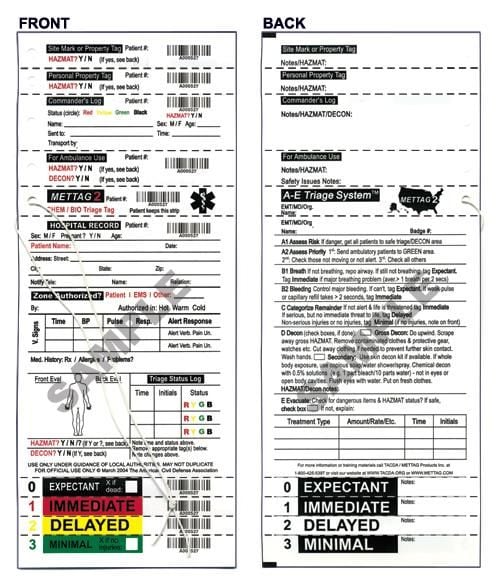
METTAG CB-100 Chemical Biological Triage Tags (25)
Miscellaneous
£49.18
Secure checkout
VISA
Mastercard
Apple Pay
Google Pay
Also accepted
AMEX
Afterpay
Zip
Klarna
PayPal
In stock
Only 999 left
SKU
CB-100
METTAG CB-100 chemical biological triage tags in a pack of 25 — tags built for chemical and biological incidents. Triage tags do one job under the worst conditions imaginable: make a casualty's priority visible at a glance to responders who have never met each other and have no time to confer.
Why choose the chemical biological triage tags?
The argument for proper chemical biological triage tags over improvised marking is handover. A tag that every responding service recognises means priority survives the transfer from first responder to ambulance to hospital without anyone re-assessing from scratch.
A CBRN incident adds a dimension ordinary triage does not track: whether a casualty has been decontaminated. Handing an undecontaminated patient onward contaminates the receiving facility, so the tag has to carry that status as clearly as it carries clinical priority.
Whichever system you use, use one. Mixing tag formats across a single incident is how casualties get re-triaged, missed or double-counted. See the whole METTAG range including the MT-137 disaster triage tags.
Key features
- METTAG CB-100, pack of 25
- Priority visible at a glance to any responding service
- Supports consistent handover between responders, ambulance and hospital
- Operational stock for live incidents
- Standardised format so nobody has to interpret improvised marking
Specifications
| Model | METTAG CB-100 |
| Pack | 25 tags |
| System | Chemical / biological |
| Use | Operational |
| Pricing unit | Pack of 25 |
| SKU | CB-100 |
Common uses
Emergency services, hospitals, mass-gathering medical teams, mines and large industrial sites running mass-casualty plans. Compare the SALT method tags, START tags and chemical biological tags. Training versions: START training and SALT training.
chemical biological triage tags FAQs
What is the difference between START and SALT triage?
They are two mass-casualty sorting systems. START (Simple Triage And Rapid Treatment) sorts on respirations, perfusion and mental status. SALT (Sort, Assess, Lifesaving interventions, Treatment/transport) begins with a global sort by voice and movement before individual assessment. Use whichever your jurisdiction or service has adopted — mixing tag systems across one incident causes confusion at handover.
What is the difference between a training tag and a live one?
Training tags are marked as training stock so exercise paperwork can never be mistaken for a real casualty record. Functionally they let responders practise the same tear-off, banding and documentation sequence, which is the part that has to be automatic on the day.
Why do some tags have a barcode and others not?
Barcoded tags support electronic casualty tracking where a service has that capability. Where tracking is manual, a barcode adds nothing, and some agencies prefer tags without one to avoid implying a scanning workflow that does not exist.
How many tags should an organisation hold?
Enough for a credible worst case for your site, plus a separate training stock. The failure mode is running out mid-incident and switching to improvised marking, which destroys the consistency triage depends on.
Are these used in Australia?
START and SALT are both internationally recognised mass-casualty systems and Australian services use structured triage tagging in major incidents. Follow your own service or jurisdiction protocol for which system and tag applies — this is an operational decision, not a purchasing one.
You must not rely on the information on this site as an alternative to medical advice from your medical physician or other qualified healthcare provider. Consult your healthcare provider immediately if you think that you may have a medical emergency or for the diagnosis and treatment of injuries. Always seek the advice of your physician or other qualified healthcare provider before starting any new treatment or with any questions that you may have regarding a medical condition or injury.
| Brand | METTAG |
|---|