


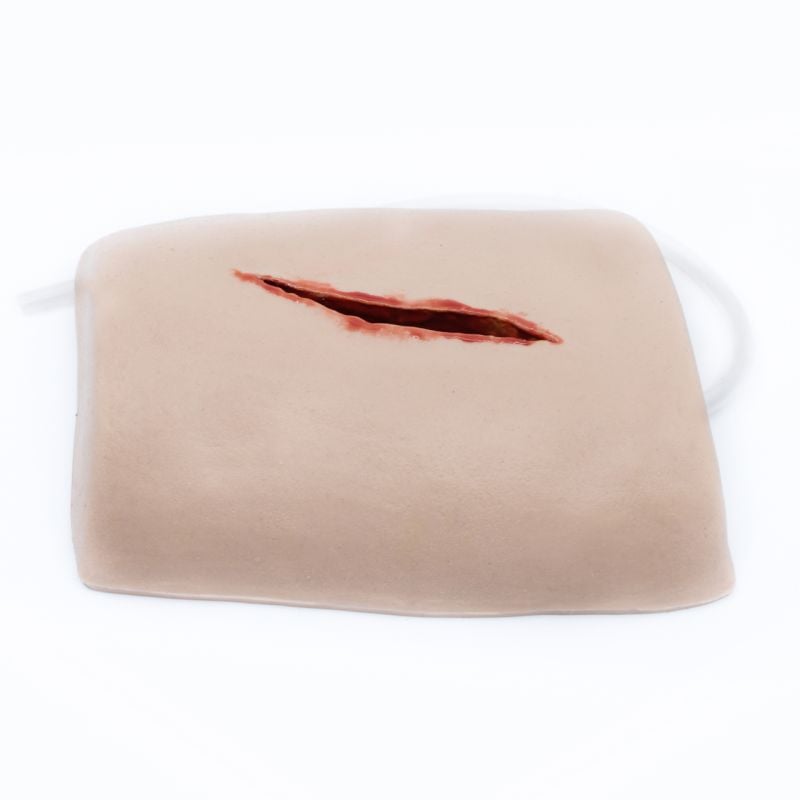
TRAUMASIM Laceration Haemostatic Clotting Trainer
Paramedic Supplies
£777.41
TraumaSim Haemostatic Clotting Trainer Laceration
Secure checkout
VISA
Mastercard
Apple Pay
Google Pay
Also accepted
AMEX
Afterpay
Zip
Klarna
PayPal
In stock
SKU
HCT03
The TRAUMASIM wound packing trainer lets trainees pack realistic bleeding wounds to practise haemostatic dressing application — a vital and very physical skill. Life-cast silicone skin looks and feels real, and a pump bottle drives simulated blood through tubing so bleeding stops only when the wound is correctly dressed.
Why choose the wound packing trainer?
Wound packing cannot be learned from a briefing. It takes real downward force, a surprising volume of gauze, and the confidence to push into a wound — and a wound packing trainer that keeps bleeding until you do it properly is the only honest way to teach that.
This is the laceration profile: a slit-shaped wound packed along its length. It is the commoner presentation and the one where trainees most often pack too shallowly, stopping at the surface instead of reaching the bleeding point.
The life-cast silicone matters more than it sounds: realistic resistance and realistic mess are what carry the skill across to a real casualty, where hesitation costs time. Practise with non-medicated training gauze and keep live haemostatic gauze sealed for real incidents.
Key features
- Trains wound packing and haemostatic dressing application
- Laceration profile — packed along the length of a slit wound
- Life-cast silicone skin looks and feels real
- Pump bottle drives simulated blood via tubing
- Bleeding stops only when the wound is correctly dressed
Specifications
| Type | Wound packing / haemostatic trainer |
| Wound profile | Laceration |
| Material | Life-cast medical-grade silicone |
| Simulation | Pump bottle and tubing |
| Feedback | Bleed stops when correctly dressed |
| Pricing unit | Unit |
| SKU | HCT03 |
Common uses
Bleeding control and wound packing training for emergency services, tactical medicine and workplaces. The other profile: square wound version. Add the arm haemorrhage simulator for a junctional wound a tourniquet cannot reach.
wound packing trainer FAQs
Why train on a simulator rather than a prop?
Because bleeding control is judged on one outcome: did the bleeding stop. A pump-driven trainer keeps bleeding until the technique is genuinely effective, so the trainee gets an objective answer instead of an instructor's opinion.
What consumables does wound-packing practice need?
Training gauze and, for tourniquet work, a training tourniquet. Use non-medicated training gauze rather than live haemostatic product — it handles identically, costs a fraction, and every live pack spent on a class is one not available for a real incident.
How is a bleeding control trainer cleaned?
Flush and wipe the wound channel after each session and let it dry before storage. Simulated blood left in tubing is the usual cause of a trainer that will not flow properly next time, and it is far harder to clear once dried.
Is it durable enough for repeated group training?
These are medical-grade silicone part-task trainers built for repeated use — the silicone is the asset, and the gauze and training tourniquets are the consumables. Expect the wound surface to show wear from packing over time; that is normal.
Who is it for?
Bleeding control courses, emergency services, tactical medicine and workplaces running in-house drills — anywhere the training has to produce competence rather than familiarity.
You must not rely on the information on this site as an alternative to medical advice from your medical physician or other qualified healthcare provider. Consult your healthcare provider immediately if you think that you may have a medical emergency or for the diagnosis and treatment of injuries. Always seek the advice of your physician or other qualified healthcare provider before starting any new treatment or with any questions that you may have regarding a medical condition or injury.
| Manufacturer_ms | Germany |
|---|---|
| Model Number_ms | K61SD521 |
| Ecolabel_ms | yes |
| Brand | TraumaSim |