

Jelonet Paraffin Gauze Dressing
Cleaning Wipes | Gauze Swabs
$20.74
Secure checkout
VISA
Mastercard
Apple Pay
Google Pay
Also accepted
AMEX
Afterpay
Zip
Klarna
PayPal
In stock
Only 1000 left
SKU
WEB-JPGD
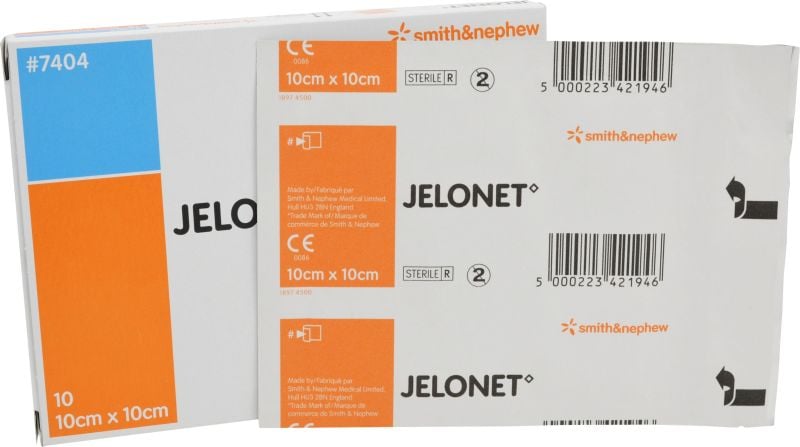
JELONET is a sterile paraffin gauze dressing - a tulle gras made from open weave gauze with a soft paraffin base. It soothes and protects the wound while remaining low-adherent, and it allows viscous exudate to pass freely into an absorbent secondary dressing. Available in a range of sizes: 10 x 10cm (10) and 5 x 5cm (50).
Why choose a paraffin gauze dressing
The value of a paraffin gauze dressing is that it does not stick. On a burn, a graft site or a raw abrasion, the damage is often done at the dressing change rather than at the injury - a dressing that adheres tears off the new epithelium you have been waiting for. The soft paraffin keeps the gauze low-adherent so it lifts away without taking the healing surface with it.
It is open weave for a reason. Wounds of this type produce viscous exudate that has to go somewhere, and a closed dressing would trap it against the skin. The open structure lets it drain freely into an absorbent secondary dressing on top - so this is a wound contact layer, always used with a secondary dressing, not a standalone.
Two practical details matter in use. The gauze has interlocking threads that minimise fraying when it is cut to shape, so it holds its form on awkward areas rather than shedding fibres into the wound. And because Jelonet is not medicated, it can be combined with whichever topical antiseptic or antibiotic is clinically indicated - the dressing does not dictate the treatment.
Key features
- Soft paraffin base - low-adherent, lifts away cleanly
- Sterile leno (open) weave presentation
- Allows free passage of viscous exudate
- Interlocking threads resist fraying when cut to shape
- Not medicated - use with the topical agent of choice
- Comprehensive size range
- 10 x 10cm (10) and 5 x 5cm (50)
Specifications
| Product | JELONET Paraffin Gauze Dressing |
| Type | Sterile paraffin tulle gras, leno weave |
| Base | Soft paraffin |
| Adherence | Low-adherent |
| Medicated | No - combine with the topical agent of choice |
| Sizes | 10 x 10cm (pack of 10), 5 x 5cm (pack of 50) |
| Use with | An absorbent secondary dressing |
| Indications | Minor burns and scalds, donor and recipient graft sites, skin loss wounds, lacerations, abrasions, leg ulcers |
Common uses
It is standard stock in emergency departments, burns and plastics units, wound clinics, general practice and aged care - anywhere a non-adherent contact layer is needed over a raw surface. It always needs a secondary dressing over it: AEROPAD Non-Adherent Dressings and an absorbent pad handle that role. If you need a single dressing rather than a box, the Jelonet 10 x 10cm single dressing is stocked separately. See our wound dressings and burn treatments ranges.
paraffin gauze dressing FAQs
What is a paraffin gauze dressing used for?
Minor burns and scalds, donor and recipient graft sites, skin loss wounds, lacerations, abrasions and leg ulcers. It is a low-adherent contact layer placed directly on the wound so the dressing above can absorb exudate without sticking to the healing surface.
What does tulle gras mean?
It is the traditional term for an open weave gauze impregnated with soft paraffin - literally "greasy net". The paraffin is what stops the gauze adhering, and the open weave is what lets exudate through.
Do I need a second dressing on top?
Yes. Jelonet is a wound contact layer, not a complete dressing. It deliberately allows exudate to pass through, so it must be covered with an absorbent secondary dressing that collects it and is changed as required.
Is Jelonet medicated?
No, and that is intentional. Being unmedicated means it can be used with whichever topical antiseptic or antibiotic is clinically appropriate, rather than committing you to an agent built into the dressing.
Can it be cut to shape?
Yes. The gauze has interlocking threads that minimise fraying when cut, so it can be trimmed to fit fingers, faces or awkward contours without shedding loose fibres into the wound.
How often should it be changed?
That depends on the wound, the volume of exudate and the clinical plan - follow the treating clinician's instructions or your facility's wound care protocol. The secondary dressing usually needs changing more often than the contact layer.
For use in accordance with the product instructions and, where applicable, a clinical wound management plan. Sterile - do not use if the packaging is damaged or open, and use a single dressing for a single patient. This is a wound contact layer and must be used with an appropriate secondary dressing. Seek medical assessment for burns that are large, deep, blistered, or involve the face, hands, feet or genitals, for wounds showing signs of infection, and for any wound that is not healing.
| Brand | Jelonet |
|---|
Frequently bought together