


Reviewed by the Medibc First Aid Team — last updated May 2026.
According to Safe Work Australia, every workplace that handles blood, body fluids, chemicals or shared surfaces must stock disposable gloves — and the wrong glove choice can be worse than no glove at all. Latex allergies affect up to 6% of Australian healthcare workers and cause anaphylactic reactions; powdered gloves were banned in clinical use by the TGA in 2017; and the wrong thickness leaves gaps in chemical protection.
This guide explains the differences between nitrile, latex and vinyl gloves, when to use which, the broader PPE you should stock in a workplace first aid kit, and the latest Australian WHS compliance rules for 2026.

Nitrile vs latex vs vinyl — what's the difference?
Nitrile gloves (the 2026 workplace default)
Nitrile is a synthetic rubber (acrylonitrile-butadiene). Modern nitrile gloves are:
- Latex-free — no natural rubber protein, safe for latex-allergic workers and patients
- More puncture-resistant than latex of the same thickness (35-40% stronger)
- Better chemical resistance — resist oils, solvents, fuels, mild acids
- Available in workplace colours — black/blue for industrial, white/blue for medical, purple for chemo
- Thicknesses: 3-4 mil for medical, 5-8 mil for heavy-duty industrial
Cost-wise, nitrile is now 5-15% more expensive than latex but the gap closes every year as production scales. For Australian workplaces in 2026, nitrile is the standard.
Latex gloves (legacy, mostly phased out)
Natural rubber latex (NRL) gloves were the medical and first aid standard from the 1980s through the 2010s. They offer excellent tactile sensitivity and stretch but have three big problems: (1) up to 6% of healthcare workers develop NRL allergy — reactions range from mild contact dermatitis to anaphylactic shock; (2) latex protein aerosolises when powdered gloves are removed, exposing nearby workers; (3) latex is biological and degrades faster than nitrile in storage. Most Australian hospitals are 100% latex-free as of 2024. Workplaces should follow suit.
Vinyl gloves (low-risk only)
Vinyl (PVC) gloves are the cheapest disposable option. They have minimal flex, low puncture resistance, and degrade under stretch — not suitable for first aid, clinical, or chemical work. Use vinyl only for: brief food handling, cleaning low-soil surfaces, and ad-hoc tasks where puncture risk is near zero. NEVER use vinyl for blood/body fluid contact — gaps form between the glove and skin during normal hand movement.
Quick comparison table
Nitrile beats latex on safety and beats vinyl on protection. Latex beats nitrile only on raw tactile sensitivity — relevant for delicate surgery but not workplace first aid.
Powder-free vs powdered — why powder-free wins
What powder is and why it was used
Cornstarch powder was added to gloves as a release agent — making it easier to slide on dry hands. It also absorbed sweat during long shifts.
Why powder is now banned in clinical use
The TGA banned powdered surgical gloves in Australian healthcare in 2017 because: powder absorbs latex proteins (in latex gloves) and aerosolises when gloves are removed; powder particles cause surgical wound granulomas (foreign-body reactions); and powder can trigger asthma in workers with respiratory conditions. The TGA decision aligned with the US FDA's 2016 ban.
Buy powder-free even where not legally required
Even in non-clinical workplaces (offices, retail, food service), powder-free is the right choice. The hygiene, allergy and asthma benefits apply to every worker. The cost difference is now under 5%.
Examination grade vs industrial grade
Examination grade (AS/NZS 4011.1)
Australian/New Zealand Standard 4011.1 sets the minimum quality for medical examination gloves: pinhole rate (Acceptable Quality Level, AQL) no more than 1.5%, tensile strength minimum, and biocompatibility testing. Use examination grade for: first aid kits (blood/body fluid contact), clinical care, food handling, aged care, beauty/personal care, and any task with infection risk. All Medibc nitrile gloves are AS/NZS 4011.1 compliant. Browse our full first aid supplies range for compliant PPE.
Industrial grade (typically AS/NZS 2161.10)
Industrial gloves are thicker (5-8 mil), tested against chemical permeation (which chemicals the glove blocks, and for how long), and rated for cut and abrasion resistance. Use industrial grade for: mechanical work, painting, cleaning with strong chemicals, gardening, construction. The Storm Black Heavy Duty Nitrile 6-mil gloves are a good example of industrial-grade nitrile.
Sizing and fit
Workplaces need at least 3 sizes (S/M/L) and ideally 4 (S/M/L/XL) to fit every worker. Gloves that are too loose tear at the fingertips; too tight gloves fatigue the hand. Workplace audit: walk through any shift, ask each worker if their issued size fits — if not, escalate to procurement.
Hand hygiene before and after glove use
Gloves do NOT replace hand washing
One of the most common workplace mistakes: putting gloves over dirty hands. Gloves are a barrier, not a sterilisation method. Always wash with soap and water OR rub with 60%+ alcohol hand sanitiser BEFORE donning gloves. The healthdirect 5-step hand wash technique takes 30 seconds and prevents 80% of workplace hand-borne infections.
After removing gloves
Glove removal is a high-contamination moment — the inside of the glove (your skin) touches the outside (whatever you contacted). Use the "glove-in-glove" technique: peel the first glove off inside-out with the other gloved hand, then slide a finger under the second glove and peel it off enclosing the first. Drop into a clinical waste bin. Wash hands with soap and water immediately afterwards. Repeated washing plus glove occlusion is what drives workplace hand dermatitis, so moisturise once hands are dry: a fragrance-free emollient such as QV Cream is the usual choice, because there is less in it to irritate skin that is already stressed.
Hand sanitiser stations
Every workplace first aid station should have a wall-mount hand sanitiser dispenser (60%+ ethanol). Top up dispensers weekly. Browse our hand sanitiser range for workplace stocking.
Finger cots — the small-task barrier
What finger cots are for
Finger cots (or "fingercots") cover a single finger — the use case is: a first aider has a minor cut or blister on one finger, and needs to handle a casualty. Putting a full glove on for a 30-second wound check is overkill; a finger cot maintains a barrier where needed. Also used in: jewellery making, electronics assembly, food prep (cracked nail covering), and aged care nail/cuticle work.
Sizes and materials
Finger cots come in small/medium/large/X-large and in latex or nitrile. Latex finger cots stretch more for a tighter fit, but follow the same workplace rule as gloves: nitrile preferred where allergies are possible. AEROSHIELD nitrile cots are anti-static for electronics work and powder-free for food service.
Storage and use
Keep a small pack at every workplace first aid station, sales counter, and clinical bench. Single use only — discard after each task. Hand wash before and after donning.
Face shields, eye protection & respiratory PPE
Why face shields matter for first aid
During CPR or any procedure that risks blood/body fluid splash, the first aider's face is the most exposed body part. A disposable face shield blocks droplets, splatter and aerosolised fluids. The ANZCOR-recommended CPR face shield has a one-way valve so air goes IN to the casualty but blood/saliva does NOT come back to the rescuer. Always include face shields in the workplace first aid kit and consider a key-ring pocket version for first aiders.
Disposable face shields vs reusable
Disposable shields (single-use sachets) suit workplace first aid — they're sterile and disposed of after one casualty. Reusable shields (snap-on plastic with replaceable visors) suit clinical environments with cleaning protocols. The Medibc AEROSHIELD disposable shield comes in single-use sachets — sterile, individually wrapped, 5-year shelf life.
Combined CPR pocket kits
The most useful first aider personal item is the AEROSHIELD Key Ring CPR Face Shield + Gloves — a single-use face shield with one-way valve plus a pair of disposable gloves, in a key-ring pouch. Pop it on your work key ring and you're equipped wherever you go.
Aprons and gowns — body fluid barriers
Plastic disposable aprons
Plastic aprons protect the front of the body during splash-prone tasks: nappy changes, vomit clean-up, casualty bleeding control, food prep, dental hygiene. Disposable plastic is single-use and dropped into clinical waste afterwards. Stock 20+ in a workplace kit for mass-casualty contingency.
Fluid-resistant gowns (isolation gowns)
Isolation gowns wrap fully around the body, cover the arms, and tie at the back — the standard for extended-care contact with body fluids, infectious diseases, or in clinical examination. The blue fluid-resistant gown (non-sterile) is suitable for first aid responses where you expect prolonged casualty contact. Sterile isolation gowns are needed only in surgical settings.
When to use each
Quick contact (minor bleed, eye wash, vomit cleanup): apron is enough. Extended contact (full first aid response, infection precaution, transferring an unconscious casualty): isolation gown. Donned over normal workwear, removed and discarded as the LAST item of PPE.
How to put on and take off PPE safely
Donning sequence (putting on)
- Hand hygiene (soap or sanitiser)
- Gown or apron (tie at back)
- Face mask or respirator (over nose and mouth, secure with elastic)
- Eye protection (goggles or face shield)
- Gloves (over the cuff of the gown sleeve)
Doffing sequence (taking off)
- Gloves (peel inside-out, glove-in-glove technique)
- Eye protection (avoid touching the front)
- Gown or apron (peel down from the inside)
- Face mask (untie from behind, don't touch the front)
- Hand hygiene (final wash with soap or sanitiser)
What NOT to do
Never reuse single-use PPE. Never touch the front of contaminated items. Never carry contaminated PPE through clean areas. Never push gloves down to wear "around the wrist" between tasks — either keep them on properly or remove and replace.
Storing and stocking workplace PPE
Storage requirements
Store disposable gloves and gowns: in their original sealed box (UV light degrades nitrile and latex); below 30 degrees Celsius ambient; away from chemical fumes (solvents weaken glove polymer); off the floor on a shelf in the first aid cabinet. Check expiry dates at every quarterly audit.
Quantity per workplace
Safe Work Australia model Code of Practice indicative quantities: small office (under 25 workers) — 1 box (100) gloves, 10 face shields, 5 aprons. Medium workplace (25-100 workers) — 2-3 boxes gloves in multiple sizes, 20 face shields, 10 aprons, 5 isolation gowns. High-risk workplace (manufacturing, construction, remote) — 3-5 boxes gloves, 30+ face shields, 20 aprons, 10 isolation gowns, plus respiratory masks.
Restock triggers
Trigger replenishment at: 25% of original stock remaining (don't wait for "empty"); after every major use; quarterly audit (replace any items past expiry); annual WHS review (recalibrate quantity based on workforce changes).
Industry-specific PPE notes
Healthcare and aged care
Stock examination-grade nitrile in 4 sizes, sterile isolation gowns, face shields, N95/P2 respirators, single-use aprons. Lockable cabinet to prevent unauthorised access. Daily audit of stock during pandemic alert periods.
Food service and hospitality
Blue-coloured detectable nitrile gloves (visible if dropped in food). Plastic disposable aprons. Hand sanitiser at every workstation. Browse our surgical face mask range for food-handling face coverings.
Mechanical and construction
Heavy-duty 5-8 mil black or blue nitrile (chemical and abrasion resistant). Cut-resistant gloves for sharp tools (separate from disposables). Eye protection (impact-rated). Mask grade depending on dust/fume.
Mobile workers and tradies
Personal CPR pocket kit (key-ring face shield + gloves) plus a small pack of finger cots in the vehicle. Top up from the central first aid cabinet weekly.
Frequently asked questions
Should I use nitrile or latex disposable gloves in an Australian workplace?
Nitrile is the workplace default in 2026 - latex is being phased out due to widespread latex allergies (1-6% of healthcare workers, 0.5-1% of the general population). Nitrile gloves are puncture-resistant, chemical-resistant, fit closely to the hand, and contain no natural rubber latex (NRL) protein. Use latex only if a specific task genuinely requires latex's elasticity AND no allergic worker will use them. For high-risk workplaces (medical, food prep, mechanical, cleaning, first aid) - nitrile is the safer default.
What does 'powder-free' mean and why does it matter?
Powdered gloves use cornstarch as a release agent to make donning easier. The powder absorbs latex proteins (in latex gloves) and aerosolises into the workplace air - causing respiratory allergic reactions in nearby workers. The TGA banned powdered surgical gloves in Australian healthcare in 2017. Powder-free gloves are the current standard for all clinical, food handling, first aid, and workplace use. Pick powder-free even when not legally required.
What's the difference between examination grade and industrial grade gloves?
Examination grade (medical grade) nitrile gloves meet AS/NZS 4011.1 (examination) standard - tested for pinholes (AQL 1.5 max), suitable for first aid, food, cleaning and clinical use. Industrial grade gloves are thicker (5-8 mil vs 3-4 mil for medical), have higher chemical resistance (printed on the box), and suit mechanical, construction, painting, or cleaning chemical exposure. Workplace first aid kits should always stock examination grade for blood/body fluid contact.
How long can I wear the same pair of disposable gloves?
Disposable gloves are SINGLE USE. Change between casualties, between tasks, and immediately after any contact with blood or body fluids. Even in low-risk tasks, gloves degrade with sweat and friction within 30-60 minutes. Never wash and reuse - washing removes the chemical barrier layer and amplifies any pinholes. After removing, wash hands with soap and water or alcohol hand sanitiser (60%+ ethanol) before doing the next task.
What other PPE should I stock in a workplace first aid kit besides gloves?
Australian Safe Work model Code of Practice recommends: disposable face shields (CPR + splash protection), disposable plastic aprons (body fluid protection), disposable isolation gowns (extended-care protection), finger cots (for first aiders with their own minor cuts who need to handle a casualty), nitrile gloves in 3+ sizes (S/M/L/XL accommodate the whole workforce), and a CPR pocket mask with one-way valve. Stock 2x daily-use volume in case of mass-casualty incidents.
Workplace PPE & Disposable Gloves
Nitrile gloves, finger cots, face shields, isolation gowns and CPR pocket kits for Australian workplaces, clinics and first aiders.
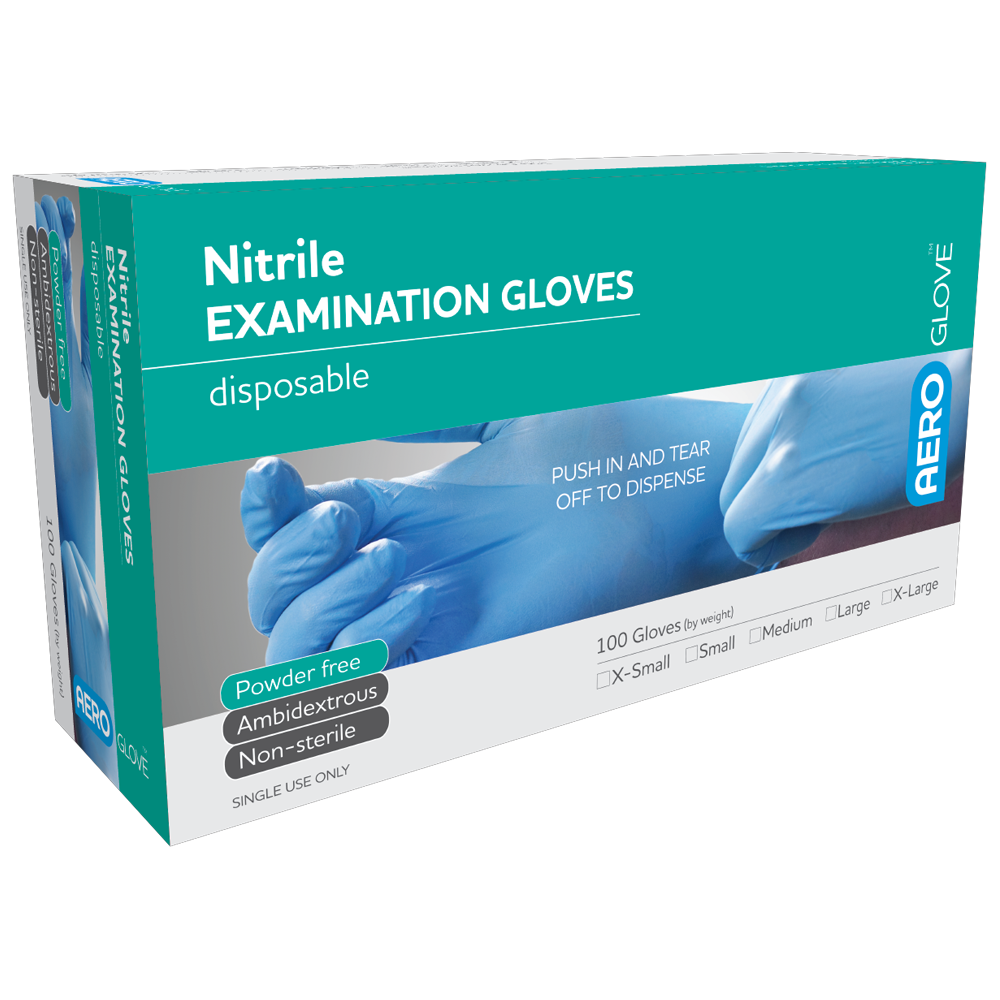
AEROGLOVE Nitrile Powder-Free Gloves (Box 100)
Standard workplace examination nitrile gloves, powder-free.
Shop Now
Storm Black Heavy Duty Nitrile Gloves (100)
Industrial 6-mil heavy-duty nitrile for mechanical & chemical work.
Shop Now

AEROSHIELD Nitrile Finger Cots (Box 100)
Single-finger barrier for minor wound + workshop tasks.
Shop Now


Sources: Safe Work Australia — First aid in the workplace, healthdirect.gov.au — First aid, Therapeutic Goods Administration, healthdirect.gov.au — Hand washing.