

Reviewed by the Medibc First Aid Team — last updated March 2026.
Australian workplaces with high-consequence hazards — construction, mining, oil & gas, large-scale manufacturing, agriculture — need more than a standard workplace kit. Major trauma is rare, but when it happens, the first 10 minutes determine the outcome. A purpose-built trauma response kit, properly placed and properly stocked, is the difference between a worker walking off site and a fatality.
This guide walks Australian safety officers, WHS managers, and remote-area first aiders through trauma kit selection, contents, placement, and the spine-board and immobilisation gear every high-risk site should hold.
When you need a trauma kit (not just a workplace kit)
Standard workplace kits handle cuts, sprains, and minor burns. Trauma kits handle the high-consequence incidents that standard kits aren’t built for.
Workplaces that need a trauma kit
- Construction sites — falls from height, crush injuries, machinery accidents.
- Mining and resources — remote location, machinery, multi-victim potential.
- Heavy manufacturing — conveyor, press, and forklift injuries.
- Forestry and agriculture — chainsaw lacerations, machinery entanglement, animal-related trauma.
- Transport and logistics — vehicle incidents involving workers or members of the public.
- Emergency response teams — lifesavers, SES volunteers, industrial first response squads.
The Safe Work Australia baseline
Under the First Aid in the Workplace Code of Practice, “high-risk” workplaces require additional supplies above the standard workplace kit, calibrated to the risk profile from the site’s WHS assessment. For most construction and remote sites that means a trauma bag, an extra-large dressing module, and stretchering equipment.
Trauma kit formats: backpack, soft bag, or wall cabinet?
The shape matters as much as the contents. Mismatched format means slow access when speed counts.
Trauma backpacks for mobile response
The standard for site-based emergency response teams. Worn on the shoulders, leaves both hands free to climb, drag, or carry. Internal modules and external pouches let responders find dressings by feel without unpacking the whole bag.
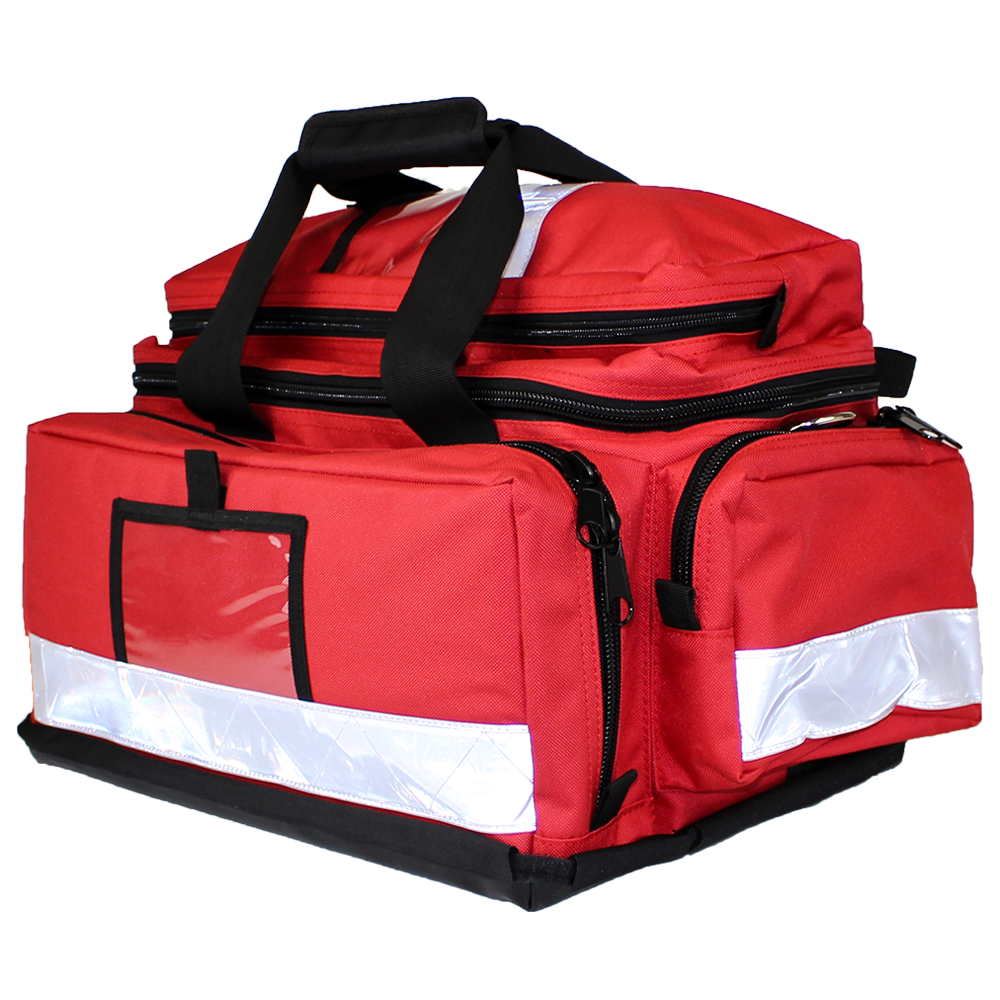
A high-vis bright-red trauma first aid backpack (48 x 54 x 32cm) is the size most industrial sites standardise on — large enough for two-victim response, small enough to clear scaffolding and confined spaces.
Trauma bags for vehicle-based response
Wide-mouth soft bags that open flat, sit on the floor of a ute or work truck, and give faster access than backpacks when the team is operating from a vehicle. The AEROBAG red trauma bag (49 x 30 x 28.5cm) is the standard for road crews, mine rescue vehicles, and event medical teams.
Cabinet trauma stations for fixed sites
For factories and warehouses, a wall-mounted trauma cabinet at the rescue marshalling point holds the heavier equipment — spine boards, stretchers, immobilisers — that wouldn’t fit in a portable bag.
What goes in a trauma response kit
Beyond the standard cuts-and-bruises kit, a trauma response kit needs the specific items for major haemorrhage, airway management, immobilisation, and shock prevention.
Major haemorrhage control
- 2-4 commercial tourniquets (CAT or SOFT-T style).
- Haemostatic gauze for wounds at the neck, groin, and other “junctional” sites where a tourniquet can’t reach.
- Multiple trauma dressings (Israeli-style bandage or T3 wound dressing).
- Pressure compression bandages.
- Gloves — at least 6 pairs, sized to the team.
Airway and breathing
- OPA (oropharyngeal airway) set in multiple sizes.
- Pocket mask or bag-valve-mask for CPR with supplementary oxygen.
- Chest seal dressings for penetrating chest wounds.
Immobilisation and transport
For suspected spinal injury — falls from height, vehicle incidents, crush trauma — the spine-board kit is non-negotiable.
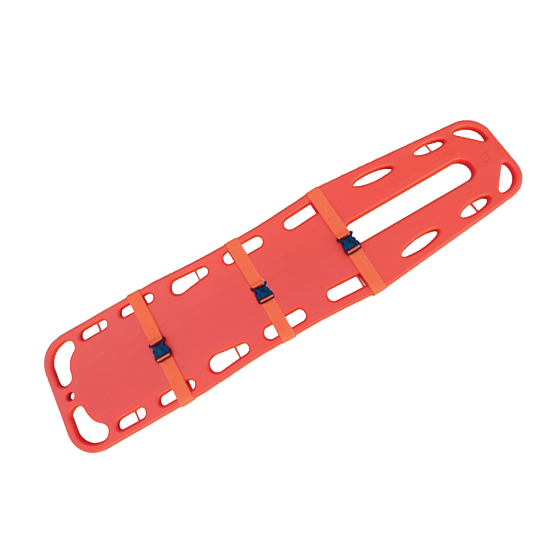
- A rigid plastic spine board stretcher with straps takes a patient flat from the site to the ambulance.
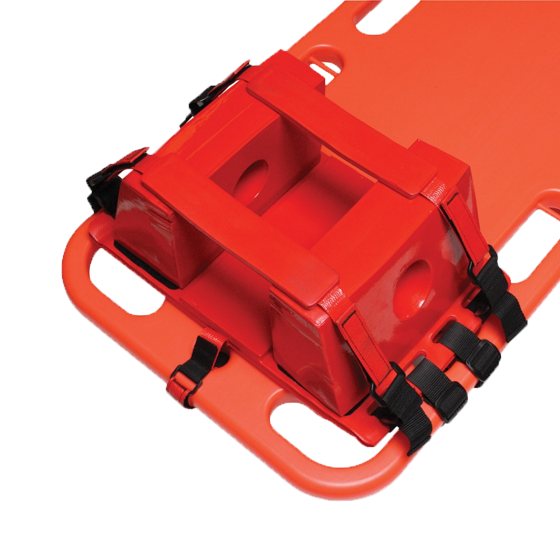
- An anatomic head immobiliser locks the head and neck in line with the body once the patient is on the board.
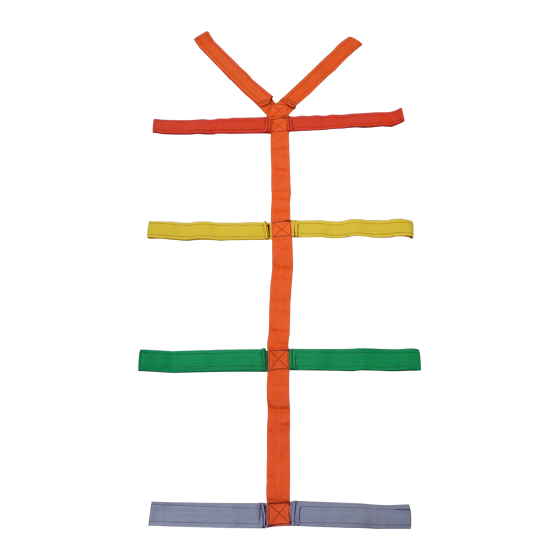
- The T-strap restraint secures the head immobiliser to the board for transport.
Shock prevention
Trauma patients lose body heat fast — hypothermia kicks in even on warm days when there’s blood loss and exposed skin. A bag of emergency thermal blankets (100 per bag) at the trauma cabinet means every team vehicle and response kit has a fresh blanket ready.
Spine board and immobilisation technique
A spine board protects an injured spine during extraction and transport, but only if applied correctly. Get the technique wrong and you can make a salvageable injury into a permanent one.
Step-by-step spinal immobilisation
- Maintain manual stabilisation of the head and neck from the moment a spinal injury is suspected — one rescuer holds the head still while the rest of the team works.
- Apply a cervical collar sized to the patient if available.
- Log-roll the patient as one unit (head, shoulders, hips, legs all moving together) to position the spine board beneath them.
- Centre and strap the body to the board — chest, hips, legs, feet.
- Fit the head immobiliser on either side of the head.
- Secure with the T-strap across the forehead and chin, anchored to the board.
- Recheck airway and breathing before lifting.
When NOT to spine-board
For penetrating trauma (gunshot, stab wound) with no obvious spinal injury, current best practice is rapid transport without spine-boarding — the time spent boarding outweighs the marginal protection. Follow ambulance service direction.
Placement and access for trauma kits
A perfect kit in the wrong place is useless. Site rules:
- Within 4 minutes’ reach of any hazard — aligns with the brain-damage threshold for major bleeding.
- Multiple locations on large sites — not just one central cabinet.
- Trained responders only — trauma kits are for properly trained first responders, not the general workforce. Train at least 2-3 designated emergency response personnel per shift.
- Audit quarterly — expiry dates, used items, broken seals, missing equipment.
- Visible signage — bright red bag/cabinet, visible from any approach.
Training the team
A trauma kit without trained users is decoration. Industrial emergency response training in Australia is delivered by RTOs like St John Ambulance and Red Cross. The core training package for high-risk workplaces should include:
- HLTAID011 Provide First Aid (mandatory baseline).
- HLTAID014 Provide Advanced First Aid (for designated responders).
- HLTAID015 Provide Advanced Resuscitation (oxygen, defib).
- Site-specific scenario drills every 6 months.
Browse the full trauma backpack and bag range on Medibc to bundle a kit for your site profile.
Frequently asked questions
What is the difference between a workplace kit and a trauma kit?
A standard workplace first aid kit handles minor injuries — cuts, sprains, bruises, mild burns. A trauma kit handles major haemorrhage, airway compromise, spinal injury, and shock. Trauma kits include tourniquets, haemostatic gauze, large trauma dressings, airway adjuncts, spine boards, and head immobilisers. Standard workplaces need the workplace kit; high-risk industries need both.
Who can use a trauma kit?
Trauma equipment should be applied by properly trained first responders — HLTAID014 Advanced First Aid level minimum for tourniquet use, spinal immobilisation, and airway adjuncts. Standard workplace first aiders (HLTAID011) can apply pressure bandages and call for the advanced responder. Untrained use of tourniquets or spine boards can worsen the injury.
How often should a trauma kit be audited?
Quarterly is the minimum. Check expiry dates on dressings and haemostatic gauze (usually 3-5 year shelf life), replace any used items, inspect tourniquet windlasses for cracks, confirm spine board straps still buckle cleanly, and run an inventory against the kit’s contents list. After any actual deployment, replenish before the kit is returned to service.
Be ready for the rare day
Major trauma in a workplace is rare — but rare doesn’t mean never. The right kit, in the right place, with the right training behind it, turns a fatal incident into a survivable one. Match the trauma bag format to your response model, stock the haemorrhage and immobilisation supplies, and run the scenarios with the team every six months.
Sources: Safe Work Australia — First Aid in the Workplace Code of Practice, St John Ambulance Australia — First Aid Training, NCBI — Pre-hospital trauma care best practice.
Trauma Kit & Spine Board Essentials
Trauma backpacks, spine boards, head immobilisers, and thermal blankets for industrial and remote-site emergency response.